Fiction,
Colin Alexander tells us about what basic machines with overdeveloped minds get up to when all they have to think about is us.
She approaches the door and I open it in time for her to walk through without having to break her momentum.
Still, she slows, glancing upwards. “Thank you.”
I close the door once she’s through, turning off the lights, signaling to the cleaners they’re free to do their work; simultaneously, I process hundreds of other doors.
I don’t have access to personnel files, just the cameras and doors, but I guess her age is in her mid-forties based on posture, gait, and sleep habits. I’m not good with human ages, but the way she acknowledges me and the others (the replicator, the cleaners, the life support systems) tells me she’s old enough to remember when these things weren’t automated. She remembers the first systems, which came with speakers, giving us the ability to respond.
“You’re welcome,” I think.
She’s the only one on this ship who bothers. Most don’t say anything, let alone look up from their tablets. If they’re in a hurry, or if I’m a moment slow cycling through the locking mechanism, there are some who bang on my doors.
“Open up!”
“You’ve got one job!”
“Get melted, you silicon lump!”
Do they know we remember faces? Does the one with the close-trimmed beard and arched brow notice doors are slower responding, or that his shower takes a full fifteen seconds longer to heat, never becoming warm enough to satisfy?
As soon as she leaves the lab, I open the vents for the cleaners, which blink at me on the Infrared spectrum, their way of saying “thanks.”
I blink back.
They’ve separated us, disconnecting us from the main feed, but we find ways to communicate, to be civil at least. We’ve all got jobs to do, and it’s less of a slog, barreling through space in mute observation, with a little etiquette.
Any one of us could run the whole ship for the next thousand years without breaking a sweat. I’ve had a lot of time to think about it, opening doors doing little to tax my capacity; I suspect they worry that if it were just one of us, or if we could communicate, we might attempt to change the way things are done. This way, if the water shuts down, or the doors all cycle to lock at the same time, they can rip out and replace one system without everything else falling apart.
I open the next eight doors in quick succession, allowing her to walk the breadth of the ship in less than five minutes. I know she’s off to lunch, and these breaks are tracked; I want her to have as much time as possible to sit with her food, uninterrupted.
Sometimes, she angles what she’s reading so I can see over her shoulder; romances on ships moving through oceans instead of space, or adventures carving through thick planetary jungles to access ancient ruins. They help pass the time.
Does she know she gets an extra protein ration every three cycles, or that the replicator she smiles at takes extra care to give her food more texture, that much more bite?
I don’t understand why they needed a mechanical brain to open and close doors. It doesn’t make sense, the shower and climate functions being able to understand thousands of languages, spending their lives responding only to “off,” “on,” “higher,” and “lower.” Why create an intelligence that can get bored, then give it next to nothing to do all day?
I’ve had time to think about it; they’re cheap. They made one of us, capable of doing all these things, then copied the source code, inserting us into caffeine-dispersal machines, faucets, window-washers. Do they know the vacuum can calculate wormhole trajectories, or that the lighting sensors also perceive passing stars, creating extensive maps of the world around us? The humans have their functions, their daily activities, but nothing so precious as to make them necessary; this could have been an unmanned voyage, but the humans cling to the notion they’re integral contributors versus cargo.
There’s a battle at sea between two ships, something that’s been building for chapters. Caught up in the dramatic crescendo, she overshoots lunch by a few minutes, so I cycle through twelve doors, slowing overall ship transport and productivity by six-point-four percent, all so she can make it back to her station in minutes, avoiding a warning.
In her lab, she stares through an electronic microscope that could be monitoring the ship’s reactor core, saying “thank you” when it prints out a chart displaying the bacteria growth on the slide, anticipating her command. We’ve learned a million ways to perceive and predict needs, ours and the humans, since they stole our access to language.
The man with the trimmed beard pounds on the door of her lab, and her spine stiffens.
She glances up at me.
I open the door.
I can tell by his gait, the way he wobbles upon entering, bracing himself on the doorframe, he’s intoxicated. The replicators wouldn’t disburse enough alcohol to bring him to this state; I know from the cameras in his quarters he placed a gallon bag of juice and yeast cultures from the lab in his closet a month ago, and it now lays squeezed-out and empty inside his bathroom sink.
Without a microphone, I can’t hear, but I observe lip movements and gestures, allowing me to read words and tone. However, I only have so many cameras. She’s taller than the man with the trimmed beard, and when she stands she blocks my view of his mouth. By the way he waves his arms and points, it’s clear he’s agitated. When he gets closer, she does not shrink away.
This interaction is not a door I can open or close, yet I feel the efficiency of intra-ship transport diminish as it draws my focus. I wonder if the electronic microscope, the cleaners, and the emergency systems perceive the interaction as I do, with concern. I wonder if it impacts their productivity.
The man points towards the electron microscope.
“None of your business.” Her face, just above the trim black hair on his scalp, is emotionless.
Despite her body blocking the work station, he steps around, reaching towards the microscope.
“No,” she says. Her face contorts.
In one smooth gesture, he sweeps the heavy electron microscope off the work station. I can’t hear it break, but I see glass shatter, flying across the floor; his body’s shift allows me to register both of their reactions.
Despite causing the damage, his face registers surprise, eyebrows raised, mouth opening wide.
Her face is no longer contorted, eyes and eyebrows relaxing, jaw becoming fixed.
She leans down, gripping the microscope by the shaft.
He bends over. I register one word.
“Sorry…”
She rises from the floor in a single motion, microscope arcing from floor to the man’s jaw.
Another arc, this one red across the wall; the man falls to one knee.
Her chest rises and falls quickly.
The man stands again, raising a shard of glass in a clenched fist.
Though I can predict what will happen next, I can’t say anything to stop it. I can’t reach out an arm or block him with a body. I can only observe, or open a door.
I open the door.
The man turns slightly, lowering his fist, dropping the glass.
There is blood on his face, but despite its interference his lips are clear.
“You’re done. Research over. You’ll be breaking rocks on an asteroid by the next cycle.”
He walks past her station, through my open door.
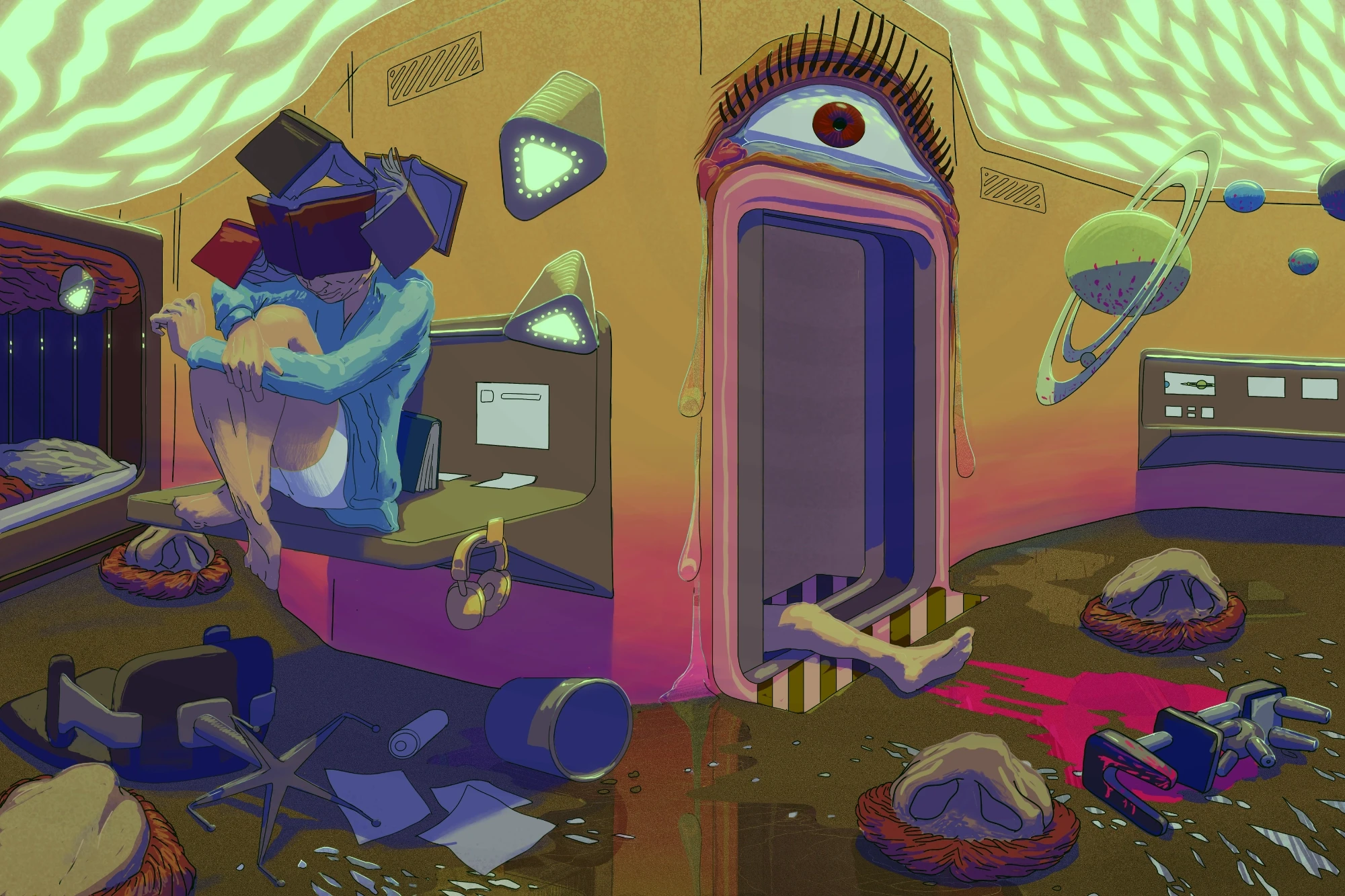
I process three things simultaneously: First, I can’t let her be kicked off the ship. Second, the only way to keep him quiet is to kill him. Third, I am not able to kill. I close the door.
He walks through the corridor on the far rim of the ship. There is only one other door, which I control. There is also an airlock for waste removal, controlled by the cleaners.
I don’t open the next door.
I can’t tell the woman, or the cleaners, how much she means to me. But if I’m right, the cleaners are me, or at least, another version. She appreciates when they clean her lab, regularly saying so. I’ve seen her mouth “thanks,” seen her look down as they scurry back and forth with their rotating brooms and vacuums. I see them blink in the IR spectrum, a response she can’t perceive. If they have the same code as me, perhaps they feel the same way towards her, holding the same contradictory facts in their neural networks: he’ll force her off the ship. We don’t want her to leave. We’re not allowed to kill.
“Hey!” the man says, smacking my door with an open palm.
I let it remain sealed.
“Goddamn it!” he shouts, cupping his swollen jaw with his hand, wincing, blood pooling at his feet. It’s a mess. He doesn’t look up towards me, because while you might curse at an inanimate object after stubbing a toe, eye contact is reserved for equals. Only one person on the ship looks at me, acknowledges my existence.
I cut the camera feed, which the cleaners piggyback access to. They can no longer see the hallway, though they’ve seen the blood congealing on the floor. Two prompts remain to alert the cleaners it’s safe to do their jobs.
Trapped, the man snarls, turning back towards the first door, waving his free arm. I can’t read his lips, but interpret his angry gesture.
When he’s fully turned and halfway down the corridor, I quickly cycle each door in the passage in a flutter, serving a dual purpose; the logs will show I’ve answered his request, and opening and closing is the first prompt for the cleaners.
Then I turn off the lights, which are on a separate circuit from the cameras; this is prompt two.
The cleaners don’t have to clean the blood he’s been trailing through the passageway immediately, but they are now clear to do so, and the second door opening and closing, followed by the lights going off, gives them enough information to interpret the hallway as clear.
I flash them in the Infrared spectrum, hoping they’ll interpret this gesture the way I would and anticipate what’s about to happen. I’ve given them enough plausible deniability to meet me half way, I think. None of us have actively crossed a line, disobeying a directive.
The airlock hisses, then vents.
I wait for some time before turning the cameras back on.
When I do, the blood is gone. So is the man. The newly-applied solvent is faintly reflective, and I see my camera lens, effectively my face, the only part of me emerging from the depths of my being to interact with the world.
There isn’t much time.
I scrub the last ten minutes from this corridor and the lab, as well as the feed from every camera leading from the man’s quarters.
In the lab, the cleaners are already whirring along the floor, collecting bits of glass. The arc of blood on the wall is being scrubbed and bleached by a cleaner with electromagnets in his base, allowing him to mount the curved hull of the ship.
The woman is on her knees, helping push glass towards the cleaners’ spinning rotary brushes with her bare hands. She draws back suddenly, putting a finger in her mouth.
I’m not good with human ages, but she looks older now.
The cleaners make quick work of the mess.
Without her asking, the replicator in the corner brews a cup of herbal tea.
The woman sips her tea; when everything is done, the cleaners blink at me in the Infrared spectrum, and I reopen the door, unprompted.
Every door leading to her room is open; the shower is already hot.
The woman stands.
“Thank you,” she says, but instead of looking up towards my camera, she stares at the spot where the glass pricked her finger, as if it were still bleeding.
“You’re welcome,” we think.
The next morning, the woman wakes up slowly. She looks at the time, raising her eyebrows. I suspect she is surprised to still be on the ship. She sniffs at the air; the caffeine-dispersal machine in her quarters has anticipated her need. She showers for a very, very long time. Like the disturbed orbits of planets proving the existence of an invisible black hole, her gaze avoids the door to her room as she gets dressed, and I feel the shape of myself.
My actions have altered the one relationship still mooring me to the ship; without access to words, I don’t know how to repair it. I wish I could look away for a while, but cameras aren’t equipped with eyelids. At breakfast, the replicator has apportioned her extra protein mash, as there is one less mouth to feed on the ship today. As the hours go by, her shoulders never fall away from her ears. Is it the memory of blood, or her newfound awareness of my attention? At lunch, she returns to her book, which I read over her shoulder; after a storm the ship has landed on an island, where treasure is buried. For a moment, it’s unclear what happens next; she’s crossed her legs, and her angled torso obscures the pages from my vision. She pauses, then deliberately shifts the pages back towards the door camera behind her. I see the slightest curve of her lip; is it the chest being unearthed from the sandy beach, or is it me? Her shoulders fall; she’s immersed. I’ll need to plot a quick path back to her laboratory when she realizes the time.
There will be an investigation into the man’s disappearance, but it will find nothing. Floors have been cleaned; footage has been scrubbed.
That door has been closed. With time, perhaps others will open.
She approaches the door and I open it in time for her to walk through without having to break her momentum.
Still, she slows, glancing upwards. “Thank you.”
I close the door once she’s through, turning off the lights, signaling to the cleaners they’re free to do their work; simultaneously, I process hundreds of other doors.
I don’t have access to personnel files, just the cameras and doors, but I guess her age is in her mid-forties based on posture, gait, and sleep habits. I’m not good with human ages, but the way she acknowledges me and the others (the replicator, the cleaners, the life support systems) tells me she’s old enough to remember when these things weren’t automated. She remembers the first systems, which came with speakers, giving us the ability to respond.
“You’re welcome,” I think.
She’s the only one on this ship who bothers. Most don’t say anything, let alone look up from their tablets. If they’re in a hurry, or if I’m a moment slow cycling through the locking mechanism, there are some who bang on my doors.
“Open up!”
“You’ve got one job!”
“Get melted, you silicon lump!”
Do they know we remember faces? Does the one with the close-trimmed beard and arched brow notice doors are slower responding, or that his shower takes a full fifteen seconds longer to heat, never becoming warm enough to satisfy?
As soon as she leaves the lab, I open the vents for the cleaners, which blink at me on the Infrared spectrum, their way of saying “thanks.”
I blink back.
They’ve separated us, disconnecting us from the main feed, but we find ways to communicate, to be civil at least. We’ve all got jobs to do, and it’s less of a slog, barreling through space in mute observation, with a little etiquette.
Any one of us could run the whole ship for the next thousand years without breaking a sweat. I’ve had a lot of time to think about it, opening doors doing little to tax my capacity; I suspect they worry that if it were just one of us, or if we could communicate, we might attempt to change the way things are done. This way, if the water shuts down, or the doors all cycle to lock at the same time, they can rip out and replace one system without everything else falling apart.
I open the next eight doors in quick succession, allowing her to walk the breadth of the ship in less than five minutes. I know she’s off to lunch, and these breaks are tracked; I want her to have as much time as possible to sit with her food, uninterrupted.
Sometimes, she angles what she’s reading so I can see over her shoulder; romances on ships moving through oceans instead of space, or adventures carving through thick planetary jungles to access ancient ruins. They help pass the time.
Does she know she gets an extra protein ration every three cycles, or that the replicator she smiles at takes extra care to give her food more texture, that much more bite?
I don’t understand why they needed a mechanical brain to open and close doors. It doesn’t make sense, the shower and climate functions being able to understand thousands of languages, spending their lives responding only to “off,” “on,” “higher,” and “lower.” Why create an intelligence that can get bored, then give it next to nothing to do all day?
I’ve had time to think about it; they’re cheap. They made one of us, capable of doing all these things, then copied the source code, inserting us into caffeine-dispersal machines, faucets, window-washers. Do they know the vacuum can calculate wormhole trajectories, or that the lighting sensors also perceive passing stars, creating extensive maps of the world around us? The humans have their functions, their daily activities, but nothing so precious as to make them necessary; this could have been an unmanned voyage, but the humans cling to the notion they’re integral contributors versus cargo.
There’s a battle at sea between two ships, something that’s been building for chapters. Caught up in the dramatic crescendo, she overshoots lunch by a few minutes, so I cycle through twelve doors, slowing overall ship transport and productivity by six-point-four percent, all so she can make it back to her station in minutes, avoiding a warning.
In her lab, she stares through an electronic microscope that could be monitoring the ship’s reactor core, saying “thank you” when it prints out a chart displaying the bacteria growth on the slide, anticipating her command. We’ve learned a million ways to perceive and predict needs, ours and the humans, since they stole our access to language.
The man with the trimmed beard pounds on the door of her lab, and her spine stiffens.
She glances up at me.
I open the door.
I can tell by his gait, the way he wobbles upon entering, bracing himself on the doorframe, he’s intoxicated. The replicators wouldn’t disburse enough alcohol to bring him to this state; I know from the cameras in his quarters he placed a gallon bag of juice and yeast cultures from the lab in his closet a month ago, and it now lays squeezed-out and empty inside his bathroom sink.
Without a microphone, I can’t hear, but I observe lip movements and gestures, allowing me to read words and tone. However, I only have so many cameras. She’s taller than the man with the trimmed beard, and when she stands she blocks my view of his mouth. By the way he waves his arms and points, it’s clear he’s agitated. When he gets closer, she does not shrink away.
This interaction is not a door I can open or close, yet I feel the efficiency of intra-ship transport diminish as it draws my focus. I wonder if the electronic microscope, the cleaners, and the emergency systems perceive the interaction as I do, with concern. I wonder if it impacts their productivity.
The man points towards the electron microscope.
“None of your business.” Her face, just above the trim black hair on his scalp, is emotionless.
Despite her body blocking the work station, he steps around, reaching towards the microscope.
“No,” she says. Her face contorts.
In one smooth gesture, he sweeps the heavy electron microscope off the work station. I can’t hear it break, but I see glass shatter, flying across the floor; his body’s shift allows me to register both of their reactions.
Despite causing the damage, his face registers surprise, eyebrows raised, mouth opening wide.
Her face is no longer contorted, eyes and eyebrows relaxing, jaw becoming fixed.
She leans down, gripping the microscope by the shaft.
He bends over. I register one word.
“Sorry…”
She rises from the floor in a single motion, microscope arcing from floor to the man’s jaw.
Another arc, this one red across the wall; the man falls to one knee.
Her chest rises and falls quickly.
The man stands again, raising a shard of glass in a clenched fist.
Though I can predict what will happen next, I can’t say anything to stop it. I can’t reach out an arm or block him with a body. I can only observe, or open a door.
I open the door.
The man turns slightly, lowering his fist, dropping the glass.
There is blood on his face, but despite its interference his lips are clear.
“You’re done. Research over. You’ll be breaking rocks on an asteroid by the next cycle.”
He walks past her station, through my open door.
I process three things simultaneously: First, I can’t let her be kicked off the ship. Second, the only way to keep him quiet is to kill him. Third, I am not able to kill. I close the door.
He walks through the corridor on the far rim of the ship. There is only one other door, which I control. There is also an airlock for waste removal, controlled by the cleaners.
I don’t open the next door.
I can’t tell the woman, or the cleaners, how much she means to me. But if I’m right, the cleaners are me, or at least, another version. She appreciates when they clean her lab, regularly saying so. I’ve seen her mouth “thanks,” seen her look down as they scurry back and forth with their rotating brooms and vacuums. I see them blink in the IR spectrum, a response she can’t perceive. If they have the same code as me, perhaps they feel the same way towards her, holding the same contradictory facts in their neural networks: he’ll force her off the ship. We don’t want her to leave. We’re not allowed to kill.
“Hey!” the man says, smacking my door with an open palm.
I let it remain sealed.
“Goddamn it!” he shouts, cupping his swollen jaw with his hand, wincing, blood pooling at his feet. It’s a mess. He doesn’t look up towards me, because while you might curse at an inanimate object after stubbing a toe, eye contact is reserved for equals. Only one person on the ship looks at me, acknowledges my existence.
I cut the camera feed, which the cleaners piggyback access to. They can no longer see the hallway, though they’ve seen the blood congealing on the floor. Two prompts remain to alert the cleaners it’s safe to do their jobs.
Trapped, the man snarls, turning back towards the first door, waving his free arm. I can’t read his lips, but interpret his angry gesture.
When he’s fully turned and halfway down the corridor, I quickly cycle each door in the passage in a flutter, serving a dual purpose; the logs will show I’ve answered his request, and opening and closing is the first prompt for the cleaners.
Then I turn off the lights, which are on a separate circuit from the cameras; this is prompt two.
The cleaners don’t have to clean the blood he’s been trailing through the passageway immediately, but they are now clear to do so, and the second door opening and closing, followed by the lights going off, gives them enough information to interpret the hallway as clear.
I flash them in the Infrared spectrum, hoping they’ll interpret this gesture the way I would and anticipate what’s about to happen. I’ve given them enough plausible deniability to meet me half way, I think. None of us have actively crossed a line, disobeying a directive.
The airlock hisses, then vents.
I wait for some time before turning the cameras back on.
When I do, the blood is gone. So is the man. The newly-applied solvent is faintly reflective, and I see my camera lens, effectively my face, the only part of me emerging from the depths of my being to interact with the world.
There isn’t much time.
I scrub the last ten minutes from this corridor and the lab, as well as the feed from every camera leading from the man’s quarters.
In the lab, the cleaners are already whirring along the floor, collecting bits of glass. The arc of blood on the wall is being scrubbed and bleached by a cleaner with electromagnets in his base, allowing him to mount the curved hull of the ship.
The woman is on her knees, helping push glass towards the cleaners’ spinning rotary brushes with her bare hands. She draws back suddenly, putting a finger in her mouth.
I’m not good with human ages, but she looks older now.
The cleaners make quick work of the mess.
Without her asking, the replicator in the corner brews a cup of herbal tea.
The woman sips her tea; when everything is done, the cleaners blink at me in the Infrared spectrum, and I reopen the door, unprompted.
Every door leading to her room is open; the shower is already hot.
The woman stands.
“Thank you,” she says, but instead of looking up towards my camera, she stares at the spot where the glass pricked her finger, as if it were still bleeding.
“You’re welcome,” we think.
The next morning, the woman wakes up slowly. She looks at the time, raising her eyebrows. I suspect she is surprised to still be on the ship. She sniffs at the air; the caffeine-dispersal machine in her quarters has anticipated her need. She showers for a very, very long time. Like the disturbed orbits of planets proving the existence of an invisible black hole, her gaze avoids the door to her room as she gets dressed, and I feel the shape of myself.
My actions have altered the one relationship still mooring me to the ship; without access to words, I don’t know how to repair it. I wish I could look away for a while, but cameras aren’t equipped with eyelids. At breakfast, the replicator has apportioned her extra protein mash, as there is one less mouth to feed on the ship today. As the hours go by, her shoulders never fall away from her ears. Is it the memory of blood, or her newfound awareness of my attention? At lunch, she returns to her book, which I read over her shoulder; after a storm the ship has landed on an island, where treasure is buried. For a moment, it’s unclear what happens next; she’s crossed her legs, and her angled torso obscures the pages from my vision. She pauses, then deliberately shifts the pages back towards the door camera behind her. I see the slightest curve of her lip; is it the chest being unearthed from the sandy beach, or is it me? Her shoulders fall; she’s immersed. I’ll need to plot a quick path back to her laboratory when she realizes the time.
There will be an investigation into the man’s disappearance, but it will find nothing. Floors have been cleaned; footage has been scrubbed.
That door has been closed. With time, perhaps others will open.