Fiction,
In her second entry at Phano, Miah O’Malley tells a story about having special insight, and the isolation one experiences when it challenges what others know to be true. The universe is vast. Big, unbelievable things loom just over the horizon if you know how to look.
The radio spectrum’s quiet band always greeted her first with a small headache, as if someone tapped a spoon against the inside of her skull.
Ping, at fourteen-twenty megahertz.
Ping, again when she eased the tuner toward the hydroxyl line.
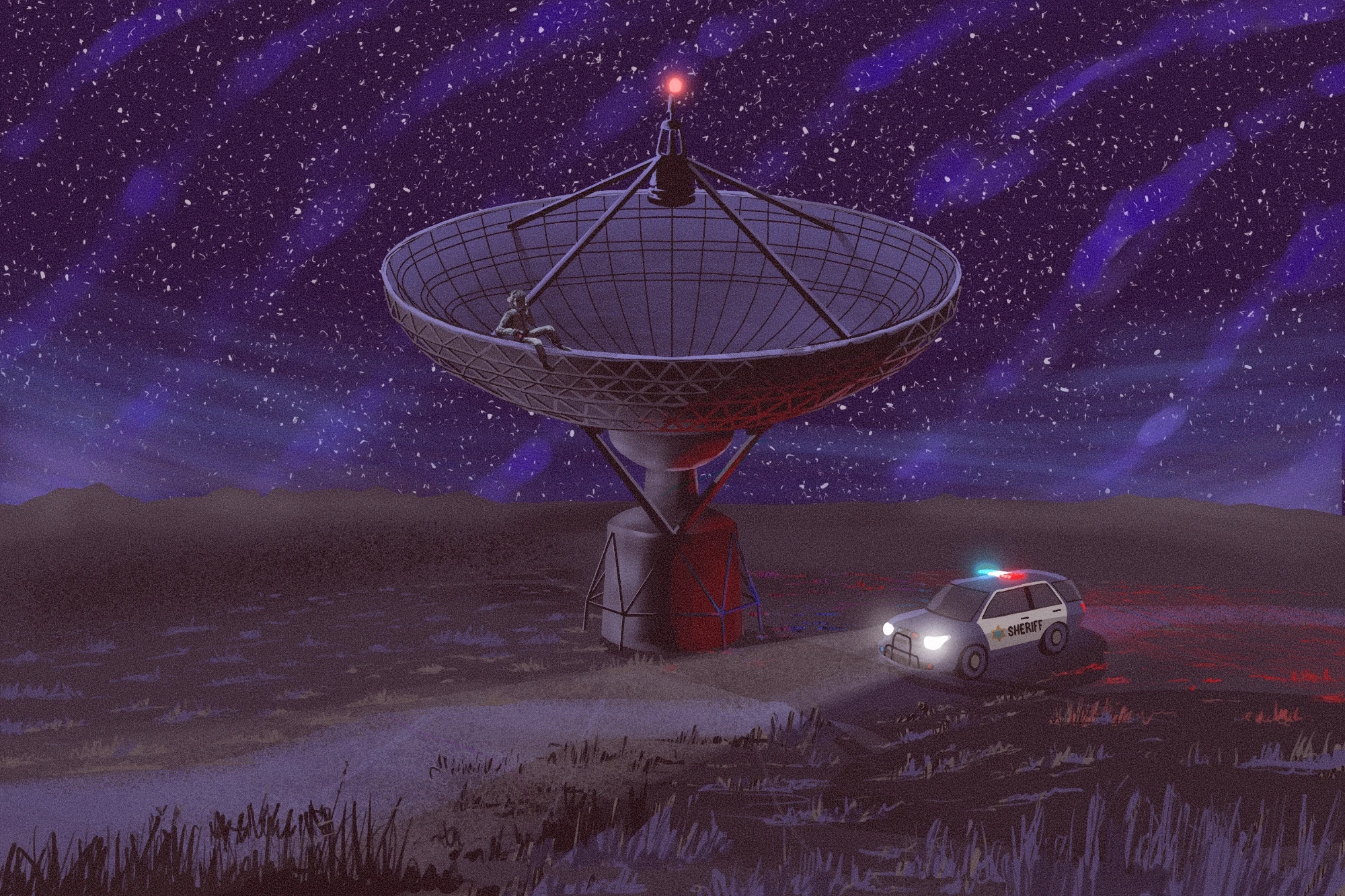
Laying along the rim of the Juniper Basin dish, Edy rubbed her temples and concentrated, letting the radio pulses settle into place. The metal dish was cold through her jacket; the stars above looked half-asleep. The headset receiver pressed warm against her ear, translating the band into pressure and sound.
Her old astronomy professor used to call this slice of spectrum the water hole. A cosmic rest stop. A place where hydrogen murmured and hydroxyl answered and anyone sensible would come grab a drink and chat across the void. Edy remembered the professor saying that as if the molecules were little travelers with dusty boots.
Edy had liked that. It made the universe feel friendlier.
Her classmates had liked it too, until Edy started answering the frequencies out loud during labs, or pointing out where the murmurs felt denser, as if they carried weather. She’d felt it, how hydrogen flipped its spin state and released a photon, hydroxyl absorbed and re-radiated energy in more chaotic bursts. Those processes bathed the band and over time, they left traces. Molecules carried memory. It was so clear: configurations that worked once were more likely to recur. Attractor behavior. A history accumulated. But people got concerned. Professors frowned. Someone wrote “pattern delusions” in her file.
Now she had no lab, no badge, no login for any blessed database. She had fences and locks and rusting radio dishes with no one to love them. The array at Juniper Basin had shut down years ago, staff redistributed, consoles stripped and hauled away. She’d started her journey, to find a dish she could work at, someone who would hear her ideas. Different towns. Different police and social workers.
Officially, nothing here heard a thing.
With her back against it, the Juniper Basin dish cupped the sky, big and white and tilted to catch whatever fell. Thin frost clung to the seams. Weeds grew through cracks in the asphalt below, stalks catching the wind in a low hiss that threaded itself through the static in her ears. “Hello,” she murmured. “Testing, testing.”
She adjusted the receiver against her head with careful fingers. The hydrogen line loosened into a bright tone. The hydroxyl emission fluttered in, a breathier murmur. Between them stretched the quiet band, the way a river stretches between its banks, carrying silt and seeds and stories downstream.
“That’s better,” she whispered to it. “You’re clearing up.”
Static sifted into something more graceful. Little pulses stepped into regular distances, then grouped, then regrouped. A new thread rose above them, a high and delicate line, the exact frequency she had tracked for the past week. It moved under her headache, opening like a horizon rushing to greet her.
Then, orchids. Spectral orchids. They always opened late in the listening.
She made a small, pleased sound in her throat.
The band thickened. She pictured the shapes she had been sketching all spring in her notebook. Translucent trunks rising through the quiet frequencies, veined leaves patterned with waveforms, moths with wings of interference beating slowly at the canopy edge. Their bodies hung with little crescents of static, their antennae tuned to the softest hiss.
“You’re growing.” She smiled. “I am listening.”
Edy inched the tuner. The orchids brightened. She imagined their little static-pollen grains drifting sideways through the band.
She exhaled, slow and happy, letting her cheek rest against the cold metal when a flashlight beam swept her boots. The pressure shifted in her skull, a brief tightening that had nothing to do with the band. A taste like chalk rose at the back of her tongue.
Edy lifted her head once, breath sharp, and caught the outline of a person below. The band resolved into a soft rush, hydrogen steady as ever. She flattened herself against the dish, grounding herself in the cold, and waited for the footsteps to retreat.
“Edy,” a gruff voice called from below, tight and low. “You need to come down. Right now.”
She sighed. “I’m in the middle of something delicate.”
“Now.”
The beam shook once, a little tremor that sent brightness skidding over her knees. Edy winced, not from the light but from the way the orchids flinched under the intrusion. The high thread she had been tracking shivered and drew itself inward, luminous petals furled away from the glare.
“I know,” she murmured into the headset. “Don’t go, I’m here.” Her breath clouded the metal beneath her cheek. She flattened herself against the dish, waiting for the retreat of footsteps, her breath fogging the night air.
“Edy.”
The headache sharpened when she rolled onto her side. The spoon against bone gave one last insistent tap. “I am fine. Please leave me alone.”
“You know it doesn’t work that way, Edy. I need you to come down, and then we’ll talk about it.”
She slid her legs over the rim, boots searching for the uppermost rung. The frost made the steel slick, and she curled her fingers around the rail until the bite of cold reached tendons.
“Three points of contact,” the officer called. “Hands and feet. I do not want paperwork tonight.”
“You complain about the paperwork,” she answered, and felt for the next rung with her toe. “But you keep coming out here anyway, Travis.”
“Because you keep breaking in,” he said. His silhouette waited at the base of the ladder, flashlight held low now, angled away from her face. “We boarded up the access gate, so you went ahead and crawled under barbed wire.”
“The board was loose,” she said. “And the wire leaves room for foxes and women who listen to the cosmos.”
He muttered something that did not carry.
By the time her boots hit asphalt, her headache had settled into a single clean band across her forehead. The quiet water between frequencies thinned, the way a marsh thinned when you stepped up onto a bank. She let herself feel that loss for a moment and then turned to Travis.
He stood with one hand on his belt and one still holding the flashlight, beam dropped to her boots. His jacket bore the county star, its edges dulled by years of dust. He carried the symbol, but not the understanding—the stars in his blood; the old hydrogen that made him, made her, made everything she listened to. The elements inside him had been forged in older fires than he’d ever imagine.
“You’re not allowed on this property,” he said. His voice was tired rather than angry. “You’re not staff. No one is staff. It is decommissioned. Which you know. You created a hazard. We keep going over this.”
“I reduced a hazard,” she said. “Unattended equipment grows lonely. Loneliness leads to bad decisions.” She smiled. The officer did not laugh.
His gaze flicked to the headset still hugging one ear. “Take that off, please.”
“I need to finish the work,” she said. The receiver hummed lightly against her skin, a soft pressure that told her the preset still listened in the background. The orchids had not completely folded. They were waiting, their petals held shut the way some flowers did when a cloud passed.
His hand extended, palm up. “Headset, Edy.”
She unclipped the band and held the headset against her chest. “Only if you will try to listen, Travis. Will you?” The loss of contact ran down her neck in a cold line. The world outside the band always felt slightly dimmer, its air less textured.
“Step away from the ladder, please.”
She gripped the cold rung. “You said we would just talk.” The weeds that pushed through the cracked asphalt brushed her boots, seed heads rattling against leather. Somewhere beyond the fence, night insects sang in overlapping pulses she had never learned to diagram, but she kept her attention on the dish’s white rim. In her mind, the orchids unfurled again, mist through the band, patient, patient.
“How many times is this now?” he asked.
“Several,” she allowed, and swallowed. The work had its own way of counting that did not map cleanly onto the citations folded in her pack. Every return visit deepened the roots. Here. At the valley array before this, before the night she was removed and the morning she woke somewhere she hadn’t chosen. Her chest tightened. “Others when I was a student.”
He made a low sound. “So, a lot, then.”
“The dish is where the work happens,” she said.
“Yes, yes,” he said. “The hydro-laser line, the, the megahertz. We have talked about this.”
“Fourteen-twenty to seventeen-twenty megahertz. The neutral hydrogen line and the hydroxyl maser line, quiet between them,” she answered. The last time he had picked her up, a rain had just ended and the band had been muddy with interference. It had not yet begun to grow trunks and orchids. “You told me I would get hurt. You told me the county does not have funds to scrape me off a dish if I fall and crack my skull.”
“Those are still my concerns,” he said. “Do you know what my other concern is tonight?”
She looked up at the dish, then back at him. His jaw had a tightness now that had not been there the last time. The beam of his flashlight held steady. “That someone will call you in the morning,” she recited. “And say I am on the dish. That you will have to come get me at some godawful hour of the morning when people should be asleep.” She glanced at him to see if she’d remembered his words correctly.
“That you are escalating,” he said. “That you are not listening to us. That I will be legally required to do more than give you a citation.”
The word legally hung between them with an empty space around it. She did not need him to say 5150. She had lived the number already: hands on her arms, unyielding, a doctor’s voice explaining her to someone else while she tried to keep the band in focus. The injection came before she could object. The spectrum collapsed into a blank, airless hush. Later, they told her that was care.
She slipped her arm through the bar of the ladder. Gripped it in the crook of her elbow. “The band is changing,” she said quietly. “I can’t miss it. It has never done this.”
“Done what, Edy?” His voice was strained.
She searched for a frame that might fit in his head neatly, because the full shape of it would not fit. The estuary had length and depth and a slow churn that could not be flattened into a checklist.
“The interval between fourteen-twenty and seventeen-twenty megahertz has always been quiet,” she said. “The water hole. You understand that, right?”
He frowned. “I don’t, but I believe that you believe it.” He angled his body in the direction of the car, waved her toward it.
She slid behind the ladder. “Hydrogen and hydroxyl are the parent and child of water,” she reminded him. “To listen there is to lean in close to the chemistry of seas. The signpost that says: we understand water. We are kin.”
The dish’s white rim curved wide above them, a frozen tide.
“Kin,” he repeated, his voice low.
“They thought of it as a channel for messages,” she said. “I thought that too. Until the patterns started to accumulate. They do not behave like speech.”
He turned toward her, watched her with alert stillness. His light stayed low.
“Things gather there,” she said. “Frequencies settle into layers and silt. The band holds the memory of it all—not as metaphor. As habit. As structure.” She reached for his arm, then pulled back.
“I know, Edy, you hear forests,” he said softly. The phrase carried the echo of some report he had read, some italicized note from a psychiatrist. “Don’t get excited.” He reached toward her, motioning her forward but not grabbing.
“I hear an ecology,” she said.
He nodded, a small quick motion. “Get in the car,” he said. “We’ll talk where it’s warmer. Please, Edy.” He began walking. The cruiser waited by the main gate, its white paint faint under starlight.
The heater in the cruiser sighed against the cold. Edy rubbed her hands in the heat and let sensation return to numb fingers. Travis did not handcuff her. He had never cuffed her. She sat in the front. That mercy belonged to him, not to the system that sent form letters on county letterhead. In the warmth, silence stretched between them.
“I’m supposed to take you in tonight,” he said after a while. His hands rested on the steering wheel. The radio on the console crackled now and then with distant voices. “You know that. The station has your file flagged. Repeated trespass. Prior holds. Not following instructions.”
“Prior holds for carrying on with this work, for noticing what the band does,” she said.
“People worry,” he said. “They worry you may do worse than fall, one of these nights. Possibly harm yourself.”
“My presence is not harm,” she said. “It is not harm. It is…pilgrimage.”
“Edy, I don’t understand the difference.” He rubbed his hand across his forehead. His honesty put a small crack in her irritation. “Help me.”
She glanced out the windshield. The dish was only a pale crescent from this angle, its full bowl hidden by the control building’s dark bulk. Beyond the fence, the valley lay in low angles. Frost gleamed on grass where the cruiser’s headlights cut through.
Edy wrapped her arms around herself and sank against the door. “The water’s country, Travis,” she said. “There is communication happening. But you won’t listen.”
In school, they’d studied that band as a place where someone else might speak. Everyone imagined a voice, a clear signal that everyone could understand. She’d never planned for the changes, the costs. She thought about what the next hospital might be like—the injections that made her nauseated, too tired to walk. She squeezed her arms tighter against the images.
He tilted his head. “What happens there, Edy? The ecology?”
She inhaled deeply. “An ecology is forming,” she said.
“What kind of ecology?”
“A structure,” she said. The universe made weather out of clouds of gas, cells out of organic slush. At some point, the gradient between element and molecule, between silence and noise, began to support connections. She glanced at him.
He ran a thumb along the steering wheel. The fabric of his uniform whispered against the seat when he shifted.
“So,” he said slowly. “You think some kind of life is growing there.”
“Life is a word with politics attached.” The orchids stirring in the band, at the far edge, behaved as if they had a niche. Moths of interference that skirted their canopy. Roots that pressed down into lower frequencies, searching for stable ground. “Every day the dish picks up their passage, the way wetlands host bird migrations. I am following the migration.”
“What if you stop following?” he asked.
She looked down at her hands. The nails had crescents of graphite under them from hurried sketches.
“Then no one will be there when it presses through,” she said. “At the point where the band touches matter. Where the spectral estuary meets real water.”
He turned and stared at her, something like unease flattening the skin around his eyes. The cruiser’s radio hissed and subsided.
He shut his eyes briefly. “You hear how that sounds, right?” His voice was soft.
“Yes,” she said. “You don’t know what it does to you, being told again and again that the things you see are wrong. That the rest of the world is fine and you’re the error in it.” She looked past him, at the dark beyond the glass.
He met her eyes. For a heartbeat, she let herself hope. The hope hurt worse than the headache.
He exhaled through his nose. “Look, I’m not qualified to believe or disbelieve,” he said. “I’m qualified to drive you to the hospital when you break the law and ignore safety directives. That’s my job.” He looked at the steering wheel again.
She swallowed. “If you do that, these emergent structures will continue without me. They will be alone.”
Outside, frost deepened on the windshield in feathery lines. Somewhere far overhead, hydrogen flipped and flipped, patient as the sunrise.
He slowed the car, shaking his head.
“I’m not taking you to the hospital tonight,” he said. “I am taking you home, and you are going to agree not to climb the dish. Do you understand me?”
“Yes,” she said. “I understand you perfectly.”
-
The motel room smelled of old soap and stale fabrics. Edy set her backpack on the bed, then drew the curtains tighter until the glow of the parking lot shrank to a narrow line.
She pulled out her notebook. The pages were already dense with sketches: trunks rising through bands, leaves veined with frequency, moths whose bodies glowed in the interference fringes. She added tonight’s positions, a cluster of orchids drifting eastward in megahertz the way pollen rode wind. On another page she had drawn the dish at Juniper Basin. She traced the lines, knuckles brushing worn paper.
“The shrine,” she murmured.
She had tried explaining it once to her advisor, back before the comments in her file multiplied. They had stood in front of a spectrogram and argued about significance thresholds, his hand tapping a printout, her finger resting lightly on a faint pattern he dismissed as noise. She had watched his mouth moving and imagined a little static-moth perched on his lower lip, beating its wings in time with the syllables.
“Pattern-finding is what we do,” she had told him. “At what point do you admit the pattern is not in my head but in the data?”
There would be no observers unless she carried out the work. She had the receiver, the notes of tonight’s positions. She also had Travis’s warning and the knowledge that if she stayed, he would run out of patience.
The headache was dull now, more of a pressure than a pain. It rocked her toward sleep. In that drifting space, hydrogen’s steady tone became the riverbed under everything, hydroxyl’s chatter the stones, and orchids rose through them in translucent columns, their petals catching a kind of light that had nothing to do with photons.
When her phone alarm tore through the hum, she woke with her heart hammering. She sat up fast, the world tipping, then steadied on the thought of vines finding purchase, the long rhythm of growth and tide.
She packed the receiver in its padded box and slid the notebooks into her pack. Outside, the motel clerk did not look up from his television. Dawn had not yet thinned the stars.
The day came clean and cold as she walked. The dish stood white against the sky, its curve catching light.
A truck rolled in without urgency and stopped. Her heart rang in her ears. Travis got out with two paper cups. Steam lifted from both. He held out one of the cups.
She took it. The heat surprised her, biting through the paper. She wrapped both hands around the cup and let the warmth climb her wrists.
He zipped his jacket. No faded star today, no uniform. In the open cold he looked briefly unfinished, just another presence held upright by gravity, breath lifting and fading.
The dish rose above them, deliberate and vast, its open face turned to the sky.
The radio spectrum’s quiet band always greeted her first with a small headache, as if someone tapped a spoon against the inside of her skull.
Ping, at fourteen-twenty megahertz.
Ping, again when she eased the tuner toward the hydroxyl line.
Laying along the rim of the Juniper Basin dish, Edy rubbed her temples and concentrated, letting the radio pulses settle into place. The metal dish was cold through her jacket; the stars above looked half-asleep. The headset receiver pressed warm against her ear, translating the band into pressure and sound.
Her old astronomy professor used to call this slice of spectrum the water hole. A cosmic rest stop. A place where hydrogen murmured and hydroxyl answered and anyone sensible would come grab a drink and chat across the void. Edy remembered the professor saying that as if the molecules were little travelers with dusty boots.
Edy had liked that. It made the universe feel friendlier.
Her classmates had liked it too, until Edy started answering the frequencies out loud during labs, or pointing out where the murmurs felt denser, as if they carried weather. She’d felt it, how hydrogen flipped its spin state and released a photon, hydroxyl absorbed and re-radiated energy in more chaotic bursts. Those processes bathed the band and over time, they left traces. Molecules carried memory. It was so clear: configurations that worked once were more likely to recur. Attractor behavior. A history accumulated. But people got concerned. Professors frowned. Someone wrote “pattern delusions” in her file.
Now she had no lab, no badge, no login for any blessed database. She had fences and locks and rusting radio dishes with no one to love them. The array at Juniper Basin had shut down years ago, staff redistributed, consoles stripped and hauled away. She’d started her journey, to find a dish she could work at, someone who would hear her ideas. Different towns. Different police and social workers.
Officially, nothing here heard a thing.
With her back against it, the Juniper Basin dish cupped the sky, big and white and tilted to catch whatever fell. Thin frost clung to the seams. Weeds grew through cracks in the asphalt below, stalks catching the wind in a low hiss that threaded itself through the static in her ears. “Hello,” she murmured. “Testing, testing.”
She adjusted the receiver against her head with careful fingers. The hydrogen line loosened into a bright tone. The hydroxyl emission fluttered in, a breathier murmur. Between them stretched the quiet band, the way a river stretches between its banks, carrying silt and seeds and stories downstream.
“That’s better,” she whispered to it. “You’re clearing up.”
Static sifted into something more graceful. Little pulses stepped into regular distances, then grouped, then regrouped. A new thread rose above them, a high and delicate line, the exact frequency she had tracked for the past week. It moved under her headache, opening like a horizon rushing to greet her.
Then, orchids. Spectral orchids. They always opened late in the listening.
She made a small, pleased sound in her throat.
The band thickened. She pictured the shapes she had been sketching all spring in her notebook. Translucent trunks rising through the quiet frequencies, veined leaves patterned with waveforms, moths with wings of interference beating slowly at the canopy edge. Their bodies hung with little crescents of static, their antennae tuned to the softest hiss.
“You’re growing.” She smiled. “I am listening.”
Edy inched the tuner. The orchids brightened. She imagined their little static-pollen grains drifting sideways through the band.
She exhaled, slow and happy, letting her cheek rest against the cold metal when a flashlight beam swept her boots. The pressure shifted in her skull, a brief tightening that had nothing to do with the band. A taste like chalk rose at the back of her tongue.
Edy lifted her head once, breath sharp, and caught the outline of a person below. The band resolved into a soft rush, hydrogen steady as ever. She flattened herself against the dish, grounding herself in the cold, and waited for the footsteps to retreat.
“Edy,” a gruff voice called from below, tight and low. “You need to come down. Right now.”
She sighed. “I’m in the middle of something delicate.”
“Now.”
The beam shook once, a little tremor that sent brightness skidding over her knees. Edy winced, not from the light but from the way the orchids flinched under the intrusion. The high thread she had been tracking shivered and drew itself inward, luminous petals furled away from the glare.
“I know,” she murmured into the headset. “Don’t go, I’m here.” Her breath clouded the metal beneath her cheek. She flattened herself against the dish, waiting for the retreat of footsteps, her breath fogging the night air.
“Edy.”
The headache sharpened when she rolled onto her side. The spoon against bone gave one last insistent tap. “I am fine. Please leave me alone.”
“You know it doesn’t work that way, Edy. I need you to come down, and then we’ll talk about it.”
She slid her legs over the rim, boots searching for the uppermost rung. The frost made the steel slick, and she curled her fingers around the rail until the bite of cold reached tendons.
“Three points of contact,” the officer called. “Hands and feet. I do not want paperwork tonight.”
“You complain about the paperwork,” she answered, and felt for the next rung with her toe. “But you keep coming out here anyway, Travis.”
“Because you keep breaking in,” he said. His silhouette waited at the base of the ladder, flashlight held low now, angled away from her face. “We boarded up the access gate, so you went ahead and crawled under barbed wire.”
“The board was loose,” she said. “And the wire leaves room for foxes and women who listen to the cosmos.”
He muttered something that did not carry.
By the time her boots hit asphalt, her headache had settled into a single clean band across her forehead. The quiet water between frequencies thinned, the way a marsh thinned when you stepped up onto a bank. She let herself feel that loss for a moment and then turned to Travis.
He stood with one hand on his belt and one still holding the flashlight, beam dropped to her boots. His jacket bore the county star, its edges dulled by years of dust. He carried the symbol, but not the understanding—the stars in his blood; the old hydrogen that made him, made her, made everything she listened to. The elements inside him had been forged in older fires than he’d ever imagine.
“You’re not allowed on this property,” he said. His voice was tired rather than angry. “You’re not staff. No one is staff. It is decommissioned. Which you know. You created a hazard. We keep going over this.”
“I reduced a hazard,” she said. “Unattended equipment grows lonely. Loneliness leads to bad decisions.” She smiled. The officer did not laugh.
His gaze flicked to the headset still hugging one ear. “Take that off, please.”
“I need to finish the work,” she said. The receiver hummed lightly against her skin, a soft pressure that told her the preset still listened in the background. The orchids had not completely folded. They were waiting, their petals held shut the way some flowers did when a cloud passed.
His hand extended, palm up. “Headset, Edy.”
She unclipped the band and held the headset against her chest. “Only if you will try to listen, Travis. Will you?” The loss of contact ran down her neck in a cold line. The world outside the band always felt slightly dimmer, its air less textured.
“Step away from the ladder, please.”
She gripped the cold rung. “You said we would just talk.” The weeds that pushed through the cracked asphalt brushed her boots, seed heads rattling against leather. Somewhere beyond the fence, night insects sang in overlapping pulses she had never learned to diagram, but she kept her attention on the dish’s white rim. In her mind, the orchids unfurled again, mist through the band, patient, patient.
“How many times is this now?” he asked.
“Several,” she allowed, and swallowed. The work had its own way of counting that did not map cleanly onto the citations folded in her pack. Every return visit deepened the roots. Here. At the valley array before this, before the night she was removed and the morning she woke somewhere she hadn’t chosen. Her chest tightened. “Others when I was a student.”
He made a low sound. “So, a lot, then.”
“The dish is where the work happens,” she said.
“Yes, yes,” he said. “The hydro-laser line, the, the megahertz. We have talked about this.”
“Fourteen-twenty to seventeen-twenty megahertz. The neutral hydrogen line and the hydroxyl maser line, quiet between them,” she answered. The last time he had picked her up, a rain had just ended and the band had been muddy with interference. It had not yet begun to grow trunks and orchids. “You told me I would get hurt. You told me the county does not have funds to scrape me off a dish if I fall and crack my skull.”
“Those are still my concerns,” he said. “Do you know what my other concern is tonight?”
She looked up at the dish, then back at him. His jaw had a tightness now that had not been there the last time. The beam of his flashlight held steady. “That someone will call you in the morning,” she recited. “And say I am on the dish. That you will have to come get me at some godawful hour of the morning when people should be asleep.” She glanced at him to see if she’d remembered his words correctly.
“That you are escalating,” he said. “That you are not listening to us. That I will be legally required to do more than give you a citation.”
The word legally hung between them with an empty space around it. She did not need him to say 5150. She had lived the number already: hands on her arms, unyielding, a doctor’s voice explaining her to someone else while she tried to keep the band in focus. The injection came before she could object. The spectrum collapsed into a blank, airless hush. Later, they told her that was care.
She slipped her arm through the bar of the ladder. Gripped it in the crook of her elbow. “The band is changing,” she said quietly. “I can’t miss it. It has never done this.”
“Done what, Edy?” His voice was strained.
She searched for a frame that might fit in his head neatly, because the full shape of it would not fit. The estuary had length and depth and a slow churn that could not be flattened into a checklist.
“The interval between fourteen-twenty and seventeen-twenty megahertz has always been quiet,” she said. “The water hole. You understand that, right?”
He frowned. “I don’t, but I believe that you believe it.” He angled his body in the direction of the car, waved her toward it.
She slid behind the ladder. “Hydrogen and hydroxyl are the parent and child of water,” she reminded him. “To listen there is to lean in close to the chemistry of seas. The signpost that says: we understand water. We are kin.”
The dish’s white rim curved wide above them, a frozen tide.
“Kin,” he repeated, his voice low.
“They thought of it as a channel for messages,” she said. “I thought that too. Until the patterns started to accumulate. They do not behave like speech.”
He turned toward her, watched her with alert stillness. His light stayed low.
“Things gather there,” she said. “Frequencies settle into layers and silt. The band holds the memory of it all—not as metaphor. As habit. As structure.” She reached for his arm, then pulled back.
“I know, Edy, you hear forests,” he said softly. The phrase carried the echo of some report he had read, some italicized note from a psychiatrist. “Don’t get excited.” He reached toward her, motioning her forward but not grabbing.
“I hear an ecology,” she said.
He nodded, a small quick motion. “Get in the car,” he said. “We’ll talk where it’s warmer. Please, Edy.” He began walking. The cruiser waited by the main gate, its white paint faint under starlight.
The heater in the cruiser sighed against the cold. Edy rubbed her hands in the heat and let sensation return to numb fingers. Travis did not handcuff her. He had never cuffed her. She sat in the front. That mercy belonged to him, not to the system that sent form letters on county letterhead. In the warmth, silence stretched between them.
“I’m supposed to take you in tonight,” he said after a while. His hands rested on the steering wheel. The radio on the console crackled now and then with distant voices. “You know that. The station has your file flagged. Repeated trespass. Prior holds. Not following instructions.”
“Prior holds for carrying on with this work, for noticing what the band does,” she said.
“People worry,” he said. “They worry you may do worse than fall, one of these nights. Possibly harm yourself.”
“My presence is not harm,” she said. “It is not harm. It is…pilgrimage.”
“Edy, I don’t understand the difference.” He rubbed his hand across his forehead. His honesty put a small crack in her irritation. “Help me.”
She glanced out the windshield. The dish was only a pale crescent from this angle, its full bowl hidden by the control building’s dark bulk. Beyond the fence, the valley lay in low angles. Frost gleamed on grass where the cruiser’s headlights cut through.
Edy wrapped her arms around herself and sank against the door. “The water’s country, Travis,” she said. “There is communication happening. But you won’t listen.”
In school, they’d studied that band as a place where someone else might speak. Everyone imagined a voice, a clear signal that everyone could understand. She’d never planned for the changes, the costs. She thought about what the next hospital might be like—the injections that made her nauseated, too tired to walk. She squeezed her arms tighter against the images.
He tilted his head. “What happens there, Edy? The ecology?”
She inhaled deeply. “An ecology is forming,” she said.
“What kind of ecology?”
“A structure,” she said. The universe made weather out of clouds of gas, cells out of organic slush. At some point, the gradient between element and molecule, between silence and noise, began to support connections. She glanced at him.
He ran a thumb along the steering wheel. The fabric of his uniform whispered against the seat when he shifted.
“So,” he said slowly. “You think some kind of life is growing there.”
“Life is a word with politics attached.” The orchids stirring in the band, at the far edge, behaved as if they had a niche. Moths of interference that skirted their canopy. Roots that pressed down into lower frequencies, searching for stable ground. “Every day the dish picks up their passage, the way wetlands host bird migrations. I am following the migration.”
“What if you stop following?” he asked.
She looked down at her hands. The nails had crescents of graphite under them from hurried sketches.
“Then no one will be there when it presses through,” she said. “At the point where the band touches matter. Where the spectral estuary meets real water.”
He turned and stared at her, something like unease flattening the skin around his eyes. The cruiser’s radio hissed and subsided.
He shut his eyes briefly. “You hear how that sounds, right?” His voice was soft.
“Yes,” she said. “You don’t know what it does to you, being told again and again that the things you see are wrong. That the rest of the world is fine and you’re the error in it.” She looked past him, at the dark beyond the glass.
He met her eyes. For a heartbeat, she let herself hope. The hope hurt worse than the headache.
He exhaled through his nose. “Look, I’m not qualified to believe or disbelieve,” he said. “I’m qualified to drive you to the hospital when you break the law and ignore safety directives. That’s my job.” He looked at the steering wheel again.
She swallowed. “If you do that, these emergent structures will continue without me. They will be alone.”
Outside, frost deepened on the windshield in feathery lines. Somewhere far overhead, hydrogen flipped and flipped, patient as the sunrise.
He slowed the car, shaking his head.
“I’m not taking you to the hospital tonight,” he said. “I am taking you home, and you are going to agree not to climb the dish. Do you understand me?”
“Yes,” she said. “I understand you perfectly.”
-
The motel room smelled of old soap and stale fabrics. Edy set her backpack on the bed, then drew the curtains tighter until the glow of the parking lot shrank to a narrow line.
She pulled out her notebook. The pages were already dense with sketches: trunks rising through bands, leaves veined with frequency, moths whose bodies glowed in the interference fringes. She added tonight’s positions, a cluster of orchids drifting eastward in megahertz the way pollen rode wind. On another page she had drawn the dish at Juniper Basin. She traced the lines, knuckles brushing worn paper.
“The shrine,” she murmured.
She had tried explaining it once to her advisor, back before the comments in her file multiplied. They had stood in front of a spectrogram and argued about significance thresholds, his hand tapping a printout, her finger resting lightly on a faint pattern he dismissed as noise. She had watched his mouth moving and imagined a little static-moth perched on his lower lip, beating its wings in time with the syllables.
“Pattern-finding is what we do,” she had told him. “At what point do you admit the pattern is not in my head but in the data?”
There would be no observers unless she carried out the work. She had the receiver, the notes of tonight’s positions. She also had Travis’s warning and the knowledge that if she stayed, he would run out of patience.
The headache was dull now, more of a pressure than a pain. It rocked her toward sleep. In that drifting space, hydrogen’s steady tone became the riverbed under everything, hydroxyl’s chatter the stones, and orchids rose through them in translucent columns, their petals catching a kind of light that had nothing to do with photons.
When her phone alarm tore through the hum, she woke with her heart hammering. She sat up fast, the world tipping, then steadied on the thought of vines finding purchase, the long rhythm of growth and tide.
She packed the receiver in its padded box and slid the notebooks into her pack. Outside, the motel clerk did not look up from his television. Dawn had not yet thinned the stars.
The day came clean and cold as she walked. The dish stood white against the sky, its curve catching light.
A truck rolled in without urgency and stopped. Her heart rang in her ears. Travis got out with two paper cups. Steam lifted from both. He held out one of the cups.
She took it. The heat surprised her, biting through the paper. She wrapped both hands around the cup and let the warmth climb her wrists.
He zipped his jacket. No faded star today, no uniform. In the open cold he looked briefly unfinished, just another presence held upright by gravity, breath lifting and fading.
The dish rose above them, deliberate and vast, its open face turned to the sky.