Fiction,
Zanny Stohl’s portrait of a shambling highway society reminds me of photos from Richard Avedon’s “In The American West”. Souls taking in the time and place they belong to before the final turn-off.
On the corner of a median near a seven-way intersection on Exit 6, in the congested city of i-95, a photographer kneels by the world’s only known shrine to Saint Marco, Martyr of Highways.
A cross has been fashioned from strips of a broken car bumper, their curved plastic warped by the rush of 90mph winds. Smaller crosses and braided crowns have been woven from seatbelts, like Palm Sunday crafts propped up around the stem of the shrine. Lacrymatories of spilled oil glint iridescently between soggy plush dice and bleached polaroids weighed down by pebbles. Each little rock is hand-painted with quips of roadside wisdom: Buckle, Signal, Speed Limit. Little plastic hulu dancers flank the tableau, swaying back and forth, lumpy hands on static ukuleles.
RIP MARCO. 19730 - 2014. LUV U ALWAYS.
It went like this–
The martyr was a contractor. Shrouded in a highlighter-yellow hazard vest, pushing an orange handcart along a primed stencil, he marked bleach-white strips of thermoplastic along the untrimmed bikini line of the road’s median.
Above him, stippled sunlight finger-poked through an ever-expanding concrete latticework. A canopy of commerce, six woven layers of 4-lane highways built feverishly in the span of 6 months. In coming years, that light would be muffled out by the dyspepsic belch of carbon monoxide, and those last unruly sprigs of greenery along the median would wither and die, but back then, Saint Marco could still feel wet summer heat on the nape of his neck, and the dry choke of spring pollen in his throat.
In this spot, he was struck by an SUV reportedly speeding at 110 mph and was snapped like a glowstick. A second vehicle came galloping on the SUV’s coattails, hitting his prone body and flipping ass-over-kettle, crocodile-rolling into two more passing vehicles. The fifth and sixth skidded and swerved around, colliding nose to nose in a rubber-burnt swan kiss. An oil tanker scrambled against gravity to stop short but tipped sideways and disemboweled itself. Black smoke billows up fat and globular like burnt meringue. Eight more cars ran into the fire, paint weeping down in great iridescent streaks.
Saint Marco the Catalyst ultimately ignited a fifteen car pileup, and nine more souls escorted him to the heavens. It is estimated he died six minutes after the initial incident, having drowned in his own spinal fluid. The last song he listened to, still drizzling out of his earphones when the paramedics arrived, was Meat Loaf’s Paradise by the Dashboard Light. He had two daughters.
As it stands–
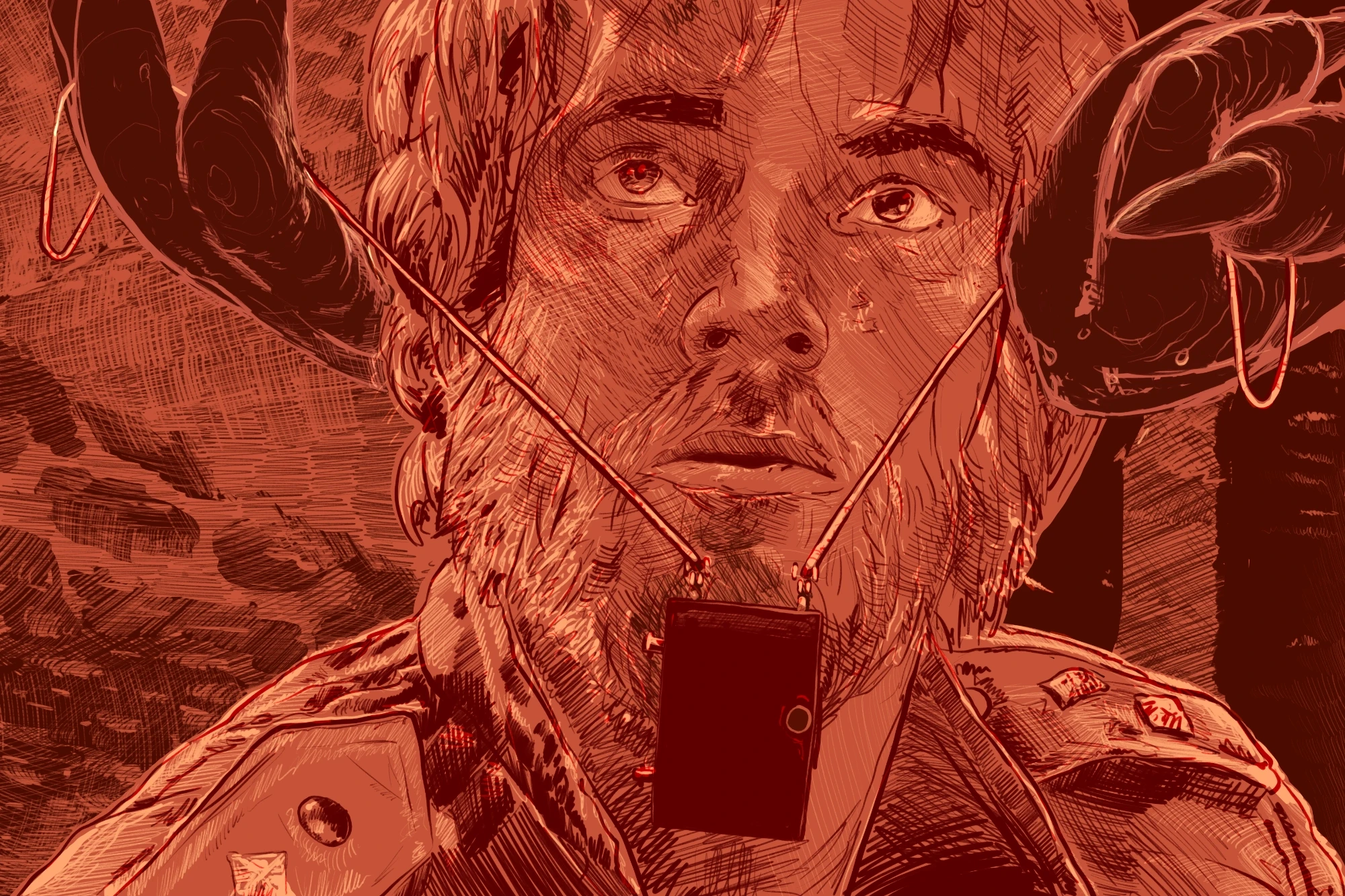
These photos will have to be brightened in post. The photographer shuffles through his memory card, dissatisfied. He is a beanpole man, his pale flesh unkindly shrink-wrapped to his musculature, his yellowed teeth unaccommodatingly too large for his mouth. He clicks through his photos with a knobby hand, the kind seen only on peat bog mummies and vitamin-deficient perverts. He can be either, depending on the day.
The photographer looks back up at the shrine, squinting, sucking his large teeth in thought. If only he could step back a bit further, get a little better lighting. His last portrait, of a urinal alcove reliquary to Blessed Linda, Lady of the Lysol, was bathed in the dreamy glass-green of bathroom fluorescence.
The way Saint Marco died, cars on the i-95 don’t speed like that anymore. They can’t. Every one of these vehicles has been converted into a teetering caravan, slotted bumper to bumper and crawling at a cozy 5 mph. It goes slow enough for road-neighbors to drape clotheslines between each other, letting their briefs and their bedsheets air-dry in moans of catalytic exhaust. Car insurance is cheaper than rent, and cheap matters when a 3 mile commute takes two weeks. The most enterprising among them might hop out and bike to work, weaving through the congestion, but this only works if someone else is back behind the wheel to keep the car inching forward. And with so many blindspots, biking can be dangerous. The photographer’s own bike, parked by kick-stand on the road’s shoulder, has a little red pennant flagging him as a city employee. The fine is $200 higher for anyone who hits him on the job.
The remote market is oversaturated, so the caravaners make their own highway markets. Mechanics are always in high demand, as is anyone selling food–especially on a road like this, where sunlight is sparse and boulevard gardens are bound to die. The photographer’s own mother used to peddle roadkill jerky. Her drying rack was stored in the trunk he used as a darkroom, and he would clip wet photos up next to her strips of meat, imbuing a chemical relish that made the most well-paved roadsters wince.
Passersby leave offerings for Saint Marco, cigarette lighter plugs and rosary beads. Saint Marco, may my breaks last another month and my windshield wiper swipe true. Saint Marco, please lower gasoline prices. Saint Marco, deliver us from potholes. Cyclists often leave spoke cards and Allen wrenches by Saint Marco’s shrine before their commute. Saint Marco, don’t let me wipe out before I clock in.
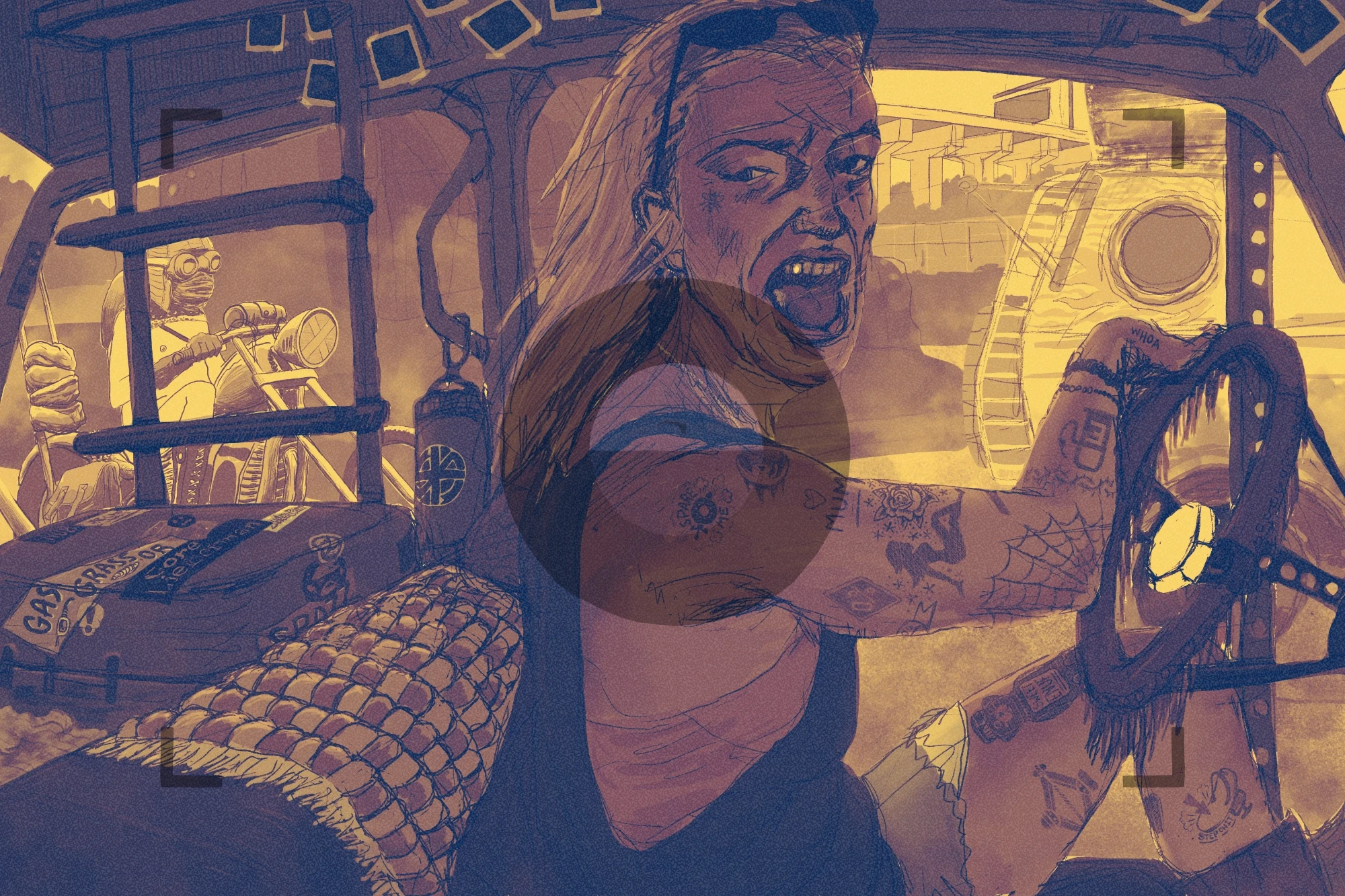
The photographer steps back, bumping into the side mirror of a modified three-story Jeep. Above him, its bulk teeters scoliostically to the right, its sheet metal walls stickered with a quilt of Gore-Lieberman 2000 bumper stickers. The driver leans out of her window. The sun-aged left half of her face is freckled and leathery, the right side softer and paler. He can see a sliver of wide pink flesh and a glittering belly jewel poking out from under the hem of her t-shirt, a dusty red sleeveless piece with AC/DC peeling off the front. A dowager’s hump curves under her bleach-fried hair, and around her neck hangs a pendant that says Honey in curling gold script. Her expression, under large tortoiseshell sunglasses, is unreadable as she chews her gum like cud.
“Hey doll. Hey. Come here.” Honey’s voice is wet with a thick film of pollutant, and she fans herself with a crumpled magazine. On the cover, a model with glossy cantaloupe breasts languishes in obscene wealth. She sits coquettishly on the broken concrete front step of a real 1200 square foot home, keys dangling between her teeth. To the photographer, her body is perfect, well-postured and even-toned, unmarred by the warping mold of a driver’s seat.
“Ah jeez,” says the photographer. “Ah man.”
Women make him nervous. He likes to keep a comfortable barrier between them and himself with his camera, happiest in the anonymity of a voyeur. No such busty models, spread-eagled for print, but unsuspecting mothers in a queue of idling cars, waiting to pass their squirmy infants through the window to drive-in daycare, big afterthought smears of rouge on their cheeks that they forgot to blend in. Stripper-bus girls who grease their legs with petrol and dangle them out the windows. Shave-headed baristas on roller skates balancing ice coffee pyramids, sweaty median gardeners with pocketfuls of onions, motorcycle nuns, the shoeless old woman who laid down in the road begging for someone to run her over.
There is something similar, he thinks, in photographing shrines. The camera is a barricade that transforms him from worshiper to observer. A more introspective person might mention all of this to a therapist, but the photographer can’t afford one.
“Put this with Saint Marco, will you?” Honey holds out a fist and drops, into his outstretched hands, a small rubber duck. It is molded to resemble a cheerleader, with blobby pompoms and crooked little eyelashes. The photographer crooks his fingers around it as if it was a real duckling.
Last spring he found a dead baby bird on the pavement. He wasn’t sure what kind it was, but sometimes mourning doves build their nests on top of 18 wheelers, sometimes, and a strong gust of wind might have knocked it over. It stuck to the road like a pink wad of bubble gum, until he looked closer and saw its limp little legs, its translucent fetal claws. The photographer held it the same way when he carried it off to the median, where he dug up handfuls of silt and pebbles. After 8 inches his nails began to scrape asphalt, and so the grave was shallow.
There’s a picture of it somewhere on his external hard drive, curled up in the dirt like the silt itself had birthed it. Another roadside shrine that only he knew. Blessed birdling, Squab of the Empty Nest, patron saint of a childhood lost. No doubt a wind like this has already exhumed it, snatched it up and splattered it on someone’s windshield.
“I’m praying the asshole behind me exits soon.” Honey thumbs over her shoulder towards the seven-story Buick casting a shadow over them both. “He’s been nudging my bumper for weeks.”
“Ah jeez,” the photographer says again. She is a handsome woman, and he wonders what it would be like to nudge her bumper himself. “That’s just–ah man. I hope so too.”
Dutifully, he wedges the duck at the base of the shrine, between two full cans of Coca-Cola, as a grainy gust of wind picks up. The pine-tree airfresher ornaments hung from the arms of the cross dance wildly with it.
“What are you taking pitchers of?” Honey shouts over the wind. Her hair whips into her open mouth, and she spits pppt pppt. The bulk overhead creaks and lurches. “The shrine?”
Pitchers. He’d scoff if the wind hadn’t just kicked up. The photographer squeezes his eyes shut, pulling up the collar of his jacket to shield his ears. All he can do is nod.
“How come?” The wind ebbs, she extracts the last strands from her mouth with a short pink nail, and her car creeps forward another inch.
“Just because. I like to do it.” The photographer slacks his shoulders and looks down, wiping the hem of his shirt around the lens of his camera. A sweaty coat of black grit rubs off. It had taken him a year’s worth of paystubs and bottle-recycling to finally buy it. For a long dry decade it sat under glass, waiting alongside two other DSLRs inside an ice cream truck that had been repurposed into a thrift store. “Ah jeez. What a mess.”
“Better wrap up soon,” Honey warns. “My phone says it’ll be a dust storm.”
He looks up and squints at her, sucking in through his teeth. “You look a lot like my mother you know.”
Another humping inch. Honey has started fanning herself again. “Yeahuh?”
“She’s dead now,” he says. “Heart attack at the wheel. Collapsed facedown onner horn and pissed off every driver in the vicinity. Fifty-three years old. Can you believe it?”
“You fuck off!” She smacks the magazine against the top of the wheel. “I’m fifty-three on Thursday.”
The photographer laughs, barking and nasal and louder than he should. “Oh jeez. Oh jeez! I hope I haven’t doomed you.”
“Yeah yeah. I’ll haunt your sorry ass.”
The air fresheners begin to rattle again, and the wind returns with venom. Before him, hazy car lights squint out through whips of dishwater gray. Something metallic rattles under his feet. He can’t see his bike.
Honey grabs the photographer by the collar and wrenches him inside, like a hooked eel. He is pliant, paralyzed, letting himself be abducted through the gullet of her car in one swift gulp. What strength! She must have one of those new resistance-training wheels installed. He tumbles gracelessly across her wide lap, into the passenger’s seat. His knees shift her car into break, his elbows snap down the sun visors, his camera strap twists around his neck like a lover’s hands, his sneakers slide against her windshield. It is the single most erotic experience of his life.
Outside, the dust storm rips on, furiously indifferent to the world it now halts.
The photographer shudders, sitting up and unwinding his camera from its vice around his throat. Around him are the usual specimens of car floor ephemera, and he feels both comforted by its familiarity, and embarrassed by his own intrusion. Somehow, observing the inside of a car feels more invasive than it would be to photograph from the outside. On her floor are receipts, ticket stubs, grocery lists, straw wrappers, empty soda bottles, soda bottles filled with urine. A mount clipped to her air conditioner vent holds up a bedazzled pink tablet on mute, where a glittering Kpop trio dance in hypnotic silence. A chattering rosary and a little silk VFW poppy are wound around her rearview mirror, and a gummy little green figure of Jesus Christ is mounted on the dashboard. Like every road-home, it smells like air freshener and fart.
Unlike every road-home, there are greasy little polaroids pasted all around the interior, a melting pot of strangers planted in the passenger’s seat he’s in now. A cyclist holding his own t-shirt to staunch a bleeding wound on his forehead, a sweaty salary man on the phone, a toothless vagrant with dirty hands and road-burn, a teen in uniform holding two pizza boxes on his lap. They all stare at the photographer with candid discomfort. He feels suddenly crowded.
“Man oh man,” says the photographer, tugging at his collar. “What are these?”
“Pitchers, dummy.” She lifts the center console hatch and removes a bulky instant camera. “I like to collect my hitchhikers.”
“Oho?”
Before he can answer, she’s snapped him. The flash spits in his eye, mean as a cobra, and it illuminates the entire jeep’s cabin against the black dust storm around them. Buglike, he shrinks under her lens. The camera ejaculates a limp photograph.
Honey pinches the edge and fans the polaroid as it fades into color. On it the photographer sees himself, a weaselly dweeb sitting knock-kneed and pale.
“You don’t get your pitcher taken often, huh?” She snaps her gum.
“No.” He licks his lips. “I’m, uh–I’m more of an observer than a subject.”
“Me too.” She spits out her gum and sticks the polaroid to an empty spot, right above the crown of her head. “I think it’s all I ever do, sitting in here. Observe. Other cars, commuters, passersby, stoplights, billboards, homeless signs, trash heaps, roadkill. Hey–how long did it take them to notice her?”
“Notice who?”
“Your mother.” Dashboard lights pattern her face hieroglyphically, Check Tires and Seatbelt Warning dotting each cheek. Afterthought smears of rouge. “How long did it take people to notice your mother? You said she pissed off the other drivers with the horn, but how long did it take them to actually notice she was dead?”
Resentment tightens his throat. Why? Why is she asking him this? Why does she need to know? He rubs his neck and tries not to remember his mother’s body on the stretcher, dried blood blooming beneath her nose. The next time he saw her she was being handed to him inside a coffee can. He rubs his neck. “I don’t know. I was at work.”
Honey hrms like she doesn’t believe him. The wind begins to ebb, and beneath it, he can hear the din of carhorns chirping like summertime peeper frogs.
“Do you miss her?” Honey asks.
The photographer scratches the side of his face, watching the window as if the wind will start to ebb if he stares hard enough. “Oh man. I don’t know. She was mean as a rattlesnake, but she was my mom. You know?”
“Sure.” She drums her fingers on the wheel. “That’s the way it goes, I guess.”
“That’s the way it goes.”
“When I was a kid,” Honey says, “a friend and I once walked from his place to a carnival. It was a long walk, longer than I thought it would be. Longer for me than for him, I guess. My God, but we didn’t get home till dark. And I was so pissed ‘cause I had these new sandals on and the blisters were so bad I was bleeding inside of them. Ruined those nice new sandals. I don’t remember a thing about the carnival itself. Isn’t that funny?”
He looks down at her feet now. A thin gray slipper taps the pedal. When was the last time he’d been to a roadside carnival, where he could chew funnel cake with his legs dangling above the i-95 from the seat of a truckbed ferris wheel? What godlike joy, to peer over the highway as if it was a small thing he had built with his own hands. Maybe that’s how it feels to be Saint Marco.
“When I was a kid,” he says, looking down at his sneakers. “When all the cars were idle at 6 o’clock, before dinner time, I used to hide underneath ours and watch people’s feet. Oh man, that sounds weird, doesn’t it? This was back when people would walk more. They’d all be walking home or like to other cars or what, and I’d just watch every pair of shoes and I’d try to guess what the person attached to them might look like. Or be like. It was so hot in the summer time, and I’d always scrape the undersides of my arms and my belly, and I’d have to like pull my shirt up over my mouth or I’d choke on the exhaust. But I did it all the time. I was addicted to it. I loved to make up a story in my head about who they were and where they were going.”
Honey draws in a long breath and just nods.
“I saw people with bloody feet sometimes,” he continues. “Like people who bled so bad they left red footprints behind them. And I knew it was probably from blisters, but in my head they always came out of a fight. Like a big angry fight, real violent, and they were the last one left alive. And I was just like in awe of them for making it all the way here, I guess ‘cause I could never do that. Even as a kid, I was honest with myself, I knew I could never do that.”
She leans her elbow on her steering wheel, and when she smiles, he can see a tiny gem embedded in her left canine. “Well. I doubt I could neither. But you never know.”
The photographer can’t bring himself to smile back. He isn’t sure why he said anything. He feels like a damp rag twisted and squeezed and now his mind is tired. When he looks out the window again, the haze of grit has lightened.
“Hey, it’s clearing up, I think,” says the photographer.
Honey deflates like an airbag. She looks forward over the crest of her steering whee. “Yeah. I think it is.”
He exits her car with an impotent little thanks, nearly catching the hem of his jacket on the door. His bike has tipped over, and when he sets it right and starts to walk it down the road, he can feel grit crackling in its littlest crevices.
He’ll keep walking until he’s far enough that Honey won’t see him. Past the schoolbuses and their mobile classrooms, past the buskers on unicycles, past the wandering mechanics who tighten loose bolts if you let them sleep in your truck bed for a night. Far enough that he can aim his camera and take her picture to satisfy himself, or take back whatever it was she took from him just then.
But when he looks over his shoulder, Honey is still watching him. Maybe, he thinks, he should have left Saint Marco an offering too.
On the corner of a median near a seven-way intersection on Exit 6, in the congested city of i-95, a photographer kneels by the world’s only known shrine to Saint Marco, Martyr of Highways.
A cross has been fashioned from strips of a broken car bumper, their curved plastic warped by the rush of 90mph winds. Smaller crosses and braided crowns have been woven from seatbelts, like Palm Sunday crafts propped up around the stem of the shrine. Lacrymatories of spilled oil glint iridescently between soggy plush dice and bleached polaroids weighed down by pebbles. Each little rock is hand-painted with quips of roadside wisdom: Buckle, Signal, Speed Limit. Little plastic hulu dancers flank the tableau, swaying back and forth, lumpy hands on static ukuleles.
RIP MARCO. 19730 - 2014. LUV U ALWAYS.
It went like this–
The martyr was a contractor. Shrouded in a highlighter-yellow hazard vest, pushing an orange handcart along a primed stencil, he marked bleach-white strips of thermoplastic along the untrimmed bikini line of the road’s median.
Above him, stippled sunlight finger-poked through an ever-expanding concrete latticework. A canopy of commerce, six woven layers of 4-lane highways built feverishly in the span of 6 months. In coming years, that light would be muffled out by the dyspepsic belch of carbon monoxide, and those last unruly sprigs of greenery along the median would wither and die, but back then, Saint Marco could still feel wet summer heat on the nape of his neck, and the dry choke of spring pollen in his throat.
In this spot, he was struck by an SUV reportedly speeding at 110 mph and was snapped like a glowstick. A second vehicle came galloping on the SUV’s coattails, hitting his prone body and flipping ass-over-kettle, crocodile-rolling into two more passing vehicles. The fifth and sixth skidded and swerved around, colliding nose to nose in a rubber-burnt swan kiss. An oil tanker scrambled against gravity to stop short but tipped sideways and disemboweled itself. Black smoke billows up fat and globular like burnt meringue. Eight more cars ran into the fire, paint weeping down in great iridescent streaks.
Saint Marco the Catalyst ultimately ignited a fifteen car pileup, and nine more souls escorted him to the heavens. It is estimated he died six minutes after the initial incident, having drowned in his own spinal fluid. The last song he listened to, still drizzling out of his earphones when the paramedics arrived, was Meat Loaf’s Paradise by the Dashboard Light. He had two daughters.
As it stands–
These photos will have to be brightened in post. The photographer shuffles through his memory card, dissatisfied. He is a beanpole man, his pale flesh unkindly shrink-wrapped to his musculature, his yellowed teeth unaccommodatingly too large for his mouth. He clicks through his photos with a knobby hand, the kind seen only on peat bog mummies and vitamin-deficient perverts. He can be either, depending on the day.
The photographer looks back up at the shrine, squinting, sucking his large teeth in thought. If only he could step back a bit further, get a little better lighting. His last portrait, of a urinal alcove reliquary to Blessed Linda, Lady of the Lysol, was bathed in the dreamy glass-green of bathroom fluorescence.
The way Saint Marco died, cars on the i-95 don’t speed like that anymore. They can’t. Every one of these vehicles has been converted into a teetering caravan, slotted bumper to bumper and crawling at a cozy 5 mph. It goes slow enough for road-neighbors to drape clotheslines between each other, letting their briefs and their bedsheets air-dry in moans of catalytic exhaust. Car insurance is cheaper than rent, and cheap matters when a 3 mile commute takes two weeks. The most enterprising among them might hop out and bike to work, weaving through the congestion, but this only works if someone else is back behind the wheel to keep the car inching forward. And with so many blindspots, biking can be dangerous. The photographer’s own bike, parked by kick-stand on the road’s shoulder, has a little red pennant flagging him as a city employee. The fine is $200 higher for anyone who hits him on the job.
The remote market is oversaturated, so the caravaners make their own highway markets. Mechanics are always in high demand, as is anyone selling food–especially on a road like this, where sunlight is sparse and boulevard gardens are bound to die. The photographer’s own mother used to peddle roadkill jerky. Her drying rack was stored in the trunk he used as a darkroom, and he would clip wet photos up next to her strips of meat, imbuing a chemical relish that made the most well-paved roadsters wince.
Passersby leave offerings for Saint Marco, cigarette lighter plugs and rosary beads. Saint Marco, may my breaks last another month and my windshield wiper swipe true. Saint Marco, please lower gasoline prices. Saint Marco, deliver us from potholes. Cyclists often leave spoke cards and Allen wrenches by Saint Marco’s shrine before their commute. Saint Marco, don’t let me wipe out before I clock in.
The photographer steps back, bumping into the side mirror of a modified three-story Jeep. Above him, its bulk teeters scoliostically to the right, its sheet metal walls stickered with a quilt of Gore-Lieberman 2000 bumper stickers. The driver leans out of her window. The sun-aged left half of her face is freckled and leathery, the right side softer and paler. He can see a sliver of wide pink flesh and a glittering belly jewel poking out from under the hem of her t-shirt, a dusty red sleeveless piece with AC/DC peeling off the front. A dowager’s hump curves under her bleach-fried hair, and around her neck hangs a pendant that says Honey in curling gold script. Her expression, under large tortoiseshell sunglasses, is unreadable as she chews her gum like cud.
“Hey doll. Hey. Come here.” Honey’s voice is wet with a thick film of pollutant, and she fans herself with a crumpled magazine. On the cover, a model with glossy cantaloupe breasts languishes in obscene wealth. She sits coquettishly on the broken concrete front step of a real 1200 square foot home, keys dangling between her teeth. To the photographer, her body is perfect, well-postured and even-toned, unmarred by the warping mold of a driver’s seat.
“Ah jeez,” says the photographer. “Ah man.”
Women make him nervous. He likes to keep a comfortable barrier between them and himself with his camera, happiest in the anonymity of a voyeur. No such busty models, spread-eagled for print, but unsuspecting mothers in a queue of idling cars, waiting to pass their squirmy infants through the window to drive-in daycare, big afterthought smears of rouge on their cheeks that they forgot to blend in. Stripper-bus girls who grease their legs with petrol and dangle them out the windows. Shave-headed baristas on roller skates balancing ice coffee pyramids, sweaty median gardeners with pocketfuls of onions, motorcycle nuns, the shoeless old woman who laid down in the road begging for someone to run her over.
There is something similar, he thinks, in photographing shrines. The camera is a barricade that transforms him from worshiper to observer. A more introspective person might mention all of this to a therapist, but the photographer can’t afford one.
“Put this with Saint Marco, will you?” Honey holds out a fist and drops, into his outstretched hands, a small rubber duck. It is molded to resemble a cheerleader, with blobby pompoms and crooked little eyelashes. The photographer crooks his fingers around it as if it was a real duckling.
Last spring he found a dead baby bird on the pavement. He wasn’t sure what kind it was, but sometimes mourning doves build their nests on top of 18 wheelers, sometimes, and a strong gust of wind might have knocked it over. It stuck to the road like a pink wad of bubble gum, until he looked closer and saw its limp little legs, its translucent fetal claws. The photographer held it the same way when he carried it off to the median, where he dug up handfuls of silt and pebbles. After 8 inches his nails began to scrape asphalt, and so the grave was shallow.
There’s a picture of it somewhere on his external hard drive, curled up in the dirt like the silt itself had birthed it. Another roadside shrine that only he knew. Blessed birdling, Squab of the Empty Nest, patron saint of a childhood lost. No doubt a wind like this has already exhumed it, snatched it up and splattered it on someone’s windshield.
“I’m praying the asshole behind me exits soon.” Honey thumbs over her shoulder towards the seven-story Buick casting a shadow over them both. “He’s been nudging my bumper for weeks.”
“Ah jeez,” the photographer says again. She is a handsome woman, and he wonders what it would be like to nudge her bumper himself. “That’s just–ah man. I hope so too.”
Dutifully, he wedges the duck at the base of the shrine, between two full cans of Coca-Cola, as a grainy gust of wind picks up. The pine-tree airfresher ornaments hung from the arms of the cross dance wildly with it.
“What are you taking pitchers of?” Honey shouts over the wind. Her hair whips into her open mouth, and she spits pppt pppt. The bulk overhead creaks and lurches. “The shrine?”
Pitchers. He’d scoff if the wind hadn’t just kicked up. The photographer squeezes his eyes shut, pulling up the collar of his jacket to shield his ears. All he can do is nod.
“How come?” The wind ebbs, she extracts the last strands from her mouth with a short pink nail, and her car creeps forward another inch.
“Just because. I like to do it.” The photographer slacks his shoulders and looks down, wiping the hem of his shirt around the lens of his camera. A sweaty coat of black grit rubs off. It had taken him a year’s worth of paystubs and bottle-recycling to finally buy it. For a long dry decade it sat under glass, waiting alongside two other DSLRs inside an ice cream truck that had been repurposed into a thrift store. “Ah jeez. What a mess.”
“Better wrap up soon,” Honey warns. “My phone says it’ll be a dust storm.”
He looks up and squints at her, sucking in through his teeth. “You look a lot like my mother you know.”
Another humping inch. Honey has started fanning herself again. “Yeahuh?”
“She’s dead now,” he says. “Heart attack at the wheel. Collapsed facedown onner horn and pissed off every driver in the vicinity. Fifty-three years old. Can you believe it?”
“You fuck off!” She smacks the magazine against the top of the wheel. “I’m fifty-three on Thursday.”
The photographer laughs, barking and nasal and louder than he should. “Oh jeez. Oh jeez! I hope I haven’t doomed you.”
“Yeah yeah. I’ll haunt your sorry ass.”
The air fresheners begin to rattle again, and the wind returns with venom. Before him, hazy car lights squint out through whips of dishwater gray. Something metallic rattles under his feet. He can’t see his bike.
Honey grabs the photographer by the collar and wrenches him inside, like a hooked eel. He is pliant, paralyzed, letting himself be abducted through the gullet of her car in one swift gulp. What strength! She must have one of those new resistance-training wheels installed. He tumbles gracelessly across her wide lap, into the passenger’s seat. His knees shift her car into break, his elbows snap down the sun visors, his camera strap twists around his neck like a lover’s hands, his sneakers slide against her windshield. It is the single most erotic experience of his life.
Outside, the dust storm rips on, furiously indifferent to the world it now halts.
The photographer shudders, sitting up and unwinding his camera from its vice around his throat. Around him are the usual specimens of car floor ephemera, and he feels both comforted by its familiarity, and embarrassed by his own intrusion. Somehow, observing the inside of a car feels more invasive than it would be to photograph from the outside. On her floor are receipts, ticket stubs, grocery lists, straw wrappers, empty soda bottles, soda bottles filled with urine. A mount clipped to her air conditioner vent holds up a bedazzled pink tablet on mute, where a glittering Kpop trio dance in hypnotic silence. A chattering rosary and a little silk VFW poppy are wound around her rearview mirror, and a gummy little green figure of Jesus Christ is mounted on the dashboard. Like every road-home, it smells like air freshener and fart.
Unlike every road-home, there are greasy little polaroids pasted all around the interior, a melting pot of strangers planted in the passenger’s seat he’s in now. A cyclist holding his own t-shirt to staunch a bleeding wound on his forehead, a sweaty salary man on the phone, a toothless vagrant with dirty hands and road-burn, a teen in uniform holding two pizza boxes on his lap. They all stare at the photographer with candid discomfort. He feels suddenly crowded.
“Man oh man,” says the photographer, tugging at his collar. “What are these?”
“Pitchers, dummy.” She lifts the center console hatch and removes a bulky instant camera. “I like to collect my hitchhikers.”
“Oho?”
Before he can answer, she’s snapped him. The flash spits in his eye, mean as a cobra, and it illuminates the entire jeep’s cabin against the black dust storm around them. Buglike, he shrinks under her lens. The camera ejaculates a limp photograph.
Honey pinches the edge and fans the polaroid as it fades into color. On it the photographer sees himself, a weaselly dweeb sitting knock-kneed and pale.
“You don’t get your pitcher taken often, huh?” She snaps her gum.
“No.” He licks his lips. “I’m, uh–I’m more of an observer than a subject.”
“Me too.” She spits out her gum and sticks the polaroid to an empty spot, right above the crown of her head. “I think it’s all I ever do, sitting in here. Observe. Other cars, commuters, passersby, stoplights, billboards, homeless signs, trash heaps, roadkill. Hey–how long did it take them to notice her?”
“Notice who?”
“Your mother.” Dashboard lights pattern her face hieroglyphically, Check Tires and Seatbelt Warning dotting each cheek. Afterthought smears of rouge. “How long did it take people to notice your mother? You said she pissed off the other drivers with the horn, but how long did it take them to actually notice she was dead?”
Resentment tightens his throat. Why? Why is she asking him this? Why does she need to know? He rubs his neck and tries not to remember his mother’s body on the stretcher, dried blood blooming beneath her nose. The next time he saw her she was being handed to him inside a coffee can. He rubs his neck. “I don’t know. I was at work.”
Honey hrms like she doesn’t believe him. The wind begins to ebb, and beneath it, he can hear the din of carhorns chirping like summertime peeper frogs.
“Do you miss her?” Honey asks.
The photographer scratches the side of his face, watching the window as if the wind will start to ebb if he stares hard enough. “Oh man. I don’t know. She was mean as a rattlesnake, but she was my mom. You know?”
“Sure.” She drums her fingers on the wheel. “That’s the way it goes, I guess.”
“That’s the way it goes.”
“When I was a kid,” Honey says, “a friend and I once walked from his place to a carnival. It was a long walk, longer than I thought it would be. Longer for me than for him, I guess. My God, but we didn’t get home till dark. And I was so pissed ‘cause I had these new sandals on and the blisters were so bad I was bleeding inside of them. Ruined those nice new sandals. I don’t remember a thing about the carnival itself. Isn’t that funny?”
He looks down at her feet now. A thin gray slipper taps the pedal. When was the last time he’d been to a roadside carnival, where he could chew funnel cake with his legs dangling above the i-95 from the seat of a truckbed ferris wheel? What godlike joy, to peer over the highway as if it was a small thing he had built with his own hands. Maybe that’s how it feels to be Saint Marco.
“When I was a kid,” he says, looking down at his sneakers. “When all the cars were idle at 6 o’clock, before dinner time, I used to hide underneath ours and watch people’s feet. Oh man, that sounds weird, doesn’t it? This was back when people would walk more. They’d all be walking home or like to other cars or what, and I’d just watch every pair of shoes and I’d try to guess what the person attached to them might look like. Or be like. It was so hot in the summer time, and I’d always scrape the undersides of my arms and my belly, and I’d have to like pull my shirt up over my mouth or I’d choke on the exhaust. But I did it all the time. I was addicted to it. I loved to make up a story in my head about who they were and where they were going.”
Honey draws in a long breath and just nods.
“I saw people with bloody feet sometimes,” he continues. “Like people who bled so bad they left red footprints behind them. And I knew it was probably from blisters, but in my head they always came out of a fight. Like a big angry fight, real violent, and they were the last one left alive. And I was just like in awe of them for making it all the way here, I guess ‘cause I could never do that. Even as a kid, I was honest with myself, I knew I could never do that.”
She leans her elbow on her steering wheel, and when she smiles, he can see a tiny gem embedded in her left canine. “Well. I doubt I could neither. But you never know.”
The photographer can’t bring himself to smile back. He isn’t sure why he said anything. He feels like a damp rag twisted and squeezed and now his mind is tired. When he looks out the window again, the haze of grit has lightened.
“Hey, it’s clearing up, I think,” says the photographer.
Honey deflates like an airbag. She looks forward over the crest of her steering whee. “Yeah. I think it is.”
He exits her car with an impotent little thanks, nearly catching the hem of his jacket on the door. His bike has tipped over, and when he sets it right and starts to walk it down the road, he can feel grit crackling in its littlest crevices.
He’ll keep walking until he’s far enough that Honey won’t see him. Past the schoolbuses and their mobile classrooms, past the buskers on unicycles, past the wandering mechanics who tighten loose bolts if you let them sleep in your truck bed for a night. Far enough that he can aim his camera and take her picture to satisfy himself, or take back whatever it was she took from him just then.
But when he looks over his shoulder, Honey is still watching him. Maybe, he thinks, he should have left Saint Marco an offering too.