Fiction,
Kalvin M. Madsen tells us about the rush to make meaning out of a moment before making sense of it. The world is only spinning faster. How are we ever going to seize the present together when it matters?
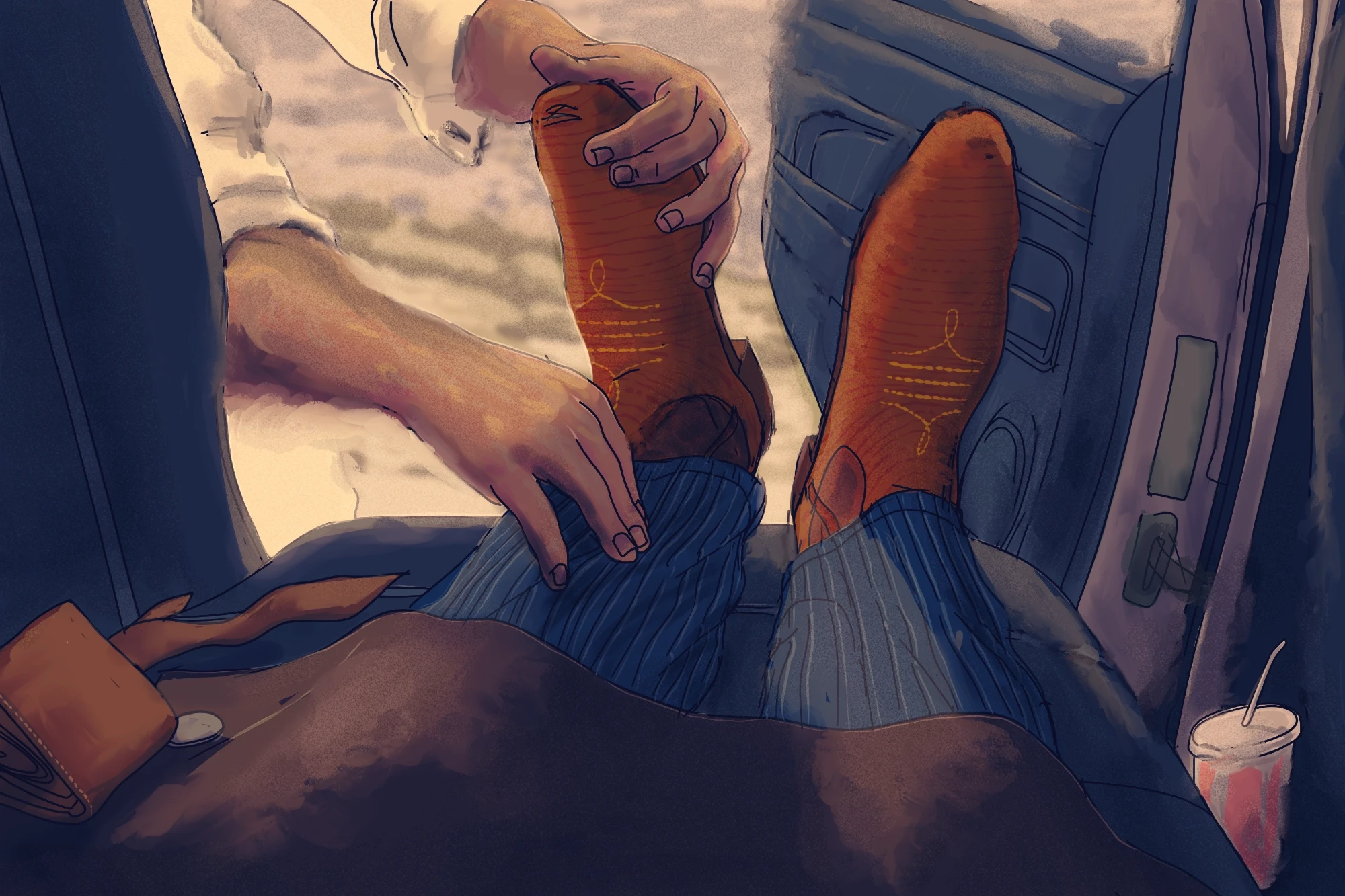
It was just one day after his death that our father’s cremation appointment had us driving across town to the great death processing vending machine, or Twilight Transitions, as they are more commonly known. He rode in the trunk, his body wrapped in linen, with just his shoes sticking out one end as they were so hard to contain.
He died suddenly. “Something wrong with his guts,” the doctors said in a diagnosis five days before. His illness took over quickly, and soon enough he was more illness than anything else. It started with intense sweating that gave way to dehydration. Then came the swollen throat, the stomach pain and then his stone cold death. My brother pulled the blanket over his dull, wide eyed stare and went off to tell mom.
Google maps led to the newer Twilight Transitions facilities, a symmetry of traditional architecture and stone detailing, a romantic mask concealing a strange interior.
We parked in the massive concrete lot on the east side of the facility, our tires rolled silently over the smooth surface. One by one we climbed out—Mom with her swollen eyes and trembling hands, Archie in his school uniform, me still wearing yesterday's wrinkled shirt, and finally, the linen-wrapped body of our father, stiff and awkward in the trunk like some terrible contraband. Together, we hoisted him up, his weight both familiar and alien. Mom supported the midsection, her fingers digging into the fabric as if she could still hold on to him, while Archie and I clutchedhis cold ankles at the end.
We walked like this for a while, occasionally stopping to adjust our grips or rest Dad on our knees. To our relief, a worker came hurrying toward us from the tower, rolling a cart beside her. She kept her eyes on the cart, not on us. "Let me help you with that," she murmured, her voice barely audible over the wheels' soft rolling. "You can place him here." She gestured to the cart, and together, we lifted Dad onto it with a thud.
We rolled Dad along to the glass entrance doors with their metallic trim glinting in the afternoon sun. The Twilight worker thanked us with a rehearsed nod, for reasons I was unsure of. She hurried off with quick steps that echoed like those of a child fleeing into a marbled mansion, leaving us alone with dad in the shadow of the intake’s canopy.
The building inhaled us into its depths like some vast, mute host. No cloying floral scent greeted us inside, just the sharp tang of electricity and the clinical gleam of industrial polish. We stood hesitant like Enlightenment-era body snatchers caught in the sudden flare of a watchman’s lantern.
Then, the worker again, hurrying back toward us with the focused energy of a warehouse floor manager. "Customer intake is at the kiosk," she declared, her voice clipped and technically efficient. She didn't look at our tear-streaked faces; she looked at the bulk of the linen-wrapped body. The worker didn't linger. She slapped a digital adhesive tag onto the heel of Dad's protruding shoe, and checked a handheld tablet, and nodded. "Room 6 is active. Follow the floor-stripes." Before we could say thank you, she was off again, tablet under her arm.
We were left alone in a monochrome white hall with marble floors that reflected our shadows like dark oil. There were no chairs, no tissues, just a series of sleek, touch-sensitive terminals and a pale blue line on the floor guiding us deeper into the machine, which we followed with a confused, hesitant pace, intruding in the deep white silence of the facility. Mom pushed the cart, her knuckles white on the steel handle. That was when Archie noticed the sticker. On it, the number 6 was printed in a thick, black font, with a square QR code below it. The sight of it made my stomach turn. The tag on his shoe had reduced his fifty years of professional life to a single digit in a queue. He wasn't Dad anymore. He was Unit 6, and his time in the machine was about to begin.
We came upon a long hall with a series of gray-blue doors on one side, probably about two dozen of them. After noticing the doors were numbered, and we were by room one, we continued on toward room 6 as it seemed logical enough. Mom stopped us suddenly.
“Are you ready?” she asked, but neither of us had an answer. She assessed us both with wide, worried eyes. “This can be strange, especially for your first time. Just follow me and we will get through it together.”
“Okay, mom,” Archie said while I quietly nodded, looking down the hall.
We continued to the door labeled "6," where Archie turned the knob and pulled it open. There was nothing but darkness until a fluorescent light fluttered on and illuminated that strange room that still torments my mind.
Dad rolled in first on his steel cart. The room was bare, with blue-gray brick walls and a ceiling so high our voices seemed to thin out before they hit the rafters. In the center of the forward wall, waiting for us like a mouth, was a wide, rectangular slot of brushed stainless steel, framed by a series of glowing status lights that flickered from amber to a steady, cold green.
Mom went to investigate its operation, starting with confusion and ending with defeated understanding. “Okay,” Mom said to herself with a sigh. Then she turned to us and said “I’ll need your help lifting him. Won’t be much longer.”
She gave us a concerned look and beckoned for help transferring our father to the cremation tray. Pulling the sheet aside revealed his body again, seeming now somehow shrunken within his clothes, his waxy skin uncanny in death, and for a moment I felt I was standing before a sleeping stranger upon whom we were enacting an elaborate prank.
Mom took his hands and crossed them on his chest like a vampire. She was crying. I hugged her as she picked white lint off Dad's charcoal-gray shirt, her tears darkening the fabric into perfect circles. I didn't want to release my grief then. I wanted to keep pretending dad was just sleeping, his chest unnaturally still beneath the starched cotton. But then I saw Archie crying too, his shoulders heaving silently, and something cracked inside me like thin ice. We all went about doing little things—Mom smoothing Dad's silver-flecked tie, Archie adjusting the cuffs of his jacket, me brushing imaginary dust from his polished oxfords.
He was always a professional man who tried to look sharp every day. Even weekends. I remember once going to Splash Kingdom with him, and he wore that pinstriped suit the whole time, standing ramrod straight beside the wave pool while children shrieked around him—I half expected him to jump into the chlorinated water while still wearing his Windsor-knotted tie. But that was five summers ago, and today he is dead.
At last, my mother pushed the drawer back in with a slow, metallic scrape that seemed to echo through my bones. The silver handle caught the harsh fluorescent light as it slid shut, sealing Dad away like a doll in some macabre collector's windowed trunk. My fingers twitched at my sides, desperate to lunge forward and wrench it open again. I caught the same desperate twitch in my mother's weathered hands—the hands that had once buttoned his shirts and straightened his ties—but the moment had passed. It was done. Her fingertips lingered on the cold steel handle, tracing its contour as if memorizing the last physical connection to him, before she finally released it with a sigh that seemed to deflate her entire body.
Mom turned to a terminal recessed into the wall, its screen casting a sickly blue glow across her grief-hollowed face. Her fingertips trembled as they found the keypad, tapping in a six-digit code that echoed in the sterile air. A moment of silence followed, then we heard intricate mechanisms stirring to life behind the wall like whirring gears, pneumatic hisses, the soft click of locks disengaging. Standing there beside eachother, the three of us regarded the machine like a painting of overlapping abstract shapes we tried in vein to discern. I began to feel cold, despite the warmth radiating from the walls.
Then, with a soft pneumatic sigh like an exhausted mourner, the door opened behind us automatically. The room was asking us to leave. Stepping back into the hallway, we were startled when the machine began to hum as the door sealed shut behind us with a soft hiss.
The hallway seemed longer on the way out, each step echoing with a haunting finality against the polished marble. As we reached the lobby, we were met by a tall man in a crisp white suit. His face was a mask of practiced, placid empathy, the kind you find on the face of a man who sells life insurance or luxury sedans.
“The process has been initiated,” he said, gently and rehearsed. “Your father’s essence is being incorporated into our local ecosystem as we speak. We pride ourselves on total legacy-optimization. Would you like to know how he will continue to serve?”
Mother nodded slightly, her fingers white as she clutched her purse.
He continued, "At Twilight Transitions, we believe in utilizing remains for a greater purpose. Your father's ashes will be processed and divided into various projects that contribute to society. A part of him will be designated as fertilizer, and will nourish local forests and gardens. Another portion will be compressed into our signature structural-units. High-density bricks that are currently being used to construct affordable housing all across the region. Kin Stone, as we call it. In fact, much of this tower was constructed with Kin Stone. Very small portions are also taken for experimental works, such as efforts to create ink or ceramics."
“I see,” our mother said. “Will you tell us… well. Which-”
“Now, that is part of the beauty of our system. We don’t offer specific information on what the ashes will be used for, or where. We typically do not keep records on the path of individual material after it reaches fabrication.”
“Okay, but,” mom started again, looking down at her feet.
“We will send all the property documentation to your address within a week,” the man said, smiling, and placing a hand on mom’s shoulder.
Archie and I craned our necks upward, scanning the vaulted ceiling with its hairline cracks and the smooth, ash-gray walls that seemed to absorb sound rather than reflect it. We searched desperately for some hint of humanity in those compressed remains—a shadow, a texture, anything to suggest the thousands of souls now cemented into this mausoleum. But the walls stared back at us, featureless and sterile, as if the process had bleached away not just bodies but memories too, leaving nothing but cold, efficient architecture built from the pulverized essence of strangers.
"In a sense, he will be everywhere," the man said, as if he were delivering a keynote on urban planning. "We believe this provides a way for your loved ones to remain an active part of the community, even in death. It's a means to ensure their legacy lives on. All of it," he continued. “The Kin-Stone, Kin-Soil, Kin-Clay, and the kin-dust itself. We call it the active-ancestry model.
There was a momentary pause, the reality of what was happening settling in. I thought about the gardens, the houses, the people who would unknowingly be touched by Dad’s essence. It felt strange, yet comforting to think that he'd still be a part of the world, in one form or another.
He handed my mother a small, ornate box with a soft, synthetic glow. “A small token of our gratitude for his contribution,” he whispered. “A way to keep him close while the rest of him goes to work.”
He then guided us to the exit and returned to other business as we left.
We left the monochrome confines of Twilight Transitions, our lungs struggling with air that suddenly felt thick and humid. The world was a shade dimmer than when we had entered, the sunlight bleaching the parking lot into a flat, overexposed gray.
Mom held the pendant between her fingers, the soft glow contrasting starkly with the paleness of her skin. It was a small, quarter-shaped carbon-chip, a synthetic grey diamond encased in a clear acrylic cube with the Twilight logo etched into the side. A serialized souvenir of a transaction. She quietly stared at it, exhausted.
In the parking lot, the vastness of the place was disquieting. As we looked around, we noticed it was mostly empty. Another car parked across the lot, and the same worker who had helped us set out from the building rolling the tray along. A family was gathered at the rear of their car, where the trunk was flipped open. There was a cargo truck parked on the west side of the building, where a worker in a blue jumpsuit was loading crates.
Mom looked at us over with calm eyes that told me nothing as I tried to read them. She glanced around the lot, and at the man loading crates, only to settle on us again looking lost.. She stepped closer and wrapped her arms about us both, drawing us into a clumsy embrace...
Across the lot, the truck’s hydraulic lift-gate began to rise with a mechanical whine. It closed with a sharp, metallic thud that echoed off the stone bricks of the building. We left before the truck, eager to catch a few stops on the way home.
It was just one day after his death that our father’s cremation appointment had us driving across town to the great death processing vending machine, or Twilight Transitions, as they are more commonly known. He rode in the trunk, his body wrapped in linen, with just his shoes sticking out one end as they were so hard to contain.
He died suddenly. “Something wrong with his guts,” the doctors said in a diagnosis five days before. His illness took over quickly, and soon enough he was more illness than anything else. It started with intense sweating that gave way to dehydration. Then came the swollen throat, the stomach pain and then his stone cold death. My brother pulled the blanket over his dull, wide eyed stare and went off to tell mom.
Google maps led to the newer Twilight Transitions facilities, a symmetry of traditional architecture and stone detailing, a romantic mask concealing a strange interior.
We parked in the massive concrete lot on the east side of the facility, our tires rolled silently over the smooth surface. One by one we climbed out—Mom with her swollen eyes and trembling hands, Archie in his school uniform, me still wearing yesterday's wrinkled shirt, and finally, the linen-wrapped body of our father, stiff and awkward in the trunk like some terrible contraband. Together, we hoisted him up, his weight both familiar and alien. Mom supported the midsection, her fingers digging into the fabric as if she could still hold on to him, while Archie and I clutchedhis cold ankles at the end.
We walked like this for a while, occasionally stopping to adjust our grips or rest Dad on our knees. To our relief, a worker came hurrying toward us from the tower, rolling a cart beside her. She kept her eyes on the cart, not on us. "Let me help you with that," she murmured, her voice barely audible over the wheels' soft rolling. "You can place him here." She gestured to the cart, and together, we lifted Dad onto it with a thud.
We rolled Dad along to the glass entrance doors with their metallic trim glinting in the afternoon sun. The Twilight worker thanked us with a rehearsed nod, for reasons I was unsure of. She hurried off with quick steps that echoed like those of a child fleeing into a marbled mansion, leaving us alone with dad in the shadow of the intake’s canopy.
The building inhaled us into its depths like some vast, mute host. No cloying floral scent greeted us inside, just the sharp tang of electricity and the clinical gleam of industrial polish. We stood hesitant like Enlightenment-era body snatchers caught in the sudden flare of a watchman’s lantern.
Then, the worker again, hurrying back toward us with the focused energy of a warehouse floor manager. "Customer intake is at the kiosk," she declared, her voice clipped and technically efficient. She didn't look at our tear-streaked faces; she looked at the bulk of the linen-wrapped body. The worker didn't linger. She slapped a digital adhesive tag onto the heel of Dad's protruding shoe, and checked a handheld tablet, and nodded. "Room 6 is active. Follow the floor-stripes." Before we could say thank you, she was off again, tablet under her arm.
We were left alone in a monochrome white hall with marble floors that reflected our shadows like dark oil. There were no chairs, no tissues, just a series of sleek, touch-sensitive terminals and a pale blue line on the floor guiding us deeper into the machine, which we followed with a confused, hesitant pace, intruding in the deep white silence of the facility. Mom pushed the cart, her knuckles white on the steel handle. That was when Archie noticed the sticker. On it, the number 6 was printed in a thick, black font, with a square QR code below it. The sight of it made my stomach turn. The tag on his shoe had reduced his fifty years of professional life to a single digit in a queue. He wasn't Dad anymore. He was Unit 6, and his time in the machine was about to begin.
We came upon a long hall with a series of gray-blue doors on one side, probably about two dozen of them. After noticing the doors were numbered, and we were by room one, we continued on toward room 6 as it seemed logical enough. Mom stopped us suddenly.
“Are you ready?” she asked, but neither of us had an answer. She assessed us both with wide, worried eyes. “This can be strange, especially for your first time. Just follow me and we will get through it together.”
“Okay, mom,” Archie said while I quietly nodded, looking down the hall.
We continued to the door labeled "6," where Archie turned the knob and pulled it open. There was nothing but darkness until a fluorescent light fluttered on and illuminated that strange room that still torments my mind.
Dad rolled in first on his steel cart. The room was bare, with blue-gray brick walls and a ceiling so high our voices seemed to thin out before they hit the rafters. In the center of the forward wall, waiting for us like a mouth, was a wide, rectangular slot of brushed stainless steel, framed by a series of glowing status lights that flickered from amber to a steady, cold green.
Mom went to investigate its operation, starting with confusion and ending with defeated understanding. “Okay,” Mom said to herself with a sigh. Then she turned to us and said “I’ll need your help lifting him. Won’t be much longer.”
She gave us a concerned look and beckoned for help transferring our father to the cremation tray. Pulling the sheet aside revealed his body again, seeming now somehow shrunken within his clothes, his waxy skin uncanny in death, and for a moment I felt I was standing before a sleeping stranger upon whom we were enacting an elaborate prank.
Mom took his hands and crossed them on his chest like a vampire. She was crying. I hugged her as she picked white lint off Dad's charcoal-gray shirt, her tears darkening the fabric into perfect circles. I didn't want to release my grief then. I wanted to keep pretending dad was just sleeping, his chest unnaturally still beneath the starched cotton. But then I saw Archie crying too, his shoulders heaving silently, and something cracked inside me like thin ice. We all went about doing little things—Mom smoothing Dad's silver-flecked tie, Archie adjusting the cuffs of his jacket, me brushing imaginary dust from his polished oxfords.
He was always a professional man who tried to look sharp every day. Even weekends. I remember once going to Splash Kingdom with him, and he wore that pinstriped suit the whole time, standing ramrod straight beside the wave pool while children shrieked around him—I half expected him to jump into the chlorinated water while still wearing his Windsor-knotted tie. But that was five summers ago, and today he is dead.
At last, my mother pushed the drawer back in with a slow, metallic scrape that seemed to echo through my bones. The silver handle caught the harsh fluorescent light as it slid shut, sealing Dad away like a doll in some macabre collector's windowed trunk. My fingers twitched at my sides, desperate to lunge forward and wrench it open again. I caught the same desperate twitch in my mother's weathered hands—the hands that had once buttoned his shirts and straightened his ties—but the moment had passed. It was done. Her fingertips lingered on the cold steel handle, tracing its contour as if memorizing the last physical connection to him, before she finally released it with a sigh that seemed to deflate her entire body.
Mom turned to a terminal recessed into the wall, its screen casting a sickly blue glow across her grief-hollowed face. Her fingertips trembled as they found the keypad, tapping in a six-digit code that echoed in the sterile air. A moment of silence followed, then we heard intricate mechanisms stirring to life behind the wall like whirring gears, pneumatic hisses, the soft click of locks disengaging. Standing there beside eachother, the three of us regarded the machine like a painting of overlapping abstract shapes we tried in vein to discern. I began to feel cold, despite the warmth radiating from the walls.
Then, with a soft pneumatic sigh like an exhausted mourner, the door opened behind us automatically. The room was asking us to leave. Stepping back into the hallway, we were startled when the machine began to hum as the door sealed shut behind us with a soft hiss.
The hallway seemed longer on the way out, each step echoing with a haunting finality against the polished marble. As we reached the lobby, we were met by a tall man in a crisp white suit. His face was a mask of practiced, placid empathy, the kind you find on the face of a man who sells life insurance or luxury sedans.
“The process has been initiated,” he said, gently and rehearsed. “Your father’s essence is being incorporated into our local ecosystem as we speak. We pride ourselves on total legacy-optimization. Would you like to know how he will continue to serve?”
Mother nodded slightly, her fingers white as she clutched her purse.
He continued, "At Twilight Transitions, we believe in utilizing remains for a greater purpose. Your father's ashes will be processed and divided into various projects that contribute to society. A part of him will be designated as fertilizer, and will nourish local forests and gardens. Another portion will be compressed into our signature structural-units. High-density bricks that are currently being used to construct affordable housing all across the region. Kin Stone, as we call it. In fact, much of this tower was constructed with Kin Stone. Very small portions are also taken for experimental works, such as efforts to create ink or ceramics."
“I see,” our mother said. “Will you tell us… well. Which-”
“Now, that is part of the beauty of our system. We don’t offer specific information on what the ashes will be used for, or where. We typically do not keep records on the path of individual material after it reaches fabrication.”
“Okay, but,” mom started again, looking down at her feet.
“We will send all the property documentation to your address within a week,” the man said, smiling, and placing a hand on mom’s shoulder.
Archie and I craned our necks upward, scanning the vaulted ceiling with its hairline cracks and the smooth, ash-gray walls that seemed to absorb sound rather than reflect it. We searched desperately for some hint of humanity in those compressed remains—a shadow, a texture, anything to suggest the thousands of souls now cemented into this mausoleum. But the walls stared back at us, featureless and sterile, as if the process had bleached away not just bodies but memories too, leaving nothing but cold, efficient architecture built from the pulverized essence of strangers.
"In a sense, he will be everywhere," the man said, as if he were delivering a keynote on urban planning. "We believe this provides a way for your loved ones to remain an active part of the community, even in death. It's a means to ensure their legacy lives on. All of it," he continued. “The Kin-Stone, Kin-Soil, Kin-Clay, and the kin-dust itself. We call it the active-ancestry model.
There was a momentary pause, the reality of what was happening settling in. I thought about the gardens, the houses, the people who would unknowingly be touched by Dad’s essence. It felt strange, yet comforting to think that he'd still be a part of the world, in one form or another.
He handed my mother a small, ornate box with a soft, synthetic glow. “A small token of our gratitude for his contribution,” he whispered. “A way to keep him close while the rest of him goes to work.”
He then guided us to the exit and returned to other business as we left.
We left the monochrome confines of Twilight Transitions, our lungs struggling with air that suddenly felt thick and humid. The world was a shade dimmer than when we had entered, the sunlight bleaching the parking lot into a flat, overexposed gray.
Mom held the pendant between her fingers, the soft glow contrasting starkly with the paleness of her skin. It was a small, quarter-shaped carbon-chip, a synthetic grey diamond encased in a clear acrylic cube with the Twilight logo etched into the side. A serialized souvenir of a transaction. She quietly stared at it, exhausted.
In the parking lot, the vastness of the place was disquieting. As we looked around, we noticed it was mostly empty. Another car parked across the lot, and the same worker who had helped us set out from the building rolling the tray along. A family was gathered at the rear of their car, where the trunk was flipped open. There was a cargo truck parked on the west side of the building, where a worker in a blue jumpsuit was loading crates.
Mom looked at us over with calm eyes that told me nothing as I tried to read them. She glanced around the lot, and at the man loading crates, only to settle on us again looking lost.. She stepped closer and wrapped her arms about us both, drawing us into a clumsy embrace...
Across the lot, the truck’s hydraulic lift-gate began to rise with a mechanical whine. It closed with a sharp, metallic thud that echoed off the stone bricks of the building. We left before the truck, eager to catch a few stops on the way home.