Essay,
Hoisting Lethem’s banner from the field, James Machell hearkens to postmodernist writers who gave us great works of science fiction and yet never bothered with fitting the genre’s mold. What would SF have come to resemble if popular acclaim veered us away from nostalgia?
A joke:
Q: When does a science fiction novel become postmodern?
A: When it’s good!
“Few of these books make any mention of spaceships,” says Michael Moorcock, describing the best works SF has yet produced for The Guardian. They “have an immediate soporific effect.” He lists only two of his contemporaries who could reliably produce works of quality SF: Brian Aldiss and J. G. Ballard. Like him, Moorcock says, “they were raised in an essentially post-modernist world and found in SF a way of describing specific experience.”
When I studied J. G. Ballard at university, the term science fiction didn’t come up, despite his series of disaster novels, despite his stories set on other planets, despite his contributions to New Worlds and association with the New Wave. Ballard was a postmodernist, at least in academic terms, and it was a sin to mention The Atrocity Exhibition in the same breath as Star Trek.
If we examine the DNA of his fix-up and this TV series, however, we discover that they are the product of divergent evolution. There were the golden and silver ages of SF (robots, intergalactic empires, future histories, etc) which provided soil for both Ballard and Gene Roddenberry to grow their roots. Ballard inverted genre stereotypes by fixing up sordid vignettes into a Rabelaisian near-future, bereft of optimism and fixated with the past, while Star Trek held more closely to its mother in order to hook the mainstream with nostalgia and thread its progressiveness with subtlety.
This was the ‘60s. ‘70s SF was marked by further literary experimentation, feminist and postcolonial narratives, and the smashing of moral taboos—Samuel R. Delany’s Dhalgren, Joanna Russ’s The Female Man, and Michael Moorcock’s Dancers at the End of Time to give just a few examples. Thomas Pynchon’s Gravity’s Rainbow, an alternate history in which a soldier’s penis develops a telekinetic relationship with the bombs hitting London during the Blitz, was perhaps the key work of postmodernism during this era. Like Dhalgren, which depicts polyamorous gangs in a time loop, Gravity’s Rainbow was influenced by both classic SF and James Joyce’s Ulysses.
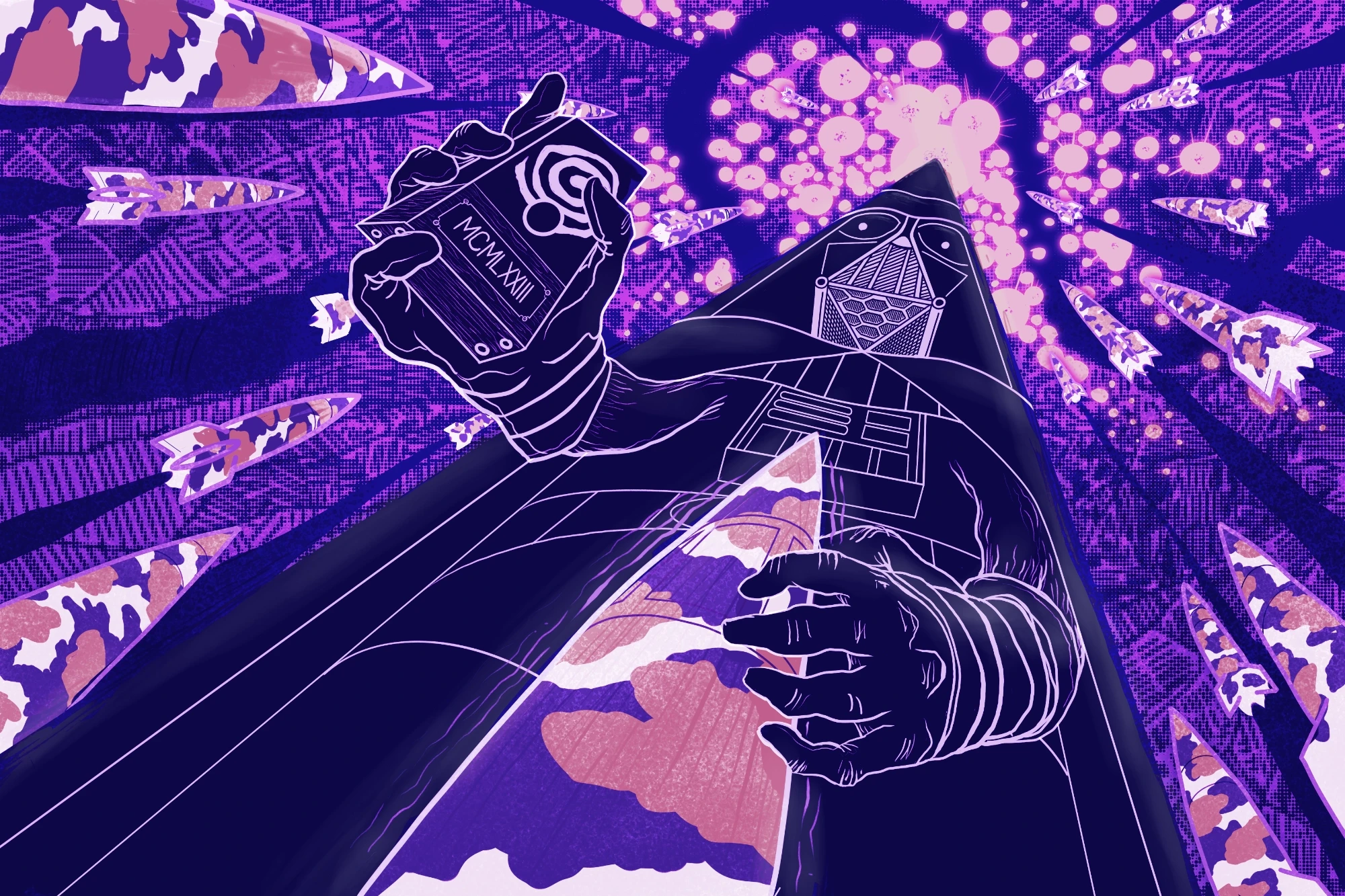
These works gave weight to the notion that two evolutionary branches, on separate genre trees, were on the verge of meeting. When their fruit fell, no one could be sure which supplied the filling for their pies. Then Luke Skywalker picked up his lightsabre and swinging wildly at Darth Vader, shaved the tips off both branches.
For Jonathan Lethem, Star Wars dashed his hope that the two genres would merge and instead of Kurt Vonnegut’s Slaughterhouse-Five and Flash Gordon being grouped together, the latter would be in the adventure category. Lethem lists Thomas Pynchon, Don DeLillo, Angela Carter, and Donald Barthelme among the greatest writers of his lifetime as well as Samuel R. Delany, Ursula K. Le Guin, Philip K. Dick and Thomas Disch. Notice how these authors all flirt with the surreal and the fantastic but are kept separate. What’s the key distinction between them, besides where they were first published? To my mind, it is the genealogy of the texts. Pynchon incorporates speculative elements into an encyclopedic novel while Dick imbues pulpy SF paperbacks with unreliable narration and existential doubt.
“The covers,” says Lethem. They’re “fucking ugly.”
Not only ugly, he elaborates. “All ugly in the same way.” He blames the inability to distinguish between SF books for children and SF books for adults on two villains, George Lucas and Steven Spielberg, who brought SF into the mainstream with the result of turning an “eccentric publishing niche” into a “cartoonified, castrated, and deeply nostalgic version” of itself. “Out with the hippie-surrealist book jackets of the '60s, with their promise of grown-up abstractions and ambiguities,” Lethem adds. He notes that the shift in culture even affected Vonnegut “who in dodging the indignities of the SF label apparently renounced the iconographic fuel that fed his best work.” Oh, the sacrifices one makes to be loved! (If anyone seeks empirical evidence of the decline in cover art, compare the original front of Isaac Asimov’s The Caves of Steel, the first novel in the Robot series, to Robots and Empire, the last. It looks as if someone got carried away on PowerPoint.)
Perhaps SF should have raised its shield before its characters became McDonalds’ toys? Lethem refers to the 1973 Nebula Awards as the great missed opportunity. Gravity’s Rainbow and Arthur C. Clarke’s Rendezvous with Rama were contenders for best novel. I have read and enjoyed both and while Clarke’s novel introduces scientific concepts, personally unconceived of, Pynchon took me on a journey of paranoia and self-reflection. (Probably not a good sign that I find myself relating to its characters). Clarke, however, was an icon so the award went to him and SF failed to recognise a landmark in speculative fiction or merge with the (highbrow) mainstream.
The question I’d like to pose to Lethem is, was this such a terrible thing?
There is a fascinating interview conducted in 1982 with Isaac Asimov, Harlan Ellison, and Gene Wolfe in which they discuss their relationship with the term, science fiction. Isaac Asimov, unsurprisingly, enjoys being part of the club, Gene Wolfe describes himself as a writer of science fantasy, and Harlan Ellison rejects it completely. He views himself as following in the steps of Franz Kafka and Dante. To him, the label, which connotes ray guns and princesses in gold bikinis, was an insult to serious speculative writing, a barrier to the modern-day Kafka.
SF, however, continues to be a space for outsiders. The plurality of magazines creates an access point for all kinds of writers and gives publishers the chance to experiment with new work without committing to promoting a novel. (I wonder if Ulysses would ever have reached renown or even completion without Ezra Pound to serialise it in The Egoist.) It is unsurprising therefore that concepts, such as gender fluidity, entered SF’s literary hemisphere before migrating into the mainstream. The trend for admittedly tacky book covers provides an extra opportunity for writing to be subversive, to defy expectations, to hit a broad audience.
When I bought a second hand copy of Samuel R. Delany’s Driftglass/Starshards, there was a handwritten note on the inside. It read, “Happy 17th Birthday Daniel. The award this chap won is the same that Orson Scott Card got so it should be good. Love Adrian.” This double-collection of short stories contains “Aye, and Gomorrah” which explores the sexuality of the asexual as well as “Night and the Loves of Joe Dicostanzo,” dripping in homoeroticism. These stories might never have reached young Adrian if not for Ender’s Game. I quite like that although SF may hit a certain kind of reader, it is also able to combine escapism with transgression.
SF’s regression into nostalgia may have started in Hollywood but it has been cemented by universities. Lethem notes that “bitter over a lack of access to the ivory tower, SF took a step backward, away from its broadest literary aspirations.” This is especially disappointing, given SF has limitless scope to challenge the morality of the present with a speculative get-out clause. (Theodore Sturgeon was able to explore sexual taboos by setting his “If All Men Were Brothers, Would You Let One Marry Your Sister” on another planet.)
However, it was the humanities, rather than George Lucas, which shut its doors to SF, allowing only a few trespassers: Vonnegut, Ballard, sometimes Dick, and Margaret Atwood (if you put her in the same club). William S. Burroughs, despite his time travel, alien invaders, and wars between sexes, will always be a Beat. Many of today’s serious readers will have studied English literature. Perhaps if students were aware that their Cat’s Cradle, which they found funny, was a work of SF, they might pick up an Eric Frank Russell next.
When I received a copy of William Gibson’s Neuromancer, I didn’t read it. “Console cowboys” and “hacking” didn’t intrigue me as I fed on Proust and Goethe. The irony was that I was quite happy to read Don DeLillo’s White Noise, despite its futuristic disaster and SF drug to treat the fear of death, because it was presented to me as postmodern. It took some time to recognise that Gibson was every bit as political as DeLillo, and arguably more prescient. It’s not clear to me either that Star Wars scared the humanities away from SF. I don’t think that universities appreciated SF’s rapid ascension from stories for children to a serious artform, often indistinguishable from postmodern. Doris Lessing was accused of abandoning her feminism and politics by undertaking her Canopus in Argos: Archives space opera sequence.
The remedy here is to recognise the presence and significance of SF in courses not specifically aimed at explorations of genre fiction. Angela Carter’s early work was collected in Best SF: 1974, edited by Brain Aldiss and Harry Harrison. John Clute puts it nicely in The Encyclopedia of Science Fiction where he writes that her later work continues to be “characterized by an expressionist freedom of reference to everyday ‘reality.’” It is similarly difficult to analyse the later works of Vonnegut and Ballard without the context of their genre routes. Clute discusses Ballard’s last novel, Kingdom Come, on the SFE Substack and “the uncanny accuracy of its vision of Brexit Britain, with St George flags revealing themselves as assaults not celebrations.” “Though the novel is not sf,” he elaborates, “Ballard is deeply about what sf might have properly aspired to address back then.”
I’m happy for books to keep their gaudy covers provided they are not dismissed on those grounds. Gravity’s Rainbow winning the Nebula might still have been a pivotal step, removing the prejudices readers of either genre may have for the other.
Note: J. G. Ballard’s The Atrocity Exhibition was published as a fix-up in 1970. Stories within it became available between 1966 and 1969. It is therefore presented as a work of the ‘60s.
A joke:
Q: When does a science fiction novel become postmodern?
A: When it’s good!
“Few of these books make any mention of spaceships,” says Michael Moorcock, describing the best works SF has yet produced for The Guardian. They “have an immediate soporific effect.” He lists only two of his contemporaries who could reliably produce works of quality SF: Brian Aldiss and J. G. Ballard. Like him, Moorcock says, “they were raised in an essentially post-modernist world and found in SF a way of describing specific experience.”
When I studied J. G. Ballard at university, the term science fiction didn’t come up, despite his series of disaster novels, despite his stories set on other planets, despite his contributions to New Worlds and association with the New Wave. Ballard was a postmodernist, at least in academic terms, and it was a sin to mention The Atrocity Exhibition in the same breath as Star Trek.
If we examine the DNA of his fix-up and this TV series, however, we discover that they are the product of divergent evolution. There were the golden and silver ages of SF (robots, intergalactic empires, future histories, etc) which provided soil for both Ballard and Gene Roddenberry to grow their roots. Ballard inverted genre stereotypes by fixing up sordid vignettes into a Rabelaisian near-future, bereft of optimism and fixated with the past, while Star Trek held more closely to its mother in order to hook the mainstream with nostalgia and thread its progressiveness with subtlety.
This was the ‘60s. ‘70s SF was marked by further literary experimentation, feminist and postcolonial narratives, and the smashing of moral taboos—Samuel R. Delany’s Dhalgren, Joanna Russ’s The Female Man, and Michael Moorcock’s Dancers at the End of Time to give just a few examples. Thomas Pynchon’s Gravity’s Rainbow, an alternate history in which a soldier’s penis develops a telekinetic relationship with the bombs hitting London during the Blitz, was perhaps the key work of postmodernism during this era. Like Dhalgren, which depicts polyamorous gangs in a time loop, Gravity’s Rainbow was influenced by both classic SF and James Joyce’s Ulysses.
These works gave weight to the notion that two evolutionary branches, on separate genre trees, were on the verge of meeting. When their fruit fell, no one could be sure which supplied the filling for their pies. Then Luke Skywalker picked up his lightsabre and swinging wildly at Darth Vader, shaved the tips off both branches.
For Jonathan Lethem, Star Wars dashed his hope that the two genres would merge and instead of Kurt Vonnegut’s Slaughterhouse-Five and Flash Gordon being grouped together, the latter would be in the adventure category. Lethem lists Thomas Pynchon, Don DeLillo, Angela Carter, and Donald Barthelme among the greatest writers of his lifetime as well as Samuel R. Delany, Ursula K. Le Guin, Philip K. Dick and Thomas Disch. Notice how these authors all flirt with the surreal and the fantastic but are kept separate. What’s the key distinction between them, besides where they were first published? To my mind, it is the genealogy of the texts. Pynchon incorporates speculative elements into an encyclopedic novel while Dick imbues pulpy SF paperbacks with unreliable narration and existential doubt.
“The covers,” says Lethem. They’re “fucking ugly.”
Not only ugly, he elaborates. “All ugly in the same way.” He blames the inability to distinguish between SF books for children and SF books for adults on two villains, George Lucas and Steven Spielberg, who brought SF into the mainstream with the result of turning an “eccentric publishing niche” into a “cartoonified, castrated, and deeply nostalgic version” of itself. “Out with the hippie-surrealist book jackets of the '60s, with their promise of grown-up abstractions and ambiguities,” Lethem adds. He notes that the shift in culture even affected Vonnegut “who in dodging the indignities of the SF label apparently renounced the iconographic fuel that fed his best work.” Oh, the sacrifices one makes to be loved! (If anyone seeks empirical evidence of the decline in cover art, compare the original front of Isaac Asimov’s The Caves of Steel, the first novel in the Robot series, to Robots and Empire, the last. It looks as if someone got carried away on PowerPoint.)
Perhaps SF should have raised its shield before its characters became McDonalds’ toys? Lethem refers to the 1973 Nebula Awards as the great missed opportunity. Gravity’s Rainbow and Arthur C. Clarke’s Rendezvous with Rama were contenders for best novel. I have read and enjoyed both and while Clarke’s novel introduces scientific concepts, personally unconceived of, Pynchon took me on a journey of paranoia and self-reflection. (Probably not a good sign that I find myself relating to its characters). Clarke, however, was an icon so the award went to him and SF failed to recognise a landmark in speculative fiction or merge with the (highbrow) mainstream.
The question I’d like to pose to Lethem is, was this such a terrible thing?
There is a fascinating interview conducted in 1982 with Isaac Asimov, Harlan Ellison, and Gene Wolfe in which they discuss their relationship with the term, science fiction. Isaac Asimov, unsurprisingly, enjoys being part of the club, Gene Wolfe describes himself as a writer of science fantasy, and Harlan Ellison rejects it completely. He views himself as following in the steps of Franz Kafka and Dante. To him, the label, which connotes ray guns and princesses in gold bikinis, was an insult to serious speculative writing, a barrier to the modern-day Kafka.
SF, however, continues to be a space for outsiders. The plurality of magazines creates an access point for all kinds of writers and gives publishers the chance to experiment with new work without committing to promoting a novel. (I wonder if Ulysses would ever have reached renown or even completion without Ezra Pound to serialise it in The Egoist.) It is unsurprising therefore that concepts, such as gender fluidity, entered SF’s literary hemisphere before migrating into the mainstream. The trend for admittedly tacky book covers provides an extra opportunity for writing to be subversive, to defy expectations, to hit a broad audience.
When I bought a second hand copy of Samuel R. Delany’s Driftglass/Starshards, there was a handwritten note on the inside. It read, “Happy 17th Birthday Daniel. The award this chap won is the same that Orson Scott Card got so it should be good. Love Adrian.” This double-collection of short stories contains “Aye, and Gomorrah” which explores the sexuality of the asexual as well as “Night and the Loves of Joe Dicostanzo,” dripping in homoeroticism. These stories might never have reached young Adrian if not for Ender’s Game. I quite like that although SF may hit a certain kind of reader, it is also able to combine escapism with transgression.
SF’s regression into nostalgia may have started in Hollywood but it has been cemented by universities. Lethem notes that “bitter over a lack of access to the ivory tower, SF took a step backward, away from its broadest literary aspirations.” This is especially disappointing, given SF has limitless scope to challenge the morality of the present with a speculative get-out clause. (Theodore Sturgeon was able to explore sexual taboos by setting his “If All Men Were Brothers, Would You Let One Marry Your Sister” on another planet.)
However, it was the humanities, rather than George Lucas, which shut its doors to SF, allowing only a few trespassers: Vonnegut, Ballard, sometimes Dick, and Margaret Atwood (if you put her in the same club). William S. Burroughs, despite his time travel, alien invaders, and wars between sexes, will always be a Beat. Many of today’s serious readers will have studied English literature. Perhaps if students were aware that their Cat’s Cradle, which they found funny, was a work of SF, they might pick up an Eric Frank Russell next.
When I received a copy of William Gibson’s Neuromancer, I didn’t read it. “Console cowboys” and “hacking” didn’t intrigue me as I fed on Proust and Goethe. The irony was that I was quite happy to read Don DeLillo’s White Noise, despite its futuristic disaster and SF drug to treat the fear of death, because it was presented to me as postmodern. It took some time to recognise that Gibson was every bit as political as DeLillo, and arguably more prescient. It’s not clear to me either that Star Wars scared the humanities away from SF. I don’t think that universities appreciated SF’s rapid ascension from stories for children to a serious artform, often indistinguishable from postmodern. Doris Lessing was accused of abandoning her feminism and politics by undertaking her Canopus in Argos: Archives space opera sequence.
The remedy here is to recognise the presence and significance of SF in courses not specifically aimed at explorations of genre fiction. Angela Carter’s early work was collected in Best SF: 1974, edited by Brain Aldiss and Harry Harrison. John Clute puts it nicely in The Encyclopedia of Science Fiction where he writes that her later work continues to be “characterized by an expressionist freedom of reference to everyday ‘reality.’” It is similarly difficult to analyse the later works of Vonnegut and Ballard without the context of their genre routes. Clute discusses Ballard’s last novel, Kingdom Come, on the SFE Substack and “the uncanny accuracy of its vision of Brexit Britain, with St George flags revealing themselves as assaults not celebrations.” “Though the novel is not sf,” he elaborates, “Ballard is deeply about what sf might have properly aspired to address back then.”
I’m happy for books to keep their gaudy covers provided they are not dismissed on those grounds. Gravity’s Rainbow winning the Nebula might still have been a pivotal step, removing the prejudices readers of either genre may have for the other.
Note: J. G. Ballard’s The Atrocity Exhibition was published as a fix-up in 1970. Stories within it became available between 1966 and 1969. It is therefore presented as a work of the ‘60s.