Fiction,
Yasmeen Amro returns with a story about a family holding together between swings of light and darkness.
“Do you know what happened here, Khadija?” My grandmother asks, tea-stained smile backlit by the permanently setting sun and all its colors. I lean forwards as much as I dare, and peer into the crater that carves a pit into the red rock. Turning back to her, I shake my head.
Her smile widens, almost maniacally, and she claps her hands together and flips them over, dropping to mid-navel.
“This is where the American station fell out of orbit.” My cousin, Nabila, steps in, white veil covering her, catching the orange and purple of the sunset with its reflective fabric. “In the war times, it tore a hole into the planet. Now the place is uninhabitable, as the nuclear core from the station’s reactor contaminated the area.”
“Do they not teach you about other planets back in the colonies?” My grandma chuckles at my cluelessness.
“They do.” I struggle to phrase correctly in Arabic, “I’ve just been taught that this is a natural…” I forget the words, so I gesture with my hands. “Landform,” I say in English, forming a fist with my hand and pummeling it into my empty palm. “When an asteroid hit.”
My grandmother shakes her head, and points back to the pulverized ground. “This isn’t natural.”
This is common knowledge in these parts, but since I’m from off-world, all I remember about Trappist- 1d is its scientific name, and that it’s colloquially known as Nabati here. There’s less water here than on Trappist-1e, where I’m from. The climate’s hotter, and there’s a smaller portion of settled land because of the lack of resources in other parts.
I’m only visiting, as I just graduated from a colony school with a degree in xenobiological sciences. When I told Nabila what I majored in she got excited and shared that she was one year away from getting her degree in geobiology. She said that we could survey together and add to the ever-expanding catalogue of newly discovered plant and animal species.
The idea of it did interest me. Only, I was burnt out from school and found that I had a deep-seeded hatred for the indifference of the natural world. For its propensity to multiply and multiply mindlessly with no other purpose but to keep pushing on. I had struggled earlier with a fungal infestation in my college dormitory that left the walls covered with a pink slimy substance. As the sludge expanded to the floor and my bed, I fought against unwillingly becoming part of the cycle of decay with antifungals and powerwashing, fearful that one day I’d wake up colonized, back encrusted with pink fungal projections, body repurposed by the will of some biological entity that straddles the line between living and non-living. It scared me, the thought that I was nothing to this planet but another host for parasitic growth.
“The crash site will be safe for humans in about a thousand years.” Nabila’s voice comes lightly, like she’s about to laugh. “Do you want to go down and take samples then?”
-
Adjustment here was hard at first. The reality of a tidally locked planet sank in early on. On one side of the planet, the sun never sets. On the other, the sun never rises. There are more moons in the night sky than I’m used to. Back home, we lived in compounds that would fake night and day. Here, we have to endure the sun forever. Back home, the false moon would greet us every state-sanctioned night, glimmering high in the forcefield dome. Trappist-1e had more natural moons than the single one projected, but I guess it felt more like home. Like Earth. A planet I have no memory of because I’ve never known it outside of maps of its surface and enormous biological catalogues. Of maps of encroaching wildlife, flora swallowing whole the abandoned infrastructure that were once bustling cities.
Earth knew night and day as cycles. Here, we can only travel between them as places.
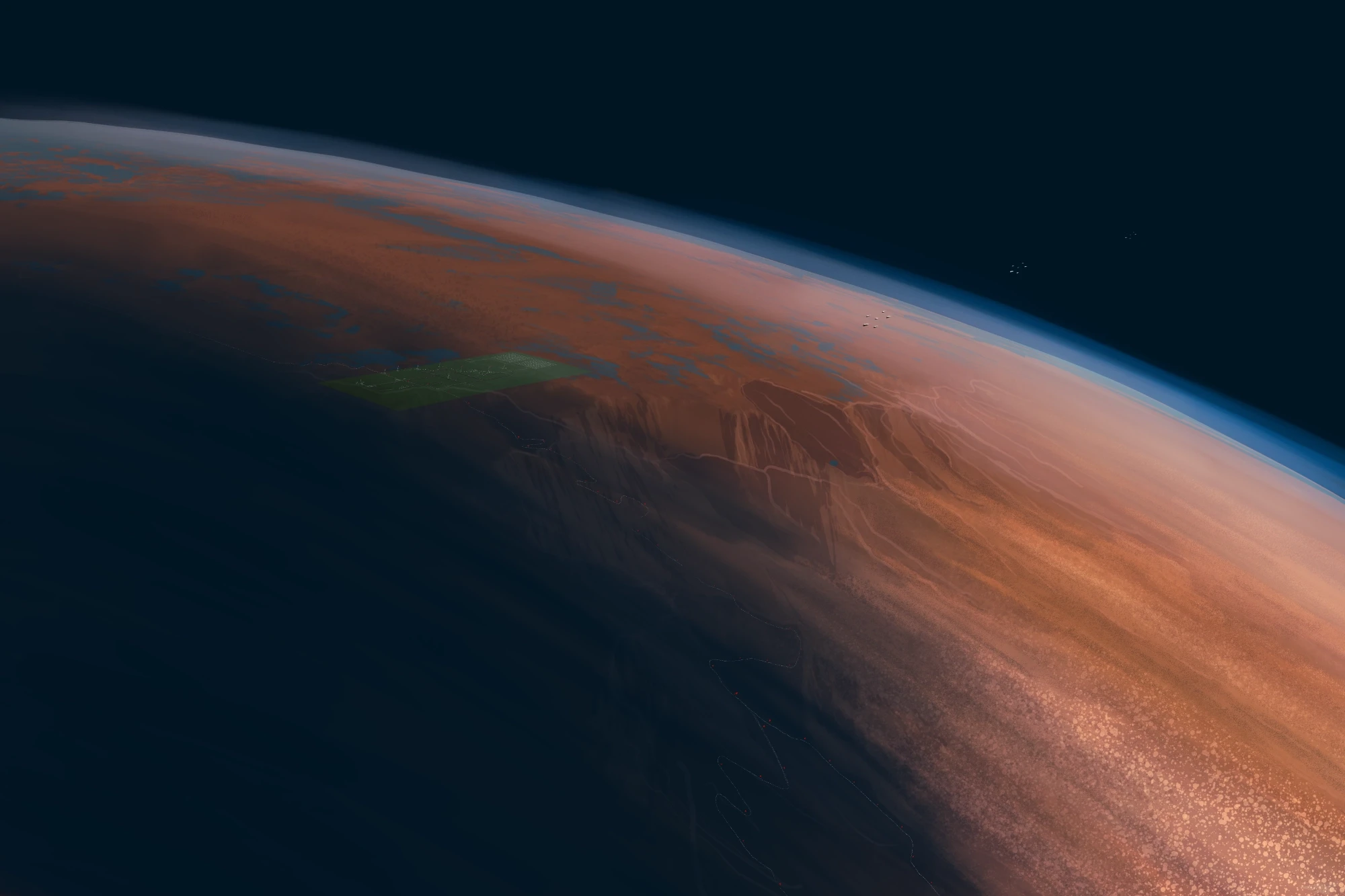
There’s a line running across the planet that separates the inhabitable from the uninhabitable. Nicknamed the terminator line, it draws the border of the frozen tundra suspended in darkness where the planet’s rotation is locked, and the searing wasteland where the sun never relents.
I’ve landed in the middle of it. Even this habitable region is sectioned out into zones. We’re in the middle zone of the populated portion, canyons and deserts, arid climate but not hot enough to kill us all. My family’s been pushed out of the greener upper portion of the region. That’s where the new settlers land to occupy the greenlands. A mix of grassy hills and groves of fatty, pulpy fruit. A soothing arm of the blue sea cools where the water meets the coastline. There’s life and relief and plenty to eat. That’s the part we could have shared with them if interplanetary regulations were kinder to us. Below us, there’s oil and other natural resources. But that’s all U.S. territory. The land’s been scorched as a deterrent and as a form as pesticide. Every few cycles, between harvests, they set the place ablaze while they’re gone, skeleton crew of androids serving as armed guards.
“Jahannam naar” is what Nabila calls it. Hellfire.
So, what am I to do with hell below me and paradise above? I explore the parts I’m allowed in. I pick at the splintered clay of the ground, ignoring the sun at my back and the bodies of Trappist-1d’s planetary siblings following me, suspended in the sky, lacking the color that night brings them.
Nabila and I pick wildflowers and other flora that emerge from the cracks in the ground. We press them, labeling and then slipping them into the laminated sheets of the binder we’ve filled with plant specimens.
Nabila tells me about their uses; some are fever reducers when brewed into a tea, others are poisonous when consumed but can be crushed down into a dye powder. There’s a family of flower species whose seeds can be ground to a hallucinogenic dust. Some have no use at all but are nice to look at. Sometimes natural things don’t have to do anything for us but be pleasing to the eye. Sometimes we don’t have to take.
When the desert cools enough for us to wander further, we press our probes into the cracked ground. This place used to be underwater, Nabila tells me, and it should still hold some vestiges of its submerged state. She says she’s studied it in school, a geobiological phenomenon known as shimmering. The world is talking to us, she says. We just don’t know what it’s saying or how to answer.
Nabila’s got the control panel in her lap, splaying dirt over the grey canvas of her athletic abaya. She programs a series of electric bursts, shocking whatever our probes dig into. For something as large as Nabila’s described, this should only feel like a gentle tap. Like a gnat landing on its arm.
We wait, as the sun burns into us, for a response. A glowing pulse of light envelops my shadow, and traces it around my cross-legged form. Nabila laughs, splaying her hands out on the ridges of the ground as brightness swells around.
“What is that?” I ask.
Nabila shakes her head. “We’re not sure. It’s been mapped out as a path of sensitive tissue. Might not even be that. During the war, there were talks about researching how to weaponize it, but they never got anywhere. No one really understands it.”
“But you do?”
“It knows me,” she says, “and I’ll teach it to know you, too.”
I nod my head and swallow dryly. A giant electrochemical phenomenon has befriended my cousin, and she’s offering to acquaint me with it.
“Sure.” I say, completely butchering the next sentence because my Arabic is not quite there yet. It’s what I can remember from an old poem, about some deep-seated connection to the earth, and the longingness life has for its own. “I’m sure the ground longs for me to walk it, to get to know me. And I will know it too.”
-
What would naturally be an entire moon cycle later, I find myself in the body of a helicopter. My other cousin Khadir, Nabila’s brother, gave airborne tours for colony tourists who came into the area and had offered me a ride.
I hug the railing, laser-focused on the ever-shrinking shapes of the landscape below me. I can’t trace a path through it. Nothing is familiar. No landmarks.
The windows are open, and sand finds its way in, kicked up by the swirling copter blades.
I hate helicopters. They remind me of a species of insect I studied during my undergrad. Bioluminescent, twin fans of wings spreading out, twisting, and twirling to create lift. Its body glows, dimming, and brightening in patterns that may be the basis of bug communication within the species.
They’re beautiful creatures. I don’t hate them for their morphology. It’s their chemistry that troubles me. The active ingredient in their bright display? Luciferin. This compound has been synthesized and powdered down. It’s well known. It’s universal. It’s been sealed off in the earth archives. We’ve known about it long before ever making contact with this family of planets. Let alone this certain species of insect. Luciferin is a compound well known to earth-originating biology. The stuff from earth matches the chemical formula and structure of the luciferin found in the alien bugs.
Something about that is deeply unsettling. Two unrelated organisms, arising from two different worlds, formed from two separate one-in-a-trillion-trillion life-starting events, in the light of two separate suns that could not be more different. And they both share vital chemistry.
There’s an uncomfortable buffeting in my ears, even under the plush of my headset, dark and clunky and so outdated I wouldn’t be surprised if Khadir told me it had survived the new-world war.
Maybe they shielded the ears of a Yankee, circling their rounds over what used to be my people’s land. They’s relieve this vessel of its cargo; desperate to see the satisfaction in the starburst they’d struck a match to. And this very headset might have carried their voice to command; “Bullseye…bullseye…bullseye.” Then the wind would kick up and they’d lurch this machine forwards, blades working at double the pace to lift them up and away from the target zone. Maybe they’d look down, past the fireworks, and onto the greenery caving in on itself as the blast rocks yet another crater into the planet.
Maybe that Yankee never anticipated that one of the descendants of those they swore to their superiors they’d sufficiently flattened would don their headset and swing her legs into the belly of this heavy machinery. Into this very same war machine. A war machine turned lookout. Peaceful, doing nothing to harm the planet or its inhabitants more than rearrange clouds of dust and sand. And my flying-over this landscape has no nefarious purpose. I’m not looking for a tactical advantage. I’m not searching for survivors afoot, sniper canted forwards and out of the opposite window, squinting into their rifle. I’m trying to kickstart a rush of endorphins. To mess my hair and scream from up so high no one can hear me, not even the pilot because the wind and the blades are so loud, I can’t produce enough noise to matter to this system.
That’s the kind of duality I still struggle to understand. The helicopter shares homologies on either side of the war. Whether used for joyrides in times of peace or in the midst of the battlefield, it retains its shape. Its danger. The helicopter used to teach me the lay of the land I’ve been denied has the same structure of the helicopter responsible for the barren stretches of burnt ground we fly over. A glowing thorax on an insect originating from this planet may have an entirely different purpose than bioluminescent bacteria on earth.
And between all of this, there’s the glowing of the planet’s crust. Something Analogous to the brightness of a different kind. Something I need to dig deeper into. I have nightmares about it, about the creature. That it would swallow me whole. That it is waiting for me in hellfire.
Nabila tells me that the superorganism is harmless, despite its massive size. She says it spits luciferin like a language, and it does not harm what it talks to. I realize that Nabila and I are beginning to speak the same language, in a way. A scientific one. Something objective, that soothes the nightmares because there are no evil creatures in a world governed by biological drives.
Whatever it is that lives under the ground, or even through us as an extant life form that is unable to die or decay because its being encompasses the entire planet, I know it does not mean any harm.
-
I sip tea from one of my grandmother’s crystal glasses. The hot liquid refracts gold-tinted orange onto my palm. I stare at it for some time then onto my grandmother’s bedridden figure before me. Nabila sits besides me, and my aunts and uncles all crowd around.
The village doctor had ordered her to three weeks of bedrest. Her skeleton was frail, he had said. This world is not kind to bodies like ours. The sun doesn’t give off the right electromagnetic radiation for vitamin D production, and the minerals in the soil are not congruent with those needed by humans. This whole planet was attuned for a different biology.
My uncles argue and my aunts leave to the kitchen to make coffee, where they chatter over the small stove. There’s not much that can be done medically. Residents of this portion of the planet tend to wither early. With no dome to protect them, no artificial sunlight better matching their native star, or even nighttime to cue the body’s natural sleep patterns, the body weakens. Right now, the consensus between my relatives is to keep my grandmother as comfortable as possible, and search for remedies in the meanwhile.
That afternoon, Nabila and I go foraging for whatever soothing herbs we can find. Something, that by pure accident would be compatible with some therapeutic mechanism in the human body. We return to the dried barren land, looking for greenery poking through the grooves of cracked dirt.
Our knowledge of native flora has expanded over the last lunar cycle, and we’re able to identify useless plants from the medicinal ones without the help of our logs. I’ve used a thick red-rooted shrub to brew a fever-reducing tea when I fell ill earlier this summer. Dark, clustering flowers have helped me with pain during menstrual cycles, and we’ve found a prickly-leaved herb to taste eerily similar to spearmint. We brew that one into teas.
Right now, we struggle to find anything of use. It seems the dry season has overextended due to emissions coming from neighboring refineries. Most plants are beginning to shrivel up, and the ones that are able to bear the heat are dangerous for human consumption. So far nothing we’ve found proves useful to us.
Nabila huffs as she sits on the ground, either to rest or to mope in defeat. The sun is too bright for me to read any expression on her face.
I come down next to her, crossing my legs over each other. The ceaseless heat at my back is starting to sting, and I stretch and rub my shoulders to distract from the sensation.
“We can move down into the valley next,” Nabila says, “the rocky walls protect from sunlight. There should be something for us there.”
I dig into the canteen slung around my side and take deep swigs. The water soothes, and the dryness in my mouth recedes enough for me to give my input.
“That’s pretty far from here.”
“The sun never sets.” Nabila shrugs. “We don’t have to worry about night falling on us. We have plenty of water and supplies.” She pats her backpack.
“Alright.” I relent, and bring myself up when I see the telltale speckles of luciferin dot the ground beneath me.
The brightness pulses, in fractal patterns from the bottoms of my feet. They jet out, in a line, so far across the stretch of land that I cannot see the extent to which it leads.
Nabila scrambles to her feet and probes at the ground with her instruments, tracing the patterns like they mean something to her. Like she knows how to decode them.
“I think it’s leading us somewhere.” She smiles. “Let’s follow it.”
We follow the trail, recording the series of repeating shapes in the glowing display, hopeful that it might be part of a vocabulary we can learn. When we reach where it leads us to, the light behind us fades, leaving a series of glowing rings before us. In the middle of them, a fluffy, pink bush.
We dig into the planet’s catalogues through the net, cross-referencing any previously discovered flora to the one we’ve just come across. There’s a single entry, dated back to when only military expedition crews would roam the land. It says that the fluff can be ground into a powder and brewed with water to make an effective anti-inflammatory concoction. That during the war, it was used to treat soldiers in field hospitals during medication shortages. The brew can be slathered onto wounds to speed up the healing process, and also ingested orally.
We cut a good portion from the bush, sparing some of it so that it could grow back and be useful to us again. As we harvest, I think about how unkind this land has been toward us before-hand. Before it guided us to pluck parts off its crust to use for our own purposes. The sun is harsh and unyielding, and the land nearly unlivable in the desert outside of the village where remaining supplies from the war days are stockpiled.
I tell Nabila about the inhospitality of this part of the world, as well as the story of the fungus on my dorm wall as we walk back towards the village. I need someone to voice the confusion in my head to, to explain why I am both terrified and in awe of this planet and the creatures upon and inside it.
“You’re funny.” She laughs. “A biologist who hates biology.”
“I like to know more about things that scare me.” I defend. “Knowledge about these things is comforting.”
Nabila stops, clutching the pink plant matter tightly in her hand.
“Knowledge is light.” She says simply.
-
We grind the fluff into powder and boil it into water. We sit our grandmother up and have her take sips from the frothy liquid. Though it looks tasty, my grandmother puckers her lips and swallows roughly. It must be bitter.
Whatever’s left of the fluffy stuff, we dry out on the roof, ground it, and set in a spice container, resting it against others in the rack.
By nighttime, my grandmother feels calm. She says her body is less stiff and she doesn’t feel pain when she tries to move. We draw the curtains shut and put her to bed, knowing she’ll sleep peacefully.
That night, I have dreams of colonization; something skittering through my scalp, latching onto each hair fiber, traversing the flat of my back and then to my chest. Maybe when I open my mouth, this creature will fall into the open chasm of my alimentary canal. I’ll become another canyon ridge to whatever walks inside me, ancient and unfathomable, my skin unbroken ground to conquer with heavy machinery, my body something to occupy.
That morning, when I tug on the curtains to bring some light into the room, nothing bright falls on me. It is all dark. I open the window and take further measures, sticking my head outside.
Nabila stirs on the bed next to mine. She mutters about the hard mattress and rubs her lower back. Once her eyes flutter open, she sees it too.
“It’s dark.” She gasps.
I can see the sun when I crane my neck out, it’s obscured by something that casts a dark shadow over it. A thin halo of light shimmers around the obstructing body. Not enough to illuminate the world.
That morning, everyone awakens to darkness. We eat breakfast in the kitchen, lighting candles with fire from the stovetop. We put the radio on and set it down besides the table as we eat our bread and legume paste.
“There was an explosion up in the green lands.” My aunt says. “They think it was a group of insurgents, tired of watching the settlers take and take.”
The radio feed floats over us. Over one-hundred dead, from either side. And we anticipate retaliation. Things like this had happened before, but never on such a large scale. Not since the war.
We look over to my grandmother, who rests under the plush of her blankets.
“This is the first sparks of resistance,” we tell her. “This could end in another war.”
She just looks off into the distance, like we’re not sitting in front of her. Like she’s seen this a thousand times and she never wants to see it again.
“There’s not going to be another war,” she says. “They’re going to flatten us.”
-
At night, though it is dark, we cannot sleep. The rumble of surveillance drones circulates throughout the village, nearing so close to our windows the sound became unbearable before it recedes and then returns. We can hear the distant roll of fighter jets, gliding through the darkness. Helicopter blades twirl and chuff around us.
“They bombed a hospital,” Nabila says, besides me. We’re both wide awake.
“What will they do to us?” I whisper, though there was no reason to.
“They’ve made it dark for us.” She rolls up and props herself on her elbows. “That thing covering the sun, we think it’s a series of satellites exchanging positions, taking turns blocking out the sun as they orbit.”
A full blackout. I’ve only heard of its use during the war, and only for hours. That was before they had the technology to cover the sun for longer. The darkness will bring panic. No one here knows a period this long without the sun.
“When do you think it’ll let up?” I ask. “When will the sun come back?”
Nabila sighs. “When they’ve killed all of our brothers and sisters in the greenlands.”
When it is time to wake, we all gather in the kitchen and Blair the radio again. My grandma sips at her pink brew. She’s going through the last of the powdered fluff, and we worry what we’ll do when we run out. It’s too dark to go foraging. Flashlights are unheard of here. There was never darkness to cut through, never the need for such instruments.
Later on in the day, which is also night, we hear the drumbeat of protestors making their procession through the town. They wave flags and bring special root vegetables to soothe the tear gas. I can’t see them when they walk, but some stop at our house asking for medical aid or supplies, for any kind of light to shine. We can’t offer them much, but we give them what we can.
Khadir joins in, marching with the colors in both fists. He says when he returns that they nearly made it into the embassy, but those at the head of the crowd were shot down by rooftop snipers or drones. He says he couldn’t tell where the bullets were coming from in the darkness.
The protests go on for weeks. The protesters find ways to illuminate their way; glimmering stones that spark when rubbed together, stolen military supplies including night vision goggles and flashlights. They found ways to adapt despite the forces working against them, taking what they could from those who occupied, who colonized the land they would never see again. And we all knew we’d never see the greenlands, that we’d never know the coastline, the feel of the water clinging to the air, of enough greenery to get lost in.
We shelter in our home, unable to leave with the swarms of bodies at the streets and the risk of getting caught in the crossfire. I can’t return to my home planet, as all ports have been shut down. This place is becoming a war zone.
Fighter jets rip through the sky, shaking the walls. The engine noises only swell around us, louder and closer now. We huddle together in my grandmother’s bedroom and think if we were to die together, then that would be the best way to go.
A jet fighter flies too low and we all gasp. Nabila and I crouch on the ground and hold each other. Our heartbeats are kicked up to a flutter, pulses skyrocketing. There’s nowhere to run in the confines of this room, but our bodies want to.
My grandmother jolts up and my aunts ease her through the fear and the pain. She’s growing frail again. We’ve run out of pink powder to give her. Nabila and I haven’t left the house since the world grew dark. We wouldn’t be able to make it far without proper lighting.
We sing songs about the homeland and light more candles. We can learn to survive like this. Like all other living things on this planet, we can adapt.
But right now, all that’s a far-cry from where we are. We’re trapped and we’re terrified, corralled in an open-air prison where there is no light, no way for us to see the forces that encroach on us.
Nabila looks at me, something in her eyes evident even in the darkness. And I know immediately what she means.
We leave when everyone is asleep, taking with us whatever we can carry. I hate how the night swallows us, how we melt into the planet and space itself when there is no sun to shine on us. The lack of light has interconnected us in a way, has forced people to crowd on the streets, to join together. We’ve all turned into a superorganism, one that faces destruction from our own kind.
We’ve made it through to the flatlands. The darkness is starting to scare me less now. It feels more like a blanket, like something protecting me from the forces above. Below us, we can see speckles of light dot the ground. We just keep going, hoping we’ll find the heart of the shining.
I run forwards, cracked planet beneath me, bags of supplies strapped to my back. Nabila’s afoot beside me, long spear of her probe slung over her back. We run, and the brightness grows and grows until it finds us.
“Do you know what happened here, Khadija?” My grandmother asks, tea-stained smile backlit by the permanently setting sun and all its colors. I lean forwards as much as I dare, and peer into the crater that carves a pit into the red rock. Turning back to her, I shake my head.
Her smile widens, almost maniacally, and she claps her hands together and flips them over, dropping to mid-navel.
“This is where the American station fell out of orbit.” My cousin, Nabila, steps in, white veil covering her, catching the orange and purple of the sunset with its reflective fabric. “In the war times, it tore a hole into the planet. Now the place is uninhabitable, as the nuclear core from the station’s reactor contaminated the area.”
“Do they not teach you about other planets back in the colonies?” My grandma chuckles at my cluelessness.
“They do.” I struggle to phrase correctly in Arabic, “I’ve just been taught that this is a natural…” I forget the words, so I gesture with my hands. “Landform,” I say in English, forming a fist with my hand and pummeling it into my empty palm. “When an asteroid hit.”
My grandmother shakes her head, and points back to the pulverized ground. “This isn’t natural.”
This is common knowledge in these parts, but since I’m from off-world, all I remember about Trappist- 1d is its scientific name, and that it’s colloquially known as Nabati here. There’s less water here than on Trappist-1e, where I’m from. The climate’s hotter, and there’s a smaller portion of settled land because of the lack of resources in other parts.
I’m only visiting, as I just graduated from a colony school with a degree in xenobiological sciences. When I told Nabila what I majored in she got excited and shared that she was one year away from getting her degree in geobiology. She said that we could survey together and add to the ever-expanding catalogue of newly discovered plant and animal species.
The idea of it did interest me. Only, I was burnt out from school and found that I had a deep-seeded hatred for the indifference of the natural world. For its propensity to multiply and multiply mindlessly with no other purpose but to keep pushing on. I had struggled earlier with a fungal infestation in my college dormitory that left the walls covered with a pink slimy substance. As the sludge expanded to the floor and my bed, I fought against unwillingly becoming part of the cycle of decay with antifungals and powerwashing, fearful that one day I’d wake up colonized, back encrusted with pink fungal projections, body repurposed by the will of some biological entity that straddles the line between living and non-living. It scared me, the thought that I was nothing to this planet but another host for parasitic growth.
“The crash site will be safe for humans in about a thousand years.” Nabila’s voice comes lightly, like she’s about to laugh. “Do you want to go down and take samples then?”
-
Adjustment here was hard at first. The reality of a tidally locked planet sank in early on. On one side of the planet, the sun never sets. On the other, the sun never rises. There are more moons in the night sky than I’m used to. Back home, we lived in compounds that would fake night and day. Here, we have to endure the sun forever. Back home, the false moon would greet us every state-sanctioned night, glimmering high in the forcefield dome. Trappist-1e had more natural moons than the single one projected, but I guess it felt more like home. Like Earth. A planet I have no memory of because I’ve never known it outside of maps of its surface and enormous biological catalogues. Of maps of encroaching wildlife, flora swallowing whole the abandoned infrastructure that were once bustling cities.
Earth knew night and day as cycles. Here, we can only travel between them as places.
There’s a line running across the planet that separates the inhabitable from the uninhabitable. Nicknamed the terminator line, it draws the border of the frozen tundra suspended in darkness where the planet’s rotation is locked, and the searing wasteland where the sun never relents.
I’ve landed in the middle of it. Even this habitable region is sectioned out into zones. We’re in the middle zone of the populated portion, canyons and deserts, arid climate but not hot enough to kill us all. My family’s been pushed out of the greener upper portion of the region. That’s where the new settlers land to occupy the greenlands. A mix of grassy hills and groves of fatty, pulpy fruit. A soothing arm of the blue sea cools where the water meets the coastline. There’s life and relief and plenty to eat. That’s the part we could have shared with them if interplanetary regulations were kinder to us. Below us, there’s oil and other natural resources. But that’s all U.S. territory. The land’s been scorched as a deterrent and as a form as pesticide. Every few cycles, between harvests, they set the place ablaze while they’re gone, skeleton crew of androids serving as armed guards.
“Jahannam naar” is what Nabila calls it. Hellfire.
So, what am I to do with hell below me and paradise above? I explore the parts I’m allowed in. I pick at the splintered clay of the ground, ignoring the sun at my back and the bodies of Trappist-1d’s planetary siblings following me, suspended in the sky, lacking the color that night brings them.
Nabila and I pick wildflowers and other flora that emerge from the cracks in the ground. We press them, labeling and then slipping them into the laminated sheets of the binder we’ve filled with plant specimens.
Nabila tells me about their uses; some are fever reducers when brewed into a tea, others are poisonous when consumed but can be crushed down into a dye powder. There’s a family of flower species whose seeds can be ground to a hallucinogenic dust. Some have no use at all but are nice to look at. Sometimes natural things don’t have to do anything for us but be pleasing to the eye. Sometimes we don’t have to take.
When the desert cools enough for us to wander further, we press our probes into the cracked ground. This place used to be underwater, Nabila tells me, and it should still hold some vestiges of its submerged state. She says she’s studied it in school, a geobiological phenomenon known as shimmering. The world is talking to us, she says. We just don’t know what it’s saying or how to answer.
Nabila’s got the control panel in her lap, splaying dirt over the grey canvas of her athletic abaya. She programs a series of electric bursts, shocking whatever our probes dig into. For something as large as Nabila’s described, this should only feel like a gentle tap. Like a gnat landing on its arm.
We wait, as the sun burns into us, for a response. A glowing pulse of light envelops my shadow, and traces it around my cross-legged form. Nabila laughs, splaying her hands out on the ridges of the ground as brightness swells around.
“What is that?” I ask.
Nabila shakes her head. “We’re not sure. It’s been mapped out as a path of sensitive tissue. Might not even be that. During the war, there were talks about researching how to weaponize it, but they never got anywhere. No one really understands it.”
“But you do?”
“It knows me,” she says, “and I’ll teach it to know you, too.”
I nod my head and swallow dryly. A giant electrochemical phenomenon has befriended my cousin, and she’s offering to acquaint me with it.
“Sure.” I say, completely butchering the next sentence because my Arabic is not quite there yet. It’s what I can remember from an old poem, about some deep-seated connection to the earth, and the longingness life has for its own. “I’m sure the ground longs for me to walk it, to get to know me. And I will know it too.”
-
What would naturally be an entire moon cycle later, I find myself in the body of a helicopter. My other cousin Khadir, Nabila’s brother, gave airborne tours for colony tourists who came into the area and had offered me a ride.
I hug the railing, laser-focused on the ever-shrinking shapes of the landscape below me. I can’t trace a path through it. Nothing is familiar. No landmarks.
The windows are open, and sand finds its way in, kicked up by the swirling copter blades.
I hate helicopters. They remind me of a species of insect I studied during my undergrad. Bioluminescent, twin fans of wings spreading out, twisting, and twirling to create lift. Its body glows, dimming, and brightening in patterns that may be the basis of bug communication within the species.
They’re beautiful creatures. I don’t hate them for their morphology. It’s their chemistry that troubles me. The active ingredient in their bright display? Luciferin. This compound has been synthesized and powdered down. It’s well known. It’s universal. It’s been sealed off in the earth archives. We’ve known about it long before ever making contact with this family of planets. Let alone this certain species of insect. Luciferin is a compound well known to earth-originating biology. The stuff from earth matches the chemical formula and structure of the luciferin found in the alien bugs.
Something about that is deeply unsettling. Two unrelated organisms, arising from two different worlds, formed from two separate one-in-a-trillion-trillion life-starting events, in the light of two separate suns that could not be more different. And they both share vital chemistry.
There’s an uncomfortable buffeting in my ears, even under the plush of my headset, dark and clunky and so outdated I wouldn’t be surprised if Khadir told me it had survived the new-world war.
Maybe they shielded the ears of a Yankee, circling their rounds over what used to be my people’s land. They’s relieve this vessel of its cargo; desperate to see the satisfaction in the starburst they’d struck a match to. And this very headset might have carried their voice to command; “Bullseye…bullseye…bullseye.” Then the wind would kick up and they’d lurch this machine forwards, blades working at double the pace to lift them up and away from the target zone. Maybe they’d look down, past the fireworks, and onto the greenery caving in on itself as the blast rocks yet another crater into the planet.
Maybe that Yankee never anticipated that one of the descendants of those they swore to their superiors they’d sufficiently flattened would don their headset and swing her legs into the belly of this heavy machinery. Into this very same war machine. A war machine turned lookout. Peaceful, doing nothing to harm the planet or its inhabitants more than rearrange clouds of dust and sand. And my flying-over this landscape has no nefarious purpose. I’m not looking for a tactical advantage. I’m not searching for survivors afoot, sniper canted forwards and out of the opposite window, squinting into their rifle. I’m trying to kickstart a rush of endorphins. To mess my hair and scream from up so high no one can hear me, not even the pilot because the wind and the blades are so loud, I can’t produce enough noise to matter to this system.
That’s the kind of duality I still struggle to understand. The helicopter shares homologies on either side of the war. Whether used for joyrides in times of peace or in the midst of the battlefield, it retains its shape. Its danger. The helicopter used to teach me the lay of the land I’ve been denied has the same structure of the helicopter responsible for the barren stretches of burnt ground we fly over. A glowing thorax on an insect originating from this planet may have an entirely different purpose than bioluminescent bacteria on earth.
And between all of this, there’s the glowing of the planet’s crust. Something Analogous to the brightness of a different kind. Something I need to dig deeper into. I have nightmares about it, about the creature. That it would swallow me whole. That it is waiting for me in hellfire.
Nabila tells me that the superorganism is harmless, despite its massive size. She says it spits luciferin like a language, and it does not harm what it talks to. I realize that Nabila and I are beginning to speak the same language, in a way. A scientific one. Something objective, that soothes the nightmares because there are no evil creatures in a world governed by biological drives.
Whatever it is that lives under the ground, or even through us as an extant life form that is unable to die or decay because its being encompasses the entire planet, I know it does not mean any harm.
-
I sip tea from one of my grandmother’s crystal glasses. The hot liquid refracts gold-tinted orange onto my palm. I stare at it for some time then onto my grandmother’s bedridden figure before me. Nabila sits besides me, and my aunts and uncles all crowd around.
The village doctor had ordered her to three weeks of bedrest. Her skeleton was frail, he had said. This world is not kind to bodies like ours. The sun doesn’t give off the right electromagnetic radiation for vitamin D production, and the minerals in the soil are not congruent with those needed by humans. This whole planet was attuned for a different biology.
My uncles argue and my aunts leave to the kitchen to make coffee, where they chatter over the small stove. There’s not much that can be done medically. Residents of this portion of the planet tend to wither early. With no dome to protect them, no artificial sunlight better matching their native star, or even nighttime to cue the body’s natural sleep patterns, the body weakens. Right now, the consensus between my relatives is to keep my grandmother as comfortable as possible, and search for remedies in the meanwhile.
That afternoon, Nabila and I go foraging for whatever soothing herbs we can find. Something, that by pure accident would be compatible with some therapeutic mechanism in the human body. We return to the dried barren land, looking for greenery poking through the grooves of cracked dirt.
Our knowledge of native flora has expanded over the last lunar cycle, and we’re able to identify useless plants from the medicinal ones without the help of our logs. I’ve used a thick red-rooted shrub to brew a fever-reducing tea when I fell ill earlier this summer. Dark, clustering flowers have helped me with pain during menstrual cycles, and we’ve found a prickly-leaved herb to taste eerily similar to spearmint. We brew that one into teas.
Right now, we struggle to find anything of use. It seems the dry season has overextended due to emissions coming from neighboring refineries. Most plants are beginning to shrivel up, and the ones that are able to bear the heat are dangerous for human consumption. So far nothing we’ve found proves useful to us.
Nabila huffs as she sits on the ground, either to rest or to mope in defeat. The sun is too bright for me to read any expression on her face.
I come down next to her, crossing my legs over each other. The ceaseless heat at my back is starting to sting, and I stretch and rub my shoulders to distract from the sensation.
“We can move down into the valley next,” Nabila says, “the rocky walls protect from sunlight. There should be something for us there.”
I dig into the canteen slung around my side and take deep swigs. The water soothes, and the dryness in my mouth recedes enough for me to give my input.
“That’s pretty far from here.”
“The sun never sets.” Nabila shrugs. “We don’t have to worry about night falling on us. We have plenty of water and supplies.” She pats her backpack.
“Alright.” I relent, and bring myself up when I see the telltale speckles of luciferin dot the ground beneath me.
The brightness pulses, in fractal patterns from the bottoms of my feet. They jet out, in a line, so far across the stretch of land that I cannot see the extent to which it leads.
Nabila scrambles to her feet and probes at the ground with her instruments, tracing the patterns like they mean something to her. Like she knows how to decode them.
“I think it’s leading us somewhere.” She smiles. “Let’s follow it.”
We follow the trail, recording the series of repeating shapes in the glowing display, hopeful that it might be part of a vocabulary we can learn. When we reach where it leads us to, the light behind us fades, leaving a series of glowing rings before us. In the middle of them, a fluffy, pink bush.
We dig into the planet’s catalogues through the net, cross-referencing any previously discovered flora to the one we’ve just come across. There’s a single entry, dated back to when only military expedition crews would roam the land. It says that the fluff can be ground into a powder and brewed with water to make an effective anti-inflammatory concoction. That during the war, it was used to treat soldiers in field hospitals during medication shortages. The brew can be slathered onto wounds to speed up the healing process, and also ingested orally.
We cut a good portion from the bush, sparing some of it so that it could grow back and be useful to us again. As we harvest, I think about how unkind this land has been toward us before-hand. Before it guided us to pluck parts off its crust to use for our own purposes. The sun is harsh and unyielding, and the land nearly unlivable in the desert outside of the village where remaining supplies from the war days are stockpiled.
I tell Nabila about the inhospitality of this part of the world, as well as the story of the fungus on my dorm wall as we walk back towards the village. I need someone to voice the confusion in my head to, to explain why I am both terrified and in awe of this planet and the creatures upon and inside it.
“You’re funny.” She laughs. “A biologist who hates biology.”
“I like to know more about things that scare me.” I defend. “Knowledge about these things is comforting.”
Nabila stops, clutching the pink plant matter tightly in her hand.
“Knowledge is light.” She says simply.
-
We grind the fluff into powder and boil it into water. We sit our grandmother up and have her take sips from the frothy liquid. Though it looks tasty, my grandmother puckers her lips and swallows roughly. It must be bitter.
Whatever’s left of the fluffy stuff, we dry out on the roof, ground it, and set in a spice container, resting it against others in the rack.
By nighttime, my grandmother feels calm. She says her body is less stiff and she doesn’t feel pain when she tries to move. We draw the curtains shut and put her to bed, knowing she’ll sleep peacefully.
That night, I have dreams of colonization; something skittering through my scalp, latching onto each hair fiber, traversing the flat of my back and then to my chest. Maybe when I open my mouth, this creature will fall into the open chasm of my alimentary canal. I’ll become another canyon ridge to whatever walks inside me, ancient and unfathomable, my skin unbroken ground to conquer with heavy machinery, my body something to occupy.
That morning, when I tug on the curtains to bring some light into the room, nothing bright falls on me. It is all dark. I open the window and take further measures, sticking my head outside.
Nabila stirs on the bed next to mine. She mutters about the hard mattress and rubs her lower back. Once her eyes flutter open, she sees it too.
“It’s dark.” She gasps.
I can see the sun when I crane my neck out, it’s obscured by something that casts a dark shadow over it. A thin halo of light shimmers around the obstructing body. Not enough to illuminate the world.
That morning, everyone awakens to darkness. We eat breakfast in the kitchen, lighting candles with fire from the stovetop. We put the radio on and set it down besides the table as we eat our bread and legume paste.
“There was an explosion up in the green lands.” My aunt says. “They think it was a group of insurgents, tired of watching the settlers take and take.”
The radio feed floats over us. Over one-hundred dead, from either side. And we anticipate retaliation. Things like this had happened before, but never on such a large scale. Not since the war.
We look over to my grandmother, who rests under the plush of her blankets.
“This is the first sparks of resistance,” we tell her. “This could end in another war.”
She just looks off into the distance, like we’re not sitting in front of her. Like she’s seen this a thousand times and she never wants to see it again.
“There’s not going to be another war,” she says. “They’re going to flatten us.”
-
At night, though it is dark, we cannot sleep. The rumble of surveillance drones circulates throughout the village, nearing so close to our windows the sound became unbearable before it recedes and then returns. We can hear the distant roll of fighter jets, gliding through the darkness. Helicopter blades twirl and chuff around us.
“They bombed a hospital,” Nabila says, besides me. We’re both wide awake.
“What will they do to us?” I whisper, though there was no reason to.
“They’ve made it dark for us.” She rolls up and props herself on her elbows. “That thing covering the sun, we think it’s a series of satellites exchanging positions, taking turns blocking out the sun as they orbit.”
A full blackout. I’ve only heard of its use during the war, and only for hours. That was before they had the technology to cover the sun for longer. The darkness will bring panic. No one here knows a period this long without the sun.
“When do you think it’ll let up?” I ask. “When will the sun come back?”
Nabila sighs. “When they’ve killed all of our brothers and sisters in the greenlands.”
When it is time to wake, we all gather in the kitchen and Blair the radio again. My grandma sips at her pink brew. She’s going through the last of the powdered fluff, and we worry what we’ll do when we run out. It’s too dark to go foraging. Flashlights are unheard of here. There was never darkness to cut through, never the need for such instruments.
Later on in the day, which is also night, we hear the drumbeat of protestors making their procession through the town. They wave flags and bring special root vegetables to soothe the tear gas. I can’t see them when they walk, but some stop at our house asking for medical aid or supplies, for any kind of light to shine. We can’t offer them much, but we give them what we can.
Khadir joins in, marching with the colors in both fists. He says when he returns that they nearly made it into the embassy, but those at the head of the crowd were shot down by rooftop snipers or drones. He says he couldn’t tell where the bullets were coming from in the darkness.
The protests go on for weeks. The protesters find ways to illuminate their way; glimmering stones that spark when rubbed together, stolen military supplies including night vision goggles and flashlights. They found ways to adapt despite the forces working against them, taking what they could from those who occupied, who colonized the land they would never see again. And we all knew we’d never see the greenlands, that we’d never know the coastline, the feel of the water clinging to the air, of enough greenery to get lost in.
We shelter in our home, unable to leave with the swarms of bodies at the streets and the risk of getting caught in the crossfire. I can’t return to my home planet, as all ports have been shut down. This place is becoming a war zone.
Fighter jets rip through the sky, shaking the walls. The engine noises only swell around us, louder and closer now. We huddle together in my grandmother’s bedroom and think if we were to die together, then that would be the best way to go.
A jet fighter flies too low and we all gasp. Nabila and I crouch on the ground and hold each other. Our heartbeats are kicked up to a flutter, pulses skyrocketing. There’s nowhere to run in the confines of this room, but our bodies want to.
My grandmother jolts up and my aunts ease her through the fear and the pain. She’s growing frail again. We’ve run out of pink powder to give her. Nabila and I haven’t left the house since the world grew dark. We wouldn’t be able to make it far without proper lighting.
We sing songs about the homeland and light more candles. We can learn to survive like this. Like all other living things on this planet, we can adapt.
But right now, all that’s a far-cry from where we are. We’re trapped and we’re terrified, corralled in an open-air prison where there is no light, no way for us to see the forces that encroach on us.
Nabila looks at me, something in her eyes evident even in the darkness. And I know immediately what she means.
We leave when everyone is asleep, taking with us whatever we can carry. I hate how the night swallows us, how we melt into the planet and space itself when there is no sun to shine on us. The lack of light has interconnected us in a way, has forced people to crowd on the streets, to join together. We’ve all turned into a superorganism, one that faces destruction from our own kind.
We’ve made it through to the flatlands. The darkness is starting to scare me less now. It feels more like a blanket, like something protecting me from the forces above. Below us, we can see speckles of light dot the ground. We just keep going, hoping we’ll find the heart of the shining.
I run forwards, cracked planet beneath me, bags of supplies strapped to my back. Nabila’s afoot beside me, long spear of her probe slung over her back. We run, and the brightness grows and grows until it finds us.