Fiction,
Andrew Kozma digs into the unglamorous task of undoing ecological ills on a planetary scale. Fixing what we’ve fucked up is slow, thankless work, and progress can be hard to see because it can outpace a lifetime. Coming to terms with these timescales demands dedication.
The worms crumbled like dry soil between Grace’s fingers. To be fair, that’s what they were designed to do. Eventually. They just shouldn’t be doing that now. And to find them up on the surface like this, like real worms baking to death on concrete after the rain, that was completely unheard of.
“Total loss?” Harris asked, leaning against the gyrowheel. His eyes were tearing up, allergies had been bothering him all day.
“We’ll have to dig to see.”
Harris groaned and unfolded a shovel from the gyrowheel’s storage. While he marked out a quadrat and started digging it out, Grace tried to read the scattershot symbols on her scanner. She’d worked artificial bees before and other purely mechanical replacements for the animals humanity had accidentally “removed” from the ecosystem, but this was her first time as a lead on one of the new organic environmental repair machines. The higher-ups back at the Kludge Factory assured her the scanner would show where the worms were underground, but the small screen was mostly static, and when it cleared up, it still seemed like the blue dots representing the worms were smeared everywhere like mud on a new pair of boots. Not helpful at all. She put the scanner away and joined Harris. She offered to take the shovel, but he waved her away, having already carved up a sizable section of the quadrat he’d laid down.
“Don’t see any sign of them yet,” Harris said, his tone resigned.
Grace knelt down before the clods of soil he’d already turned over, carefully sifting through the chunks of earth for worm tunnels, pellets of collated trash and industrial poison, even evidence of other insects or animals interfering with the worms’ lifecycles. It was slow, deliberate work. Harris kept shoveling, uncomplaining, untiring. He wasn’t hopeful—he was never hopeful—but that was a trait she appreciated. Trying to repair Earth from all the centuries of damage humanity had done was akin to bailing out a boat sinking in a river of shit. Even if you stayed afloat, everything you saved was still covered in shit. Better to be diligent and pessimistic rather than hopeful and prone to depression whenever another plan failed. She’d lost enough co-workers to the endless, unrewarding grind, the lucky ones getting poached for higher-paying corporate jobs, and the unlucky ones to, well, not that.
The sun was burning her neck by the time she decided she’d searched enough, three malfunctioning worms in a tangle at her side pulled from a cubic meter of soil. There should be at least a hundred, and fully functional. She found segments of more worms, some decomposed so much already only those trained in what to look for would have found them: the slightly lighter-colored “soil” of their bodies mixed with hard black crystals no bigger than sand grains, the nano-computers built from carbonized wood.
Grace glanced over toward Harris. He stood in the shadow of the gyrowheel, shirt off, a farmer’s tan already dark on his skin even though she knew he used the strongest sunscreen available, at least the strongest that wasn’t provided by the Kludge Factory. He’d worked at the company long enough to know that was a bad idea.
Grace stretched out on the ground and put her ear to the grassy soil. Closing her eyes, she imagined she could hear the worms tunneling beneath her, the tiny gears of their mouths grinding away, their stomach filters humming, using what they could for energy, removing the metals and hormones and deadly chemicals deposited into the soil over hundreds of years, and leaving a trail of clean castings behind them.
Cleaner, at least.
“Giving up already?” Harris asked with a teasing lilt to his voice.
“They aren’t here.”
“Where else would they be?”
A cold bottle of water landed on her stomach. Grace sat up, drank it all in one go, then crushed the paper bottle into a tiny wad and threw it back at Harris.
“Some of them are here. Parts of them are here.” At his curious frown, she added, “It’s as though most of them chose to decommission themselves and just decomposed. But they should’ve had years left of working life.”
Harris nodded. “Supposedly.”
“Supposedly.” She stood and stretched her back. “That’s what the Kludge Factory claims. But then again, they claimed this scanner would show where the worms are. Piece of shit is useless.”
“Let me see it,” Harris said, and Grace handed it over. “What about this? What’s this smear here?” Harris circled with his finger. The area on the screen was thick and long, like the worms were trying to combine themselves into a single giant ball, swirling like some kind of whirlpool under the ground.
“What is that?” she said, taking the scanner back and grabbing the shovel. The first shovelful brought up a clump of worms still wriggling, though obviously all in various states of disrepair. “This is not supposed to happen.”
“Supposed to,” Harris echoed, grabbing another shovel and an empty bucket.
They put the worms into the bucket, thinking they’d have to send them back to the Kludge Factory for study, until Grace hit something thick and, well, fleshy with her shovel. With a few gentle digs, there it was. A body. As she and Harris stared down at it, open-mouthed, worms crawled over the body in slow, jerky movements. One worm was half-in, half-out of the stomach, the entire body spotted with tiny worm holes. Blood pooled around them like sap. Harris vomited.
“We need to call someone.” he said after a moment, wiping his mouth and keeping his eyes away from the body.
“Who?”
He didn’t answer. They were in the middle of nowhere. The closest city was abandoned Houston, and no one overseeing a reclamation farm that big would care about a single body. Letting the Kludge Factory know might even be worse, since they’d use this “found resource” to test current experiments. That was exactly why Grace had gotten out of R&D to begin with.
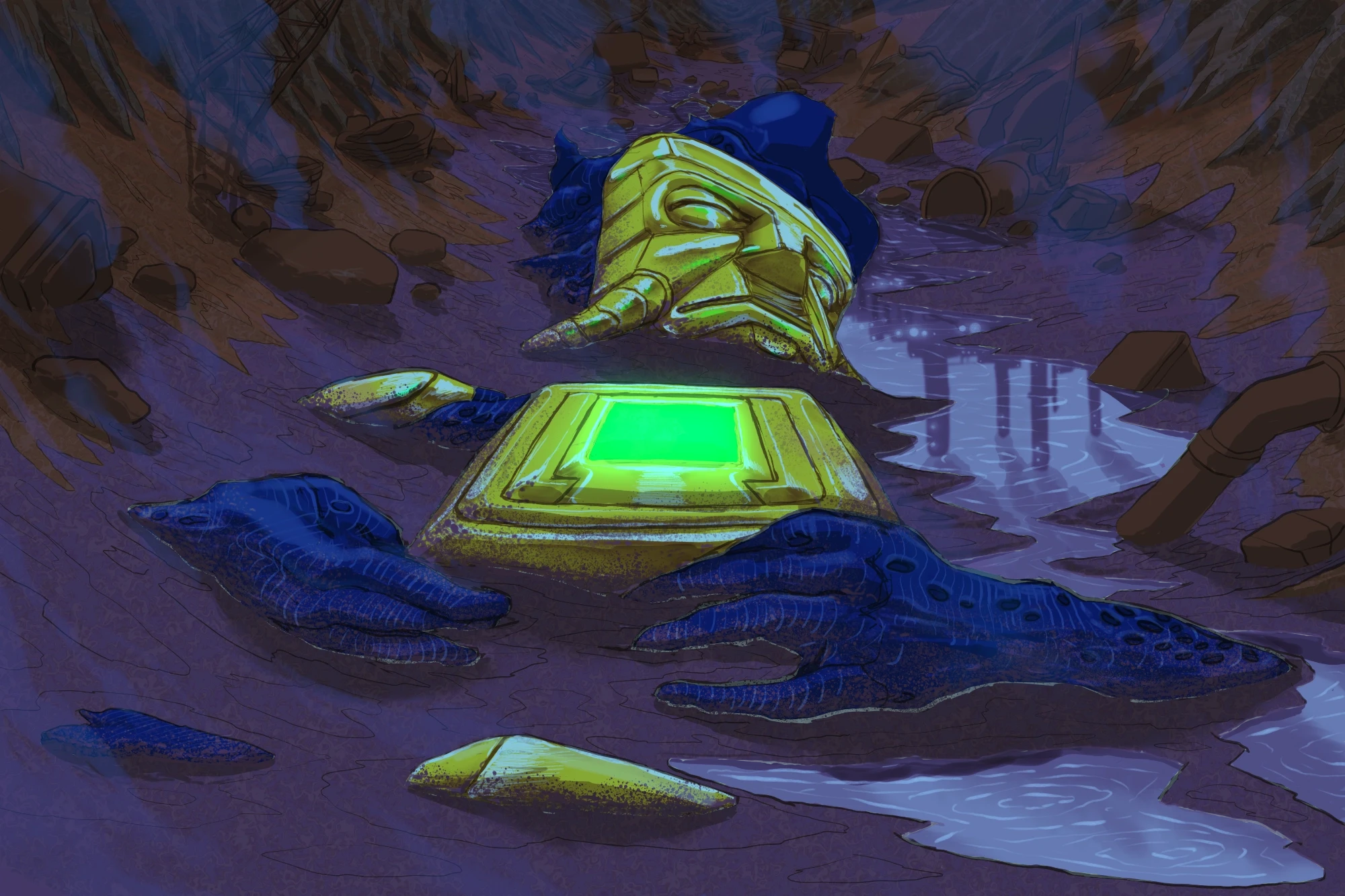
Grace cleared more of the soil away from the body, Harris joining her, until the entire front of it was exposed. It was a white man, perhaps in his mid-sixties, posed like a pharaoh, flat on his back, arms crossed, face set in a smugly peaceful expression. He was dressed in a thin Kevlar jumpsuit from neck to feet, all of it pristine, except for the wormholes Grace couldn’t help noticing. Cradled in his hands was a large metal amulet centered with a flat green jewel.
“Is that thing glowing?” Harris asked.
It was hard to really see it in the sunlight, but the jewel was glowing slightly, pulsing at a glacial pace. As Grace moved around the body, she noticed cobwebs glimmering over the man’s clothes—no, not cobwebs, but thin wires crisscrossing the body in a curving, almost organic grid, all of the wires leading back to the amulet.
Amulet. She didn’t know what else to call it, even as she realized it was more machine than decoration. Grace reached down and put her hand to the man’s cheek.
“Don’t,” Harris said, alarmed. “He might be infected.”
Grace couldn’t blame Harris. Having lived through the plague years, it was hard to forget old habits, old fears. The amulet itself was probably nuclear-powered, which meant they’d have to check their radiation levels when they got back. She decided not to mention that to Harris at the moment. One possibly terrifying revelation at a time.
“It’s not plague. It’s stasis.”
“Like the Better Days Cult?”
“Yeah.” Grace tapped the green jewel, feeling a slight tingle in her hand as she did, and the low-tech, designed-to-survive-the-apocalypse screen lit up. In a large, easy-to-read font, in several different languages, text on the screen spelled out WAKE ME WHEN IT’S BETTER.
“Exactly like the Better Days Cult.”
“So… he’s alive? Weird.” Harris crouched next to her. “Can billionaires be a cult?”
“They can be whatever they can buy. In this case, an annoyance. This must be what’s causing the problem with the worms. A stasis generator.” She tapped the screen again and it went dark. “Looks like the field it produced interfered with their processing and, those worms still able to sort of function, were drawn to the power source. Maybe to eat it, thinking it was just something else to clean from the soil? But the closer they got to the field, the more it interfered, and so we have this mess.”
A grackle descended onto one of the crippled worms they’d unearthed, took a large bite, then spit it back up. Two worms crawled over the man’s right leg, the one behind cannibalizing the one in front.
They collected all the worms they could find, but the ground around the man was clogged with the tiny corpses, the scanner still a mess of blue smears. They replaced all the soil they’d dug up, planted a yellow, all-weather warning flag over the re-buried man.
Anyway, for the Kludge Factory’s purposes, they’d gathered enough info about the stasis field to program future worms to avoid it, which should make worm-loss on that front minimal. Tired, sweaty, sore, they sucked down another bottle of water each as they looked over their work for the day, resting lazily against the gyrowheel. They’d pulled up samples of the processed worm waste. A quick drop in the portable analyzer showed the soil five percent cleaner than it had been a month ago.
“It’s working,” Harris said, the hope in his voice sounding just like disbelief. He lifted his bottle for a cheers, and Grace cheered him back, the bottles collapsing into each other with a crinkle. “To better…well, to success anyway.”
“It’s working here. And working slowly. Imagine how many worms it’ll take to repair any sizable amount of land. And that’s assuming something’s not wrong with the analysis, or that this patch of soil isn’t just naturally cleaner than what we tested before.”
“Who’s being pessimistic now?” Harris laughed. “The worms are working. And that’s something, right? However long it takes.”
Grace smiled. “However long it takes.”
She glanced at the mound of freshly-turned soil that looked like nothing so much as a new grave. Scattered all over the planet, people were hidden like this, not trying to prevent environmental decay, not trying to build new ways to accommodate the changing planet, but just wanting to avoid it altogether. Hoping to wake to a fresh new world, unspoiled and ripe.
Harris followed her gaze. “Are we really going to leave him?”
To be honest, she’d considered turning off the field, but the damage to the worms was already done, and the damage to his body meant shutting off the amulet would kill him without immediate medical attention. Maybe someone in that future he’d wanted to skip to would be able to help him when he was found again. But then Grace thought of that wreath of worms still circling that smiling man, filtering poisons from the ground, from each other, from him.
“He made his choice,” she said, climbing into the passenger seat and closing her eyes, letting Harris take the wheel.
The worms crumbled like dry soil between Grace’s fingers. To be fair, that’s what they were designed to do. Eventually. They just shouldn’t be doing that now. And to find them up on the surface like this, like real worms baking to death on concrete after the rain, that was completely unheard of.
“Total loss?” Harris asked, leaning against the gyrowheel. His eyes were tearing up, allergies had been bothering him all day.
“We’ll have to dig to see.”
Harris groaned and unfolded a shovel from the gyrowheel’s storage. While he marked out a quadrat and started digging it out, Grace tried to read the scattershot symbols on her scanner. She’d worked artificial bees before and other purely mechanical replacements for the animals humanity had accidentally “removed” from the ecosystem, but this was her first time as a lead on one of the new organic environmental repair machines. The higher-ups back at the Kludge Factory assured her the scanner would show where the worms were underground, but the small screen was mostly static, and when it cleared up, it still seemed like the blue dots representing the worms were smeared everywhere like mud on a new pair of boots. Not helpful at all. She put the scanner away and joined Harris. She offered to take the shovel, but he waved her away, having already carved up a sizable section of the quadrat he’d laid down.
“Don’t see any sign of them yet,” Harris said, his tone resigned.
Grace knelt down before the clods of soil he’d already turned over, carefully sifting through the chunks of earth for worm tunnels, pellets of collated trash and industrial poison, even evidence of other insects or animals interfering with the worms’ lifecycles. It was slow, deliberate work. Harris kept shoveling, uncomplaining, untiring. He wasn’t hopeful—he was never hopeful—but that was a trait she appreciated. Trying to repair Earth from all the centuries of damage humanity had done was akin to bailing out a boat sinking in a river of shit. Even if you stayed afloat, everything you saved was still covered in shit. Better to be diligent and pessimistic rather than hopeful and prone to depression whenever another plan failed. She’d lost enough co-workers to the endless, unrewarding grind, the lucky ones getting poached for higher-paying corporate jobs, and the unlucky ones to, well, not that.
The sun was burning her neck by the time she decided she’d searched enough, three malfunctioning worms in a tangle at her side pulled from a cubic meter of soil. There should be at least a hundred, and fully functional. She found segments of more worms, some decomposed so much already only those trained in what to look for would have found them: the slightly lighter-colored “soil” of their bodies mixed with hard black crystals no bigger than sand grains, the nano-computers built from carbonized wood.
Grace glanced over toward Harris. He stood in the shadow of the gyrowheel, shirt off, a farmer’s tan already dark on his skin even though she knew he used the strongest sunscreen available, at least the strongest that wasn’t provided by the Kludge Factory. He’d worked at the company long enough to know that was a bad idea.
Grace stretched out on the ground and put her ear to the grassy soil. Closing her eyes, she imagined she could hear the worms tunneling beneath her, the tiny gears of their mouths grinding away, their stomach filters humming, using what they could for energy, removing the metals and hormones and deadly chemicals deposited into the soil over hundreds of years, and leaving a trail of clean castings behind them.
Cleaner, at least.
“Giving up already?” Harris asked with a teasing lilt to his voice.
“They aren’t here.”
“Where else would they be?”
A cold bottle of water landed on her stomach. Grace sat up, drank it all in one go, then crushed the paper bottle into a tiny wad and threw it back at Harris.
“Some of them are here. Parts of them are here.” At his curious frown, she added, “It’s as though most of them chose to decommission themselves and just decomposed. But they should’ve had years left of working life.”
Harris nodded. “Supposedly.”
“Supposedly.” She stood and stretched her back. “That’s what the Kludge Factory claims. But then again, they claimed this scanner would show where the worms are. Piece of shit is useless.”
“Let me see it,” Harris said, and Grace handed it over. “What about this? What’s this smear here?” Harris circled with his finger. The area on the screen was thick and long, like the worms were trying to combine themselves into a single giant ball, swirling like some kind of whirlpool under the ground.
“What is that?” she said, taking the scanner back and grabbing the shovel. The first shovelful brought up a clump of worms still wriggling, though obviously all in various states of disrepair. “This is not supposed to happen.”
“Supposed to,” Harris echoed, grabbing another shovel and an empty bucket.
They put the worms into the bucket, thinking they’d have to send them back to the Kludge Factory for study, until Grace hit something thick and, well, fleshy with her shovel. With a few gentle digs, there it was. A body. As she and Harris stared down at it, open-mouthed, worms crawled over the body in slow, jerky movements. One worm was half-in, half-out of the stomach, the entire body spotted with tiny worm holes. Blood pooled around them like sap. Harris vomited.
“We need to call someone.” he said after a moment, wiping his mouth and keeping his eyes away from the body.
“Who?”
He didn’t answer. They were in the middle of nowhere. The closest city was abandoned Houston, and no one overseeing a reclamation farm that big would care about a single body. Letting the Kludge Factory know might even be worse, since they’d use this “found resource” to test current experiments. That was exactly why Grace had gotten out of R&D to begin with.
Grace cleared more of the soil away from the body, Harris joining her, until the entire front of it was exposed. It was a white man, perhaps in his mid-sixties, posed like a pharaoh, flat on his back, arms crossed, face set in a smugly peaceful expression. He was dressed in a thin Kevlar jumpsuit from neck to feet, all of it pristine, except for the wormholes Grace couldn’t help noticing. Cradled in his hands was a large metal amulet centered with a flat green jewel.
“Is that thing glowing?” Harris asked.
It was hard to really see it in the sunlight, but the jewel was glowing slightly, pulsing at a glacial pace. As Grace moved around the body, she noticed cobwebs glimmering over the man’s clothes—no, not cobwebs, but thin wires crisscrossing the body in a curving, almost organic grid, all of the wires leading back to the amulet.
Amulet. She didn’t know what else to call it, even as she realized it was more machine than decoration. Grace reached down and put her hand to the man’s cheek.
“Don’t,” Harris said, alarmed. “He might be infected.”
Grace couldn’t blame Harris. Having lived through the plague years, it was hard to forget old habits, old fears. The amulet itself was probably nuclear-powered, which meant they’d have to check their radiation levels when they got back. She decided not to mention that to Harris at the moment. One possibly terrifying revelation at a time.
“It’s not plague. It’s stasis.”
“Like the Better Days Cult?”
“Yeah.” Grace tapped the green jewel, feeling a slight tingle in her hand as she did, and the low-tech, designed-to-survive-the-apocalypse screen lit up. In a large, easy-to-read font, in several different languages, text on the screen spelled out WAKE ME WHEN IT’S BETTER.
“Exactly like the Better Days Cult.”
“So… he’s alive? Weird.” Harris crouched next to her. “Can billionaires be a cult?”
“They can be whatever they can buy. In this case, an annoyance. This must be what’s causing the problem with the worms. A stasis generator.” She tapped the screen again and it went dark. “Looks like the field it produced interfered with their processing and, those worms still able to sort of function, were drawn to the power source. Maybe to eat it, thinking it was just something else to clean from the soil? But the closer they got to the field, the more it interfered, and so we have this mess.”
A grackle descended onto one of the crippled worms they’d unearthed, took a large bite, then spit it back up. Two worms crawled over the man’s right leg, the one behind cannibalizing the one in front.
They collected all the worms they could find, but the ground around the man was clogged with the tiny corpses, the scanner still a mess of blue smears. They replaced all the soil they’d dug up, planted a yellow, all-weather warning flag over the re-buried man.
Anyway, for the Kludge Factory’s purposes, they’d gathered enough info about the stasis field to program future worms to avoid it, which should make worm-loss on that front minimal. Tired, sweaty, sore, they sucked down another bottle of water each as they looked over their work for the day, resting lazily against the gyrowheel. They’d pulled up samples of the processed worm waste. A quick drop in the portable analyzer showed the soil five percent cleaner than it had been a month ago.
“It’s working,” Harris said, the hope in his voice sounding just like disbelief. He lifted his bottle for a cheers, and Grace cheered him back, the bottles collapsing into each other with a crinkle. “To better…well, to success anyway.”
“It’s working here. And working slowly. Imagine how many worms it’ll take to repair any sizable amount of land. And that’s assuming something’s not wrong with the analysis, or that this patch of soil isn’t just naturally cleaner than what we tested before.”
“Who’s being pessimistic now?” Harris laughed. “The worms are working. And that’s something, right? However long it takes.”
Grace smiled. “However long it takes.”
She glanced at the mound of freshly-turned soil that looked like nothing so much as a new grave. Scattered all over the planet, people were hidden like this, not trying to prevent environmental decay, not trying to build new ways to accommodate the changing planet, but just wanting to avoid it altogether. Hoping to wake to a fresh new world, unspoiled and ripe.
Harris followed her gaze. “Are we really going to leave him?”
To be honest, she’d considered turning off the field, but the damage to the worms was already done, and the damage to his body meant shutting off the amulet would kill him without immediate medical attention. Maybe someone in that future he’d wanted to skip to would be able to help him when he was found again. But then Grace thought of that wreath of worms still circling that smiling man, filtering poisons from the ground, from each other, from him.
“He made his choice,” she said, climbing into the passenger seat and closing her eyes, letting Harris take the wheel.