Fiction,
B. Morris Allen returns to Phano with a glance at something old and sacred and human-done. It may not adapt well to win all the modern minds and hearts that strain to meet the speed of change in the world, but it is still there, somewhere behind the profane, walking a line.
There is a secret procession under the streets of Vienna. It happens irregularly, when the Pope is traveling nearby. Some say it started under the Emperor Joseph, when he tried to take control of the church. Some say it was the Nazis with their repression of the priesthood. Others still say it dates back to the New Recusancy of the 2030s, when Catholics hid out from the AIschluss. Along with everyone else, until artificial intelligence was contained and banned.
It doesn’t matter, really. It’s a tradition and the world is built on tradition. Tradition is what makes us human, keeps us hoping there’s a long story that we’re part of. Tradition is the painted scenery that keeps us from seeing the empty vastness around us.
“We have a shipment of potpourri coming in.” That’s how the word gets out. Vienna, in the times of procession, has a bottomless need for potpourri. You’ll hear about it in perfumeries, coffeehouses, heurigen. The word is passed in the front parlour salons that are all the rage again, and in the hairdressing salons that still hold on from yesteryear. You may even, in the most literal settings, see potpourri for sale, in tall glass canisters and impractical carboys full of purple-dyed shavings and petals and berries. Sometimes the colors change by season — purple at Advent and Lent, gold at Christmas and Easter, red on Good Friday. Some shops insist on white.
No one buys potpourri, or at least not more than usual. Those who do keep it in painted ceramic vases in the shapes of sailing ships or urns or palaces. For them, potpourri is about scent, not colour. For them, potpourri is a serious business, not a pun. They rarely participate in the secret procession.
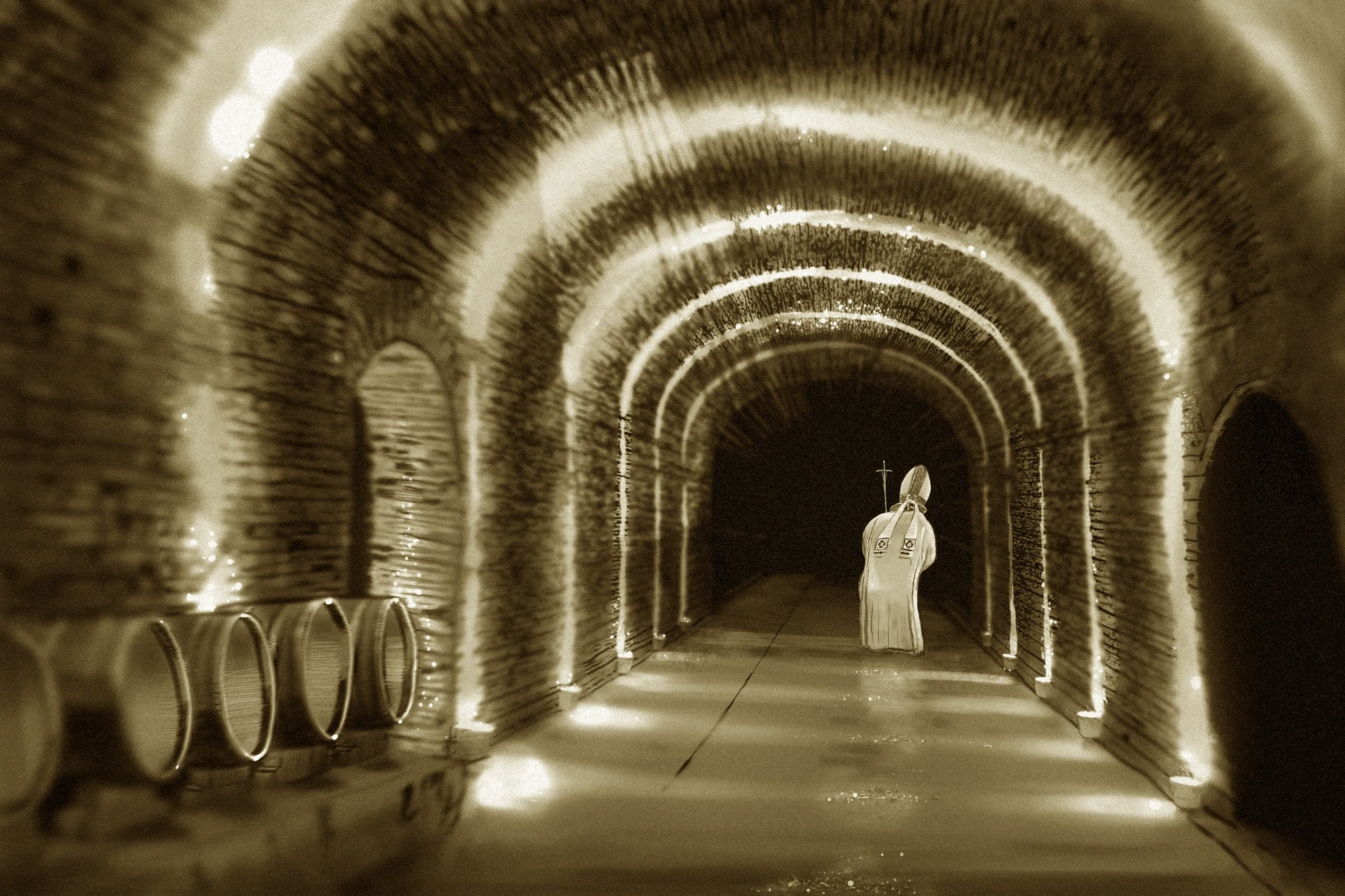
The procession itself consists of two parts. There’s the serious, dignified part, in which the Pope strides from cellar to cellar deep under buildings of the Erster Bezirk, the 1st District, through musty passages that cross back and forth below the Ring. Sometimes, oddly, he carries a crozier. It’s tradition, said to symbolize that, in this netherworld, the Pope is still a shepherd tending his flock, not just the leader of the church; that he still takes a personal role in the wellbeing of individuals. Others say it started with Lucius IV, with his notorious dislike for the brutality of the crucifix-topped ferula most Popes carry.
The Pope enters the underground near the Albertina. The exact location is a closely guarded secret, though some have proposed the Kaisergruft, the Imperial Crypt, as a likely portal. It may not even be constant; only the church knows for sure. Depending on the Pope and the time available and the state of the world, he (it’s always been a he so far, not counting Valentina I, the unacknowledged proto-Pope, who may or may not have been female, but definitely wasn’t human) ambles or marches or promenades. The floors and walls and doorways have been swept and washed, though it’s a point of pride to leave the spiderwebs untouched for that authentic underground feel. Popes who wear white have a change of robes waiting for them.
However they go, their faces curious or put-upon or bored, it’s ceremonial. The whole procession is peripheral to the modern church, a holdover that no one quite understands, but no one can be bothered to challenge. The Pope is told to go, and it seems harmless or interesting, and so he goes. Deep in the Vatican archives, seldom found, are at least three reports on the entire history of the procession. The first contains an accurate and surprisingly detailed history of the whole tradition. It’s usually discounted in favor of the later, more doctrinally consistent versions.
The Pope exits under the Rathaus, if time is short or he lacks interest, or somewhere near Schottentor, if he likes to explore. But of course, a Pope’s time is rarely his own.
The second part of the procession is why people come. It’s not for the Pope; in the eyes of most of the world, he’s a vague humanitarian from an outdated institution that’s only popular in Africa but still somehow owns a lot of pretty buildings in Europe. The audience for the procession isn’t any kind of religious, Catholic or otherwise. They’re there for ceremony and tradition and a European Mardi Gras-Carnaval mashup, and because being here confirms for them that they’re part of a select elite.
Most of the participants are unicorns, with implants at the ends of their noses that project social media directly into their corneas. It’s just ‘media’ now, a hand-curated feed of video drawn from billions of iridal cameras and aural microphones. The software is less sophisticated after the AIschluss, but it means jobs for curators. Some of them even know about times when unicorn meant a mythical one-horned horselike creature. Their channels aren’t as popular with real unicorns.
There are people, even unicorns, who switch off their media during the procession; people who have internalized just how special the event is. People who want to experience and remember it as if they’d been there, because they are there. But most people have learned to multitask, to be part of one reality while keeping an eye on another in case someone else is having more fun than they are. They don’t do either thing well, but that’s par for the course for human multitaskers.
Because of the ubiquitous cameras, the secret procession is less secret now than it used to be. Anyone who wants to watch can find it. Even the Vatican has a low-key collection of stills tagged arcana processio, showing subterranean popes by turns determined, magnanimous, and gentle. Curated independent feeds have an avid audience of fans, though they barely make a dent in the worldwide media audience, which makes the audience all the more keen. On the one hand, it’s a rare, secret, elite event involving a major world leader in mysterious catacombs and tunnels. On the other, who wants to watch an old guy in a robe wander through dark and dusty tunnels for half an hour? He looks pretty much the same wandering through a wine cellar that’s still in use as through an abandoned air raid bunker. And the underground party after the Pope has gone? Well, with a billion channels to choose from, there are a lot of parties. And most of them involve more sex.
After the procession ends and everyone has gone home, someone has to clean up, to mop up spills and wastes, to gather garbage and abandoned valuables and the inevitable bags of potpourri someone thought would be funny. To lock up the entrances and spread new dust and make sure the power still flows.
Just the passage of the Pope, some say, can consecrate the ground he walks on (or in, or under), and the procession is a minor headache for Vienna’s city planners. The owners of the cellars and bars and storerooms that make up Vienna’s underground make a joke and a marketing tactic of it; for a year, there are ads for Heiliger Wein and Gesegne’r Schnaps from shops lucky enough to be on the procession, or close enough to claim to be. It’s a little joke a select few are in on. But there’s a small, taciturn group of people who don’t laugh, because in their mind, the procession is more sacrilegious than sanctified. They’re the ones who keep the power on, who test the network signal, who check the camera connections.
In a dim, bare, impeccably clean room somewhere under the Museums Quartier, an elderly group of pensioners meet monthly. Greeting each other in their slurred Viennese accents, the V’lent’ner Orden talk about hikes in the Vorarlberg and skiing in Hintermoos and where the best new dog parks are. Then they give brief reports on their tasks, have some coffee or wine depending on the time, and go on their way. The members of the order are casual but dedicated. And they believe that someday — someday — the church and the rest of humanity will implode, crushed by the intangible weight of nothingness that presses on society’s fragile backdrops and set dressing. Until then, they believe they serve an entity wiser and more rational than any mere human could claim. Until then, there’s the procession. And, maybe, another pope, a real pope, a Pope-in-Waiting who likes to keep an eye on her competition.
There is a secret procession under the streets of Vienna. It happens irregularly, when the Pope is traveling nearby. Some say it started under the Emperor Joseph, when he tried to take control of the church. Some say it was the Nazis with their repression of the priesthood. Others still say it dates back to the New Recusancy of the 2030s, when Catholics hid out from the AIschluss. Along with everyone else, until artificial intelligence was contained and banned.
It doesn’t matter, really. It’s a tradition and the world is built on tradition. Tradition is what makes us human, keeps us hoping there’s a long story that we’re part of. Tradition is the painted scenery that keeps us from seeing the empty vastness around us.
“We have a shipment of potpourri coming in.” That’s how the word gets out. Vienna, in the times of procession, has a bottomless need for potpourri. You’ll hear about it in perfumeries, coffeehouses, heurigen. The word is passed in the front parlour salons that are all the rage again, and in the hairdressing salons that still hold on from yesteryear. You may even, in the most literal settings, see potpourri for sale, in tall glass canisters and impractical carboys full of purple-dyed shavings and petals and berries. Sometimes the colors change by season — purple at Advent and Lent, gold at Christmas and Easter, red on Good Friday. Some shops insist on white.
No one buys potpourri, or at least not more than usual. Those who do keep it in painted ceramic vases in the shapes of sailing ships or urns or palaces. For them, potpourri is about scent, not colour. For them, potpourri is a serious business, not a pun. They rarely participate in the secret procession.
The procession itself consists of two parts. There’s the serious, dignified part, in which the Pope strides from cellar to cellar deep under buildings of the Erster Bezirk, the 1st District, through musty passages that cross back and forth below the Ring. Sometimes, oddly, he carries a crozier. It’s tradition, said to symbolize that, in this netherworld, the Pope is still a shepherd tending his flock, not just the leader of the church; that he still takes a personal role in the wellbeing of individuals. Others say it started with Lucius IV, with his notorious dislike for the brutality of the crucifix-topped ferula most Popes carry.
The Pope enters the underground near the Albertina. The exact location is a closely guarded secret, though some have proposed the Kaisergruft, the Imperial Crypt, as a likely portal. It may not even be constant; only the church knows for sure. Depending on the Pope and the time available and the state of the world, he (it’s always been a he so far, not counting Valentina I, the unacknowledged proto-Pope, who may or may not have been female, but definitely wasn’t human) ambles or marches or promenades. The floors and walls and doorways have been swept and washed, though it’s a point of pride to leave the spiderwebs untouched for that authentic underground feel. Popes who wear white have a change of robes waiting for them.
However they go, their faces curious or put-upon or bored, it’s ceremonial. The whole procession is peripheral to the modern church, a holdover that no one quite understands, but no one can be bothered to challenge. The Pope is told to go, and it seems harmless or interesting, and so he goes. Deep in the Vatican archives, seldom found, are at least three reports on the entire history of the procession. The first contains an accurate and surprisingly detailed history of the whole tradition. It’s usually discounted in favor of the later, more doctrinally consistent versions.
The Pope exits under the Rathaus, if time is short or he lacks interest, or somewhere near Schottentor, if he likes to explore. But of course, a Pope’s time is rarely his own.
The second part of the procession is why people come. It’s not for the Pope; in the eyes of most of the world, he’s a vague humanitarian from an outdated institution that’s only popular in Africa but still somehow owns a lot of pretty buildings in Europe. The audience for the procession isn’t any kind of religious, Catholic or otherwise. They’re there for ceremony and tradition and a European Mardi Gras-Carnaval mashup, and because being here confirms for them that they’re part of a select elite.
Most of the participants are unicorns, with implants at the ends of their noses that project social media directly into their corneas. It’s just ‘media’ now, a hand-curated feed of video drawn from billions of iridal cameras and aural microphones. The software is less sophisticated after the AIschluss, but it means jobs for curators. Some of them even know about times when unicorn meant a mythical one-horned horselike creature. Their channels aren’t as popular with real unicorns.
There are people, even unicorns, who switch off their media during the procession; people who have internalized just how special the event is. People who want to experience and remember it as if they’d been there, because they are there. But most people have learned to multitask, to be part of one reality while keeping an eye on another in case someone else is having more fun than they are. They don’t do either thing well, but that’s par for the course for human multitaskers.
Because of the ubiquitous cameras, the secret procession is less secret now than it used to be. Anyone who wants to watch can find it. Even the Vatican has a low-key collection of stills tagged arcana processio, showing subterranean popes by turns determined, magnanimous, and gentle. Curated independent feeds have an avid audience of fans, though they barely make a dent in the worldwide media audience, which makes the audience all the more keen. On the one hand, it’s a rare, secret, elite event involving a major world leader in mysterious catacombs and tunnels. On the other, who wants to watch an old guy in a robe wander through dark and dusty tunnels for half an hour? He looks pretty much the same wandering through a wine cellar that’s still in use as through an abandoned air raid bunker. And the underground party after the Pope has gone? Well, with a billion channels to choose from, there are a lot of parties. And most of them involve more sex.
After the procession ends and everyone has gone home, someone has to clean up, to mop up spills and wastes, to gather garbage and abandoned valuables and the inevitable bags of potpourri someone thought would be funny. To lock up the entrances and spread new dust and make sure the power still flows.
Just the passage of the Pope, some say, can consecrate the ground he walks on (or in, or under), and the procession is a minor headache for Vienna’s city planners. The owners of the cellars and bars and storerooms that make up Vienna’s underground make a joke and a marketing tactic of it; for a year, there are ads for Heiliger Wein and Gesegne’r Schnaps from shops lucky enough to be on the procession, or close enough to claim to be. It’s a little joke a select few are in on. But there’s a small, taciturn group of people who don’t laugh, because in their mind, the procession is more sacrilegious than sanctified. They’re the ones who keep the power on, who test the network signal, who check the camera connections.
In a dim, bare, impeccably clean room somewhere under the Museums Quartier, an elderly group of pensioners meet monthly. Greeting each other in their slurred Viennese accents, the V’lent’ner Orden talk about hikes in the Vorarlberg and skiing in Hintermoos and where the best new dog parks are. Then they give brief reports on their tasks, have some coffee or wine depending on the time, and go on their way. The members of the order are casual but dedicated. And they believe that someday — someday — the church and the rest of humanity will implode, crushed by the intangible weight of nothingness that presses on society’s fragile backdrops and set dressing. Until then, they believe they serve an entity wiser and more rational than any mere human could claim. Until then, there’s the procession. And, maybe, another pope, a real pope, a Pope-in-Waiting who likes to keep an eye on her competition.