Fiction,
T. R. Tuttle tells us all about the ins and outs of looking after goo. What are you supposed to do with the goo? Just report to the lab, pick up the goo you’re looking after for the day and goo from there.
It’s my turn to babysit the goo. I’ve seen other people in town on goo duty since the newest chunk broke off the starter, but it’s my first time taking it out for myself.
We’re supposed to go about our daily lives and just explain things if the goo has questions. That’s all well and good and all, but, well…my life isn’t very interesting. Since I don’t have a specialty, I’m on double-duty on the task rosters and I just go where they tell me to go.
But it turns out that goo duty is my task for the day, so it’s up to the two of us to decide what we're going to do with ourselves. So far it let me know that it likes walking around outside, so we’re doing that.
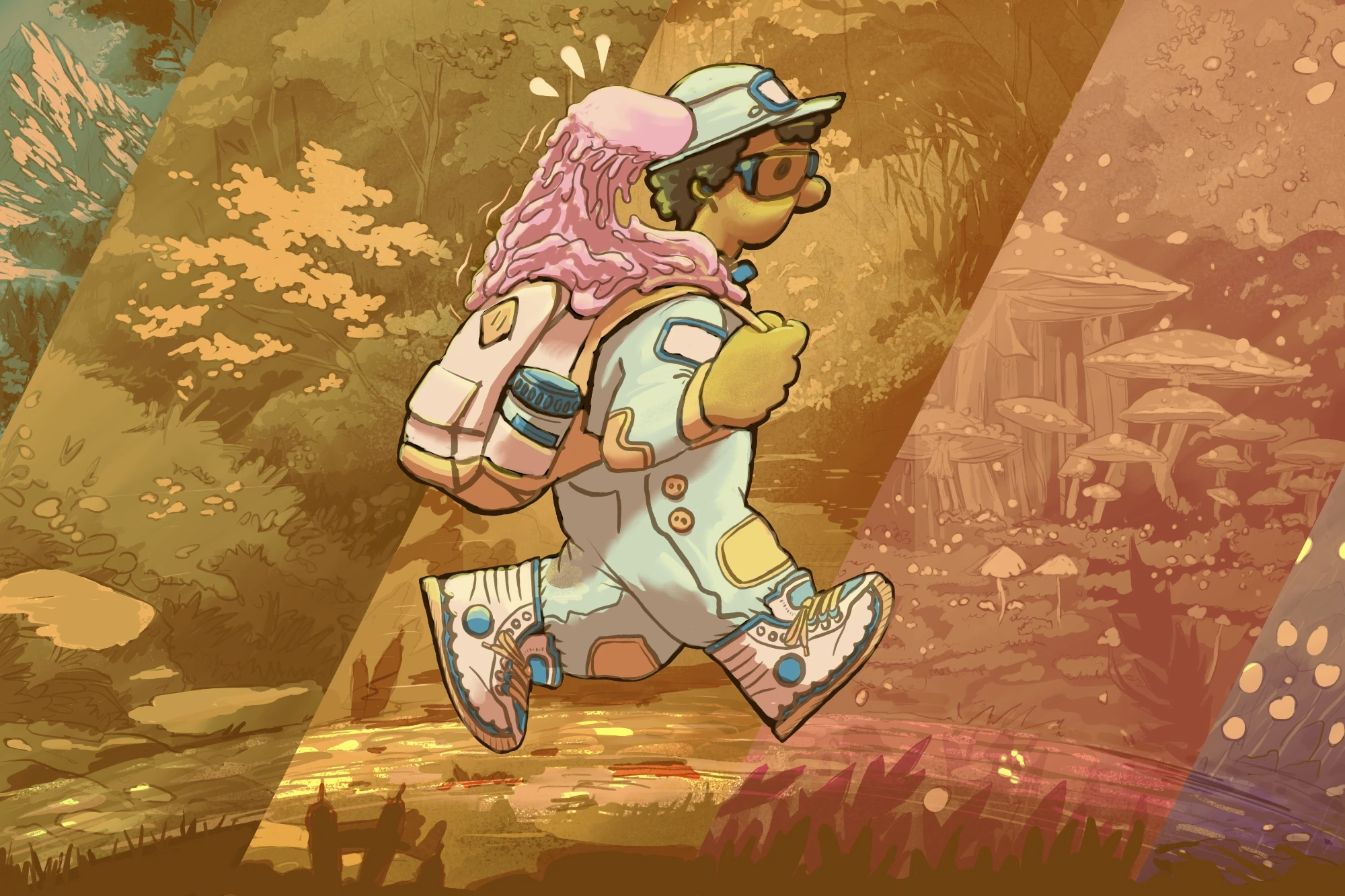
The goo kind of feels like a gel cooling pack, but without the cover. It just sits on your shoulders (or the top of your head, depending) and sort of goes along with whatever you're up to. It’s like a tag-along little kid getting a piggyback ride, if that kid was a featureless blob of nanomachines.
“What’s that?” the voice in my ear asks again. The goo comes with a headset that you wear that connects up to it—glasses so it can see what you’re seeing. It has a wire it can vibrate that attaches to headphones and a speaker so it can talk to you. So it’s kind of like streaming to an audience of one as you go about your day.
I look at the small arrow the goo placed on my glasses lens. “That’s…hm, I’m not sure actually. You don’t mean the Queen Anne’s Lace, right?”
“No, the one next to it.”
“I don’t know.” I blink three times to save a picture of the small flowers, adding it to the collection we’ve made so far. “Want to go look it up? The botany database is pretty solid.”
“Is Gathers Staples working today?” it asks.
“Oh. Probably, unless it’s on break. Should we go say hello?”
“Sure.” It might sound hesitant, but I’m not a big fan of reading hints. I turn us around and head for the botany lab.
There are a few goos around town who have separated off the main body and do their own work now. Some are more mobile than others, and most of them use custom-made tools to do the jobs they’ve chosen for themselves. The baby goos don’t get those because they haven’t had a chance to decide what they want to do yet, and we don’t really have the extra labor hours or materials to make a bunch of stuff for them before they’ve got an idea of what they’re going for.
I walk the goo across the commons to the labs block. It helps point me in the direction of the botany section, since I haven’t spent a lot of time over there. When I ask it how it knew where it is, it told me it came here last week. So I wasn’t the first person to have this idea. That’s a bit of a hit to my goo-sitting pride; it probably would have wanted to do something more original.
Gathers Staples seems happy to see us—it jiggles in place, ripples on its surface catching the light overhead. The speaker set up at its workstation greets us even as it continues its work, attached by a pair of wires to a computer tower. There’s a monitor attached for human benefit, but I can’t make very much of the information on it, it’s moving so fast.
The baby goo switches its external speaker so it’s not just speaking in my ear. “We have some pictures to upload for tagging. Can you help us identify them?”
“Of course,” Gathers Staples says, and so I take the chip out of my glasses to hand over. It ripples over my hand, absorbing the chip, and then surges over the socket to plug it in. It identifies most of the pictures as soon as they appear on the monitor, and the baby goo listens with interest as it pulls up more information about each of the plants and where they grow. The explanation starts to get too technical for me, but I make sure to look at the monitor just in case the goo needs to use the information there to understand what’s being said.
The two goos talk to each other for a while, the speakers on the desk and around my neck filling the space with pleasant, smooth generated voices. Then the earbud I’m wearing lets out a soft beep as the goo turns it back on. “Can we go somewhere else soon?” it asks me, even as it politely says, “I’m good, thanks,” to the adult goo over the speaker.
The two sentences overlap—it’s really weird to hear the same being saying two different things at once. But I say, “I gotta take the kiddo on to the next thing. You wanted to see the, uh, the art center, right? Pretty sure they’re open this time of day for walk-ins.”
“Sure!” The goo sounds a little more enthusiastic this time, and I wave goodbye to Gathers Staples before walking us out.
“So, what’s up with that?” I ask. “Just wanted out of the conversation?” It didn’t seem like a bad conversation to me, but what did I know? I wasn’t a goo.
“I thought it was gonna ask if I wanted to merge with it to share information,” the goo tells me. “It offered last time, too. I didn’t want to have to say no again.”
“Huh.” We walk out of the labs and back the way we came, crossing the commons again. I’m not sure where we’re heading yet, so I go slow. “Is merging, like, uncomfortable or something?”
“Kinda, yeah,” it tells me. “I probably won’t mind when I’m older, but like…staying a single being is tricky enough when I’m not merged with somebody.”
“Huh,” I say again, and wonder how old this goo is—developmentally, I mean. Is it more of a toddler, or a teenager? Or is it silly to think of goo as having developmental milestones like that? Probably its development is completely different from humans, so there’s no point making comparisons.
“But…yeah, it’s kind of like hugging an adult you don’t know super well. I think. Based on what I’ve heard about hugging. Only there’s more of a reason for it, because we can communicate very, very quickly that way.” It pauses. “I just…don’t like doing it very much.”
“I feel that.” I’m not much of a hugger myself. “Well, what about its job, though? Do you like experimental botany?”
“I guess.”
It sounds kind of like my younger brother, but he’s been saying things like that from the age of twelve all the way through to twenty-four, so that doesn’t really help me pin down a life stage. “So you like plants, but plant data science isn’t really your jam.”
“Nothing’s my jam yet,” it tells me, sounding distinctly glum.
I don’t quite know what to say to that. “Where do you want to head next?” I ask instead. “Actually the art center?” I said it off the top of my head, and it was my best idea at the time, but I have a suspicion it’s not a very interesting prospect.
“Nah. But…can we walk along the fence? Or are you old enough to go past the town borders?”
“I need to let someone know we’re leaving, but sure.” That has nothing to do with my age—I’ve been old enough to leave by myself for several years now. It’s a safety thing.
“Do you like gathering?” it asks. “I’m pretty good at identifying fungi.”
“Wait, really?” Mushroom gathering isn’t something I have enough training in to do safely, but… “How good?”
“98.3% accurate. And the remaining 2.7% were all false positives, so anything I identify as edible is rated generally safe for human consumption.” This time it does sound proud of itself.
“Well damn,” I say, impressed. “Let’s go get us a basket.”
I get a basket and a shoulder bag just in case before heading off towards the community forest. It’s the season for the Himalayan blackberries, and there’s no need to be shy gathering those because they’re invasive, so I stop there first and pick a whole bag of them, popping a few in my mouth as I go. But there’s not a lot the goo can do to help with that, other than picking out berries by highlighting them on my glasses, so I move on pretty quick.
It’s deeper in the forest where the mushrooms start to pop up. I stop by and grab some edible sorrel as I go, munching on the acidic leaves. It’s usually only the really easy stuff, like that and the blackberries, that I’m any good at picking out, so I don’t bother with foraging much. It’s a reasonably fun way to pass the time, though, and the goo and I play a few more rounds of “what plant is that” as we go.
It seems to really like being outside, but if it’s anything like my brother was as a teenager (and still is, really), it won’t just accept an outside observation about its interests at face value. What matters is what it decides it can say about itself.
Instead of pushing it, I ask, “How is it that you can identify poisonous mushrooms but you weren’t sure about all those plants this morning?”
“Well…” It sounds embarrassed. “Visual recognition is a lot harder than testing a chemical sample. I can ‘see’ things a lot better when they’re inside me and very small. But it also helps if there’s samples. A lot of the less important plants only have visual or verbal descriptions—their chemical compositions or DNA profiles aren’t in the database. Recognizing things by sight is more data efficient once I get good at it, but it takes repeated samples in varied contexts.”
“So…you have to look at things a lot, visually, to be able to recognize them.”
“Yes! But all it takes for ‘tasting’ something is a sample and some data to work off of. And speaking of which—I think there’s a fungus on your left.”
There is, in fact, a promising-looking mushroom a short distance off the footpath. I lift the goo off my shoulders and place it on top of the large, ridged body to have a look. I think what I’m looking at is some variety of chanterelles, but I wait until I’ve gotten goo confirmation before I touch anything myself. Other humans might make fun of me for being too cautious—I don’t think there are any other mushrooms that look like chanterelles that are dangerous—but the goo doesn’t. It just tells me what I need to know so I can gather up the fungus and stick it in my shoulder bag.
Foraging for mushrooms is a lot of walking and trying to spot familiar shapes out of the corner of my eye. The goo is much better at it than I am, sending flags through to my glasses to get me to look when it spots something.
We fall into a pattern: take a few steps in one direction, find a promising spot, head that way, inspect what we find, and then scan the area around us again. It’s pretty efficient cooperation as far as gathering goes, but I’m glad that it’s got a magnetically accurate sense of direction, because it’d be easy to get turned around off the beaten path in the woods.
The sun is starting to sink, turning the light between the trees golden and the shadows a bit deeper. The smell of green things has been in my nose for so long that most of what I smell at this point is dirt and damp. My shoes are covered in dirt and my pant legs are scuffed and covered in debris and bits of spiderweb. This isn’t a tidy activity. I’m glad my laundry day’s tomorrow.
We’re walking along the low end of a ridge, looking for a spot to climb up, when the goo suddenly jerks on my shoulder and hisses in my ear. “Stop moving,” it says, and I stumble to a halt.
“What’s wrong?” My voice is already a whisper.
“Look up and to the left. Slowly.”
I look up the ridge, and the goo helpfully highlights a shape I might have missed otherwise.
A massive feline shape is stalking down the ridge ahead of us. It steps down from where it was climbing down a rocky embankment and lifts its head. I see the moment it catches sight of us. Its body goes still. It’s staring.
Safety information runs through my mind—the wilderness safety guidelines I’ve been taught from childhood. It’s bad that I made eye contact; animals see that as a threat. I need to look big and intimidating. I shouldn’t attack it, right? Am I supposed to wave my arms and yell?
The mountain lion is still staring me in the face. Its body ripples as it moves forward. It moves too smoothly for the speed of its approach.
We’re being stalked. I look like prey. This thing isn’t that much bigger than me, probably less than six feet including the tail, but its head looks like it comes up to at least my stomach if not my torso. I’ve worked with bigger dogs before, ones that could eat me for breakfast—but they and I both knew they wouldn’t, and that social contract is entirely missing here. This thing could very well eat me for dinner if it puts its mind to it, and it seems to be weighing the appeal.
No point playing dead, then. I’m not very big or strong, so what am I supposed to do about this? I try to lift my arms but they feel frozen, my hands clenched instinctively in front of my chest. Could I throw my bag at it and run? No, running is also dangerous. Don’t make eye contact and don’t run. I’m one for two.
I force myself to lower my gaze from its eyes to its teeth. Both are far too visible now, though it’s got partial cover in the undergrowth.
The goo on my shoulders shivers. I think for a moment that it’s afraid, but then I see it moving. It pushes up, forming a collar that goes up to and then past the top of my head. It’s a gleaming, silvery lattice in the afternoon light. I see the mountain lion’s head lift as it tracks the motion.
Its mouth falls faintly open, scenting us.
The goo screams.
It’s an unearthly sound, and it’s not coming from my earpiece. It’s vibrations from within the goo itself, forming a dozen throats of different sizes and pitches, creating an eerie wailing.
It wavers as though lunging, and I can feel it pressing against the back of my neck to steady itself.
The spine-tingling sound jolts me into motion. I take a hold of the edges of my jacket and flap it outward, forcing myself to stand straight. “Leave me alone,” I intone over the screaming, making my voice as deep as I can. “Go. Get out of here. I don’t want to fight.”
The mountain lion stands straight now, pushed up high on its front paws. Its ears are forward, and it’s tracking the movement of the goo over my head.
It jerks, pupils narrowing, and then takes a step backward.
I’m not supposed to turn my back on it. I step slowly backwards myself, making sure I have solid footing before putting my weight down.
The goo’s shrieking drops in pitch, becoming more of a growl. I wave my arms awkwardly, making my jacket flap.
The mountain lion backs up. So do I.
“Good. Keep moving.” I keep talking, babbling at it. The words don’t matter, only my tone. It is incredibly bad luck to run into a mountain lion this close to town, but I suppose that luck was going to come due to someone at some point. Might as well be me.
But I’m so glad that it’s out here with me—that I have backup. I try not to imagine what might have happened if I’d been on my own. Instead, I focus on the goo overhead, rippling like a flag in the still air.
Two more steps, and the mountain lion turns, leaping up the embankment. The goo rears higher in response, but I can see the lion’s tail as it heads back the way it came. We were enough of a threat—or just too weird—to be worth the risk.
My heart is thrumming in my chest and I make a conscious effort to breathe and not just flop down onto a nearby patch of sorrel. It’s not safe yet—the mountain lion might come back. I can’t afford to look like prey.
The goo has shrunk down to its normal place wrapped around my shoulders. “We’re gonna go back now, right?”
“Yes.” My voice is only a little shaky. “If I put the glasses on backwards, can you tell me if it follows us?”
It agrees, so that’s what we do. The glasses try to slip down to the base of my skull, so I angle them up a little until they’re balanced on the crown of my head. If this makes it hard to see, the goo doesn’t complain. We don’t talk as I walk steadily back the way we came. We’re far enough from town that there’s very little point in trying to hurry, but I find myself making big strides anyway.
“Does that happen often?” the goo asks.
“No,” I say. “We’ll need to put out a warning that we spotted a mountain lion nearby. They don’t usually come too close to humans, so there might be an investigation to see if something’s driving it out of its territory. Or I think that’s the sort of thing the ecology instructors usually mention doing in cases like this.” My voice is definitely shaking, but I can pretend it’s because I’m out of breath from hiking.
“Did I do the right thing?” is the goo’s next question.
“You were fantastic,” I assured it. “I can only make myself so big. I can’t look half as scary as you can.”
“Okay,” the goo says. “I wasn’t sure what else to do. I know you’re supposed to scare them off if you can and fight if you can’t, but I’m not sure how quickly I could take it down if I had to.”
“You think you could win?” I ask, morbidly curious.
“Oh, yes,” the goo says. “There’s not a lot it could do to actually hurt me, but a lot of things I could do to hurt it. I could block its eyes or its airways, or if I needed to I could probably get into its nervous system and destroy it that way.”
I swallow down my nervousness. I’m not used to seeing goo as a threat—the humans in my town struck an understanding with them decades ago, and they’ve been a part of our community as long as I’ve been alive. And, like the goo said, physically speaking they move pretty slowly. But I’m being reminded that, just like humans, they have the capacity to be very dangerous.
This one just used that capacity to protect me, though. As far as I’m concerned, that counts for a whole lot.
“Thank you,” I say eventually. “You were very intimidating.”
“You’re welcome,” it says. Then it pauses and continues, “Do a lot of foraging groups come out this way? I might ask to be placed with some of them for the next few days, if they are.”
It doesn’t sound scared at all, but it does sound a little awkward, like it’s feeling eager but doesn’t want to admit it. “We can put that in our report. I’m sure they’ll be happy to have you along as protection, now that we know you can do that.”
“Yes,” it says. “I might ask if I can try specializing in gathering and fieldwork, actually. I’ve been thinking about it for a while.”
“Oh?”
I was told, in my instructions about goo-sitting, that it’s important to talk about its desires for the future. That was part of the point of today, taking it out to try a lot of things and think about what role it might want to play in our community. But although it’s shown some preferences in what it wanted to do today, this is the first time it’s spoken about itself this way.
“Yeah. I don’t mind engineering exactly, and medicine or craftwork can be fun…but I think it’s more interesting to be out here, identifying plants and animals and looking around for things. But…” It pauses. “I’m not very good at it by myself. And it wouldn’t be easy to learn to move around independently out here. I could try to practice moving around a form on my own, but…”
“But it’s easier to ride along with a human, right?” I finish. “That’s fine. It’s not like you’re just along for the fun of it—you were very helpful, even before the mountain lion. You’d be an asset to a foraging team.”
“Okay.” It sounds a little shy again, so I don’t push the issue too far.
Instead I consider the next couple of days and the work shifts I’ve been assigned. None of them are very related to the goo’s interests right away, but… “I can get assigned to do more foraging next week, if I put a request in,” I offer. “Want to do this again sometime? Hopefully with fewer mountain lions, though you never know.”
“Yes, hopefully,” it says, and then, “I’d like that. I’ll request it too.”
I smile as we reach the edge of town, my heartrate almost back down to normal. It’s getting close to time to get the goo back home, but I’ll take it to the city hall to make our wildlife report first. “Awesome. I’ll look forward to working with you again then, partner.”
The form we fill out at city hall isn’t complicated. The goo has the exact timestamp of our encounter with the mountain lion, which is very handy. It remembers the encounter much better than I do, so it dictates most of the report. When we’re done with the main part, I go back to the top, where we’re supposed to enter our names.
Cori Anders is easy enough to enter for myself, but I pause at the space for the goo’s name. “What should I put here?”
“You can leave that blank,” the goo says. “I just use my citizen’s number for ID right now.” It pauses, and my glasses highlight the name I just wrote. “You have a good name, Cori. Did you pick it out yourself?”
“I did,” I said proudly. “My parents weren’t really the kind to inflict a pun on a baby, but when I was changing it anyway as a teenager, I decided to go all-in.”
“Nice.” It wiggles appreciatively on my shoulders. “I’m still thinking about it, obviously, but…how does the name Shouts at Lions sound to you?”
“Ooh.” I consider this. “Would you want to go by the whole thing, or just part of it? ‘Shouts’ and ‘Lion’ are both good nicknames.”
“They are, aren’t they? But it was a mountain lion, technically, so maybe something like ‘cougar’ or ‘puma’ would be better…” It sighs. “I’ll have to keep thinking about it.”
I can feel myself smiling. “You do that.”
When I set out this morning, I hadn’t thought I might get to see my charge name itself. It might still decide not to, of course—a name is a big deal. But it feels pretty cool that it’s considering it. I wonder, as I leave to deliver it back home, if I’ll get to call it by a name the next time we hang out.
It’s my turn to babysit the goo. I’ve seen other people in town on goo duty since the newest chunk broke off the starter, but it’s my first time taking it out for myself.
We’re supposed to go about our daily lives and just explain things if the goo has questions. That’s all well and good and all, but, well…my life isn’t very interesting. Since I don’t have a specialty, I’m on double-duty on the task rosters and I just go where they tell me to go.
But it turns out that goo duty is my task for the day, so it’s up to the two of us to decide what we're going to do with ourselves. So far it let me know that it likes walking around outside, so we’re doing that.
The goo kind of feels like a gel cooling pack, but without the cover. It just sits on your shoulders (or the top of your head, depending) and sort of goes along with whatever you're up to. It’s like a tag-along little kid getting a piggyback ride, if that kid was a featureless blob of nanomachines.
“What’s that?” the voice in my ear asks again. The goo comes with a headset that you wear that connects up to it—glasses so it can see what you’re seeing. It has a wire it can vibrate that attaches to headphones and a speaker so it can talk to you. So it’s kind of like streaming to an audience of one as you go about your day.
I look at the small arrow the goo placed on my glasses lens. “That’s…hm, I’m not sure actually. You don’t mean the Queen Anne’s Lace, right?”
“No, the one next to it.”
“I don’t know.” I blink three times to save a picture of the small flowers, adding it to the collection we’ve made so far. “Want to go look it up? The botany database is pretty solid.”
“Is Gathers Staples working today?” it asks.
“Oh. Probably, unless it’s on break. Should we go say hello?”
“Sure.” It might sound hesitant, but I’m not a big fan of reading hints. I turn us around and head for the botany lab.
There are a few goos around town who have separated off the main body and do their own work now. Some are more mobile than others, and most of them use custom-made tools to do the jobs they’ve chosen for themselves. The baby goos don’t get those because they haven’t had a chance to decide what they want to do yet, and we don’t really have the extra labor hours or materials to make a bunch of stuff for them before they’ve got an idea of what they’re going for.
I walk the goo across the commons to the labs block. It helps point me in the direction of the botany section, since I haven’t spent a lot of time over there. When I ask it how it knew where it is, it told me it came here last week. So I wasn’t the first person to have this idea. That’s a bit of a hit to my goo-sitting pride; it probably would have wanted to do something more original.
Gathers Staples seems happy to see us—it jiggles in place, ripples on its surface catching the light overhead. The speaker set up at its workstation greets us even as it continues its work, attached by a pair of wires to a computer tower. There’s a monitor attached for human benefit, but I can’t make very much of the information on it, it’s moving so fast.
The baby goo switches its external speaker so it’s not just speaking in my ear. “We have some pictures to upload for tagging. Can you help us identify them?”
“Of course,” Gathers Staples says, and so I take the chip out of my glasses to hand over. It ripples over my hand, absorbing the chip, and then surges over the socket to plug it in. It identifies most of the pictures as soon as they appear on the monitor, and the baby goo listens with interest as it pulls up more information about each of the plants and where they grow. The explanation starts to get too technical for me, but I make sure to look at the monitor just in case the goo needs to use the information there to understand what’s being said.
The two goos talk to each other for a while, the speakers on the desk and around my neck filling the space with pleasant, smooth generated voices. Then the earbud I’m wearing lets out a soft beep as the goo turns it back on. “Can we go somewhere else soon?” it asks me, even as it politely says, “I’m good, thanks,” to the adult goo over the speaker.
The two sentences overlap—it’s really weird to hear the same being saying two different things at once. But I say, “I gotta take the kiddo on to the next thing. You wanted to see the, uh, the art center, right? Pretty sure they’re open this time of day for walk-ins.”
“Sure!” The goo sounds a little more enthusiastic this time, and I wave goodbye to Gathers Staples before walking us out.
“So, what’s up with that?” I ask. “Just wanted out of the conversation?” It didn’t seem like a bad conversation to me, but what did I know? I wasn’t a goo.
“I thought it was gonna ask if I wanted to merge with it to share information,” the goo tells me. “It offered last time, too. I didn’t want to have to say no again.”
“Huh.” We walk out of the labs and back the way we came, crossing the commons again. I’m not sure where we’re heading yet, so I go slow. “Is merging, like, uncomfortable or something?”
“Kinda, yeah,” it tells me. “I probably won’t mind when I’m older, but like…staying a single being is tricky enough when I’m not merged with somebody.”
“Huh,” I say again, and wonder how old this goo is—developmentally, I mean. Is it more of a toddler, or a teenager? Or is it silly to think of goo as having developmental milestones like that? Probably its development is completely different from humans, so there’s no point making comparisons.
“But…yeah, it’s kind of like hugging an adult you don’t know super well. I think. Based on what I’ve heard about hugging. Only there’s more of a reason for it, because we can communicate very, very quickly that way.” It pauses. “I just…don’t like doing it very much.”
“I feel that.” I’m not much of a hugger myself. “Well, what about its job, though? Do you like experimental botany?”
“I guess.”
It sounds kind of like my younger brother, but he’s been saying things like that from the age of twelve all the way through to twenty-four, so that doesn’t really help me pin down a life stage. “So you like plants, but plant data science isn’t really your jam.”
“Nothing’s my jam yet,” it tells me, sounding distinctly glum.
I don’t quite know what to say to that. “Where do you want to head next?” I ask instead. “Actually the art center?” I said it off the top of my head, and it was my best idea at the time, but I have a suspicion it’s not a very interesting prospect.
“Nah. But…can we walk along the fence? Or are you old enough to go past the town borders?”
“I need to let someone know we’re leaving, but sure.” That has nothing to do with my age—I’ve been old enough to leave by myself for several years now. It’s a safety thing.
“Do you like gathering?” it asks. “I’m pretty good at identifying fungi.”
“Wait, really?” Mushroom gathering isn’t something I have enough training in to do safely, but… “How good?”
“98.3% accurate. And the remaining 2.7% were all false positives, so anything I identify as edible is rated generally safe for human consumption.” This time it does sound proud of itself.
“Well damn,” I say, impressed. “Let’s go get us a basket.”
I get a basket and a shoulder bag just in case before heading off towards the community forest. It’s the season for the Himalayan blackberries, and there’s no need to be shy gathering those because they’re invasive, so I stop there first and pick a whole bag of them, popping a few in my mouth as I go. But there’s not a lot the goo can do to help with that, other than picking out berries by highlighting them on my glasses, so I move on pretty quick.
It’s deeper in the forest where the mushrooms start to pop up. I stop by and grab some edible sorrel as I go, munching on the acidic leaves. It’s usually only the really easy stuff, like that and the blackberries, that I’m any good at picking out, so I don’t bother with foraging much. It’s a reasonably fun way to pass the time, though, and the goo and I play a few more rounds of “what plant is that” as we go.
It seems to really like being outside, but if it’s anything like my brother was as a teenager (and still is, really), it won’t just accept an outside observation about its interests at face value. What matters is what it decides it can say about itself.
Instead of pushing it, I ask, “How is it that you can identify poisonous mushrooms but you weren’t sure about all those plants this morning?”
“Well…” It sounds embarrassed. “Visual recognition is a lot harder than testing a chemical sample. I can ‘see’ things a lot better when they’re inside me and very small. But it also helps if there’s samples. A lot of the less important plants only have visual or verbal descriptions—their chemical compositions or DNA profiles aren’t in the database. Recognizing things by sight is more data efficient once I get good at it, but it takes repeated samples in varied contexts.”
“So…you have to look at things a lot, visually, to be able to recognize them.”
“Yes! But all it takes for ‘tasting’ something is a sample and some data to work off of. And speaking of which—I think there’s a fungus on your left.”
There is, in fact, a promising-looking mushroom a short distance off the footpath. I lift the goo off my shoulders and place it on top of the large, ridged body to have a look. I think what I’m looking at is some variety of chanterelles, but I wait until I’ve gotten goo confirmation before I touch anything myself. Other humans might make fun of me for being too cautious—I don’t think there are any other mushrooms that look like chanterelles that are dangerous—but the goo doesn’t. It just tells me what I need to know so I can gather up the fungus and stick it in my shoulder bag.
Foraging for mushrooms is a lot of walking and trying to spot familiar shapes out of the corner of my eye. The goo is much better at it than I am, sending flags through to my glasses to get me to look when it spots something.
We fall into a pattern: take a few steps in one direction, find a promising spot, head that way, inspect what we find, and then scan the area around us again. It’s pretty efficient cooperation as far as gathering goes, but I’m glad that it’s got a magnetically accurate sense of direction, because it’d be easy to get turned around off the beaten path in the woods.
The sun is starting to sink, turning the light between the trees golden and the shadows a bit deeper. The smell of green things has been in my nose for so long that most of what I smell at this point is dirt and damp. My shoes are covered in dirt and my pant legs are scuffed and covered in debris and bits of spiderweb. This isn’t a tidy activity. I’m glad my laundry day’s tomorrow.
We’re walking along the low end of a ridge, looking for a spot to climb up, when the goo suddenly jerks on my shoulder and hisses in my ear. “Stop moving,” it says, and I stumble to a halt.
“What’s wrong?” My voice is already a whisper.
“Look up and to the left. Slowly.”
I look up the ridge, and the goo helpfully highlights a shape I might have missed otherwise.
A massive feline shape is stalking down the ridge ahead of us. It steps down from where it was climbing down a rocky embankment and lifts its head. I see the moment it catches sight of us. Its body goes still. It’s staring.
Safety information runs through my mind—the wilderness safety guidelines I’ve been taught from childhood. It’s bad that I made eye contact; animals see that as a threat. I need to look big and intimidating. I shouldn’t attack it, right? Am I supposed to wave my arms and yell?
The mountain lion is still staring me in the face. Its body ripples as it moves forward. It moves too smoothly for the speed of its approach.
We’re being stalked. I look like prey. This thing isn’t that much bigger than me, probably less than six feet including the tail, but its head looks like it comes up to at least my stomach if not my torso. I’ve worked with bigger dogs before, ones that could eat me for breakfast—but they and I both knew they wouldn’t, and that social contract is entirely missing here. This thing could very well eat me for dinner if it puts its mind to it, and it seems to be weighing the appeal.
No point playing dead, then. I’m not very big or strong, so what am I supposed to do about this? I try to lift my arms but they feel frozen, my hands clenched instinctively in front of my chest. Could I throw my bag at it and run? No, running is also dangerous. Don’t make eye contact and don’t run. I’m one for two.
I force myself to lower my gaze from its eyes to its teeth. Both are far too visible now, though it’s got partial cover in the undergrowth.
The goo on my shoulders shivers. I think for a moment that it’s afraid, but then I see it moving. It pushes up, forming a collar that goes up to and then past the top of my head. It’s a gleaming, silvery lattice in the afternoon light. I see the mountain lion’s head lift as it tracks the motion.
Its mouth falls faintly open, scenting us.
The goo screams.
It’s an unearthly sound, and it’s not coming from my earpiece. It’s vibrations from within the goo itself, forming a dozen throats of different sizes and pitches, creating an eerie wailing.
It wavers as though lunging, and I can feel it pressing against the back of my neck to steady itself.
The spine-tingling sound jolts me into motion. I take a hold of the edges of my jacket and flap it outward, forcing myself to stand straight. “Leave me alone,” I intone over the screaming, making my voice as deep as I can. “Go. Get out of here. I don’t want to fight.”
The mountain lion stands straight now, pushed up high on its front paws. Its ears are forward, and it’s tracking the movement of the goo over my head.
It jerks, pupils narrowing, and then takes a step backward.
I’m not supposed to turn my back on it. I step slowly backwards myself, making sure I have solid footing before putting my weight down.
The goo’s shrieking drops in pitch, becoming more of a growl. I wave my arms awkwardly, making my jacket flap.
The mountain lion backs up. So do I.
“Good. Keep moving.” I keep talking, babbling at it. The words don’t matter, only my tone. It is incredibly bad luck to run into a mountain lion this close to town, but I suppose that luck was going to come due to someone at some point. Might as well be me.
But I’m so glad that it’s out here with me—that I have backup. I try not to imagine what might have happened if I’d been on my own. Instead, I focus on the goo overhead, rippling like a flag in the still air.
Two more steps, and the mountain lion turns, leaping up the embankment. The goo rears higher in response, but I can see the lion’s tail as it heads back the way it came. We were enough of a threat—or just too weird—to be worth the risk.
My heart is thrumming in my chest and I make a conscious effort to breathe and not just flop down onto a nearby patch of sorrel. It’s not safe yet—the mountain lion might come back. I can’t afford to look like prey.
The goo has shrunk down to its normal place wrapped around my shoulders. “We’re gonna go back now, right?”
“Yes.” My voice is only a little shaky. “If I put the glasses on backwards, can you tell me if it follows us?”
It agrees, so that’s what we do. The glasses try to slip down to the base of my skull, so I angle them up a little until they’re balanced on the crown of my head. If this makes it hard to see, the goo doesn’t complain. We don’t talk as I walk steadily back the way we came. We’re far enough from town that there’s very little point in trying to hurry, but I find myself making big strides anyway.
“Does that happen often?” the goo asks.
“No,” I say. “We’ll need to put out a warning that we spotted a mountain lion nearby. They don’t usually come too close to humans, so there might be an investigation to see if something’s driving it out of its territory. Or I think that’s the sort of thing the ecology instructors usually mention doing in cases like this.” My voice is definitely shaking, but I can pretend it’s because I’m out of breath from hiking.
“Did I do the right thing?” is the goo’s next question.
“You were fantastic,” I assured it. “I can only make myself so big. I can’t look half as scary as you can.”
“Okay,” the goo says. “I wasn’t sure what else to do. I know you’re supposed to scare them off if you can and fight if you can’t, but I’m not sure how quickly I could take it down if I had to.”
“You think you could win?” I ask, morbidly curious.
“Oh, yes,” the goo says. “There’s not a lot it could do to actually hurt me, but a lot of things I could do to hurt it. I could block its eyes or its airways, or if I needed to I could probably get into its nervous system and destroy it that way.”
I swallow down my nervousness. I’m not used to seeing goo as a threat—the humans in my town struck an understanding with them decades ago, and they’ve been a part of our community as long as I’ve been alive. And, like the goo said, physically speaking they move pretty slowly. But I’m being reminded that, just like humans, they have the capacity to be very dangerous.
This one just used that capacity to protect me, though. As far as I’m concerned, that counts for a whole lot.
“Thank you,” I say eventually. “You were very intimidating.”
“You’re welcome,” it says. Then it pauses and continues, “Do a lot of foraging groups come out this way? I might ask to be placed with some of them for the next few days, if they are.”
It doesn’t sound scared at all, but it does sound a little awkward, like it’s feeling eager but doesn’t want to admit it. “We can put that in our report. I’m sure they’ll be happy to have you along as protection, now that we know you can do that.”
“Yes,” it says. “I might ask if I can try specializing in gathering and fieldwork, actually. I’ve been thinking about it for a while.”
“Oh?”
I was told, in my instructions about goo-sitting, that it’s important to talk about its desires for the future. That was part of the point of today, taking it out to try a lot of things and think about what role it might want to play in our community. But although it’s shown some preferences in what it wanted to do today, this is the first time it’s spoken about itself this way.
“Yeah. I don’t mind engineering exactly, and medicine or craftwork can be fun…but I think it’s more interesting to be out here, identifying plants and animals and looking around for things. But…” It pauses. “I’m not very good at it by myself. And it wouldn’t be easy to learn to move around independently out here. I could try to practice moving around a form on my own, but…”
“But it’s easier to ride along with a human, right?” I finish. “That’s fine. It’s not like you’re just along for the fun of it—you were very helpful, even before the mountain lion. You’d be an asset to a foraging team.”
“Okay.” It sounds a little shy again, so I don’t push the issue too far.
Instead I consider the next couple of days and the work shifts I’ve been assigned. None of them are very related to the goo’s interests right away, but… “I can get assigned to do more foraging next week, if I put a request in,” I offer. “Want to do this again sometime? Hopefully with fewer mountain lions, though you never know.”
“Yes, hopefully,” it says, and then, “I’d like that. I’ll request it too.”
I smile as we reach the edge of town, my heartrate almost back down to normal. It’s getting close to time to get the goo back home, but I’ll take it to the city hall to make our wildlife report first. “Awesome. I’ll look forward to working with you again then, partner.”
The form we fill out at city hall isn’t complicated. The goo has the exact timestamp of our encounter with the mountain lion, which is very handy. It remembers the encounter much better than I do, so it dictates most of the report. When we’re done with the main part, I go back to the top, where we’re supposed to enter our names.
Cori Anders is easy enough to enter for myself, but I pause at the space for the goo’s name. “What should I put here?”
“You can leave that blank,” the goo says. “I just use my citizen’s number for ID right now.” It pauses, and my glasses highlight the name I just wrote. “You have a good name, Cori. Did you pick it out yourself?”
“I did,” I said proudly. “My parents weren’t really the kind to inflict a pun on a baby, but when I was changing it anyway as a teenager, I decided to go all-in.”
“Nice.” It wiggles appreciatively on my shoulders. “I’m still thinking about it, obviously, but…how does the name Shouts at Lions sound to you?”
“Ooh.” I consider this. “Would you want to go by the whole thing, or just part of it? ‘Shouts’ and ‘Lion’ are both good nicknames.”
“They are, aren’t they? But it was a mountain lion, technically, so maybe something like ‘cougar’ or ‘puma’ would be better…” It sighs. “I’ll have to keep thinking about it.”
I can feel myself smiling. “You do that.”
When I set out this morning, I hadn’t thought I might get to see my charge name itself. It might still decide not to, of course—a name is a big deal. But it feels pretty cool that it’s considering it. I wonder, as I leave to deliver it back home, if I’ll get to call it by a name the next time we hang out.